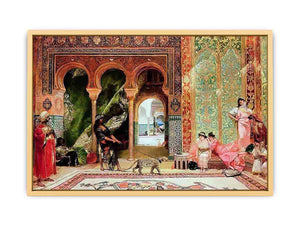
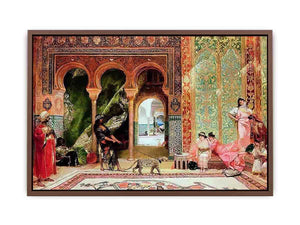
A Royal Palace in Morocco Painting by Benjamin Jean Joseph Constant
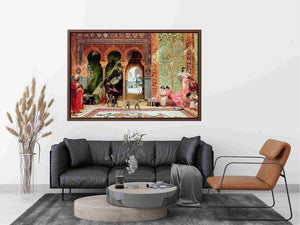
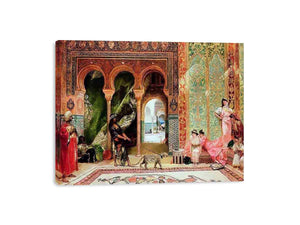
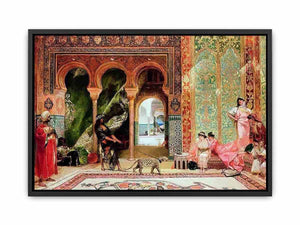
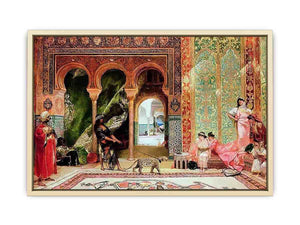
A Royal Palace in Morocco Painting by Benjamin Jean Joseph Constant is a work of architectural grandeur and cultural fascination, presenting North Africa not as fantasy alone, but as a lived environment shaped by light, ceremony, and history. Painted in the late nineteenth century, the work reflects Constant’s sustained engagement with Morocco, a place he visited repeatedly and studied with seriousness uncommon among Orientalist painters of his time. Rather than reducing the setting to spectacle, Constant constructs a scene of measured authority, where architecture, space, and atmosphere communicate the dignity and complexity of royal life.
Benjamin Jean Joseph Constant was one of the most influential French Orientalist painters of the nineteenth century, distinguished by his command of monumental scale, architectural precision, and nuanced understanding of Islamic and North African environments. Unlike artists who relied solely on studio invention, Constant’s Moroccan works were grounded in direct observation. A Royal Palace in Morocco exemplifies this commitment, combining academic structure with experiential authenticity.
The subject of a royal palace immediately signals power, hierarchy, and tradition. Yet Constant avoids depicting political authority through overt ceremony or narrative action. Instead, he allows architecture itself to speak. The palace is not merely a backdrop; it is the central protagonist. Through arches, courtyards, walls, and expanses of stone, Constant conveys the stability and continuity of royal institutions rooted in place and time.
Compositionally, the painting is built around order and openness. The architectural forms are arranged with clarity, guiding the eye through space without confusion. Vertical and horizontal elements balance one another, creating a sense of harmony and permanence. The viewer is invited into the space, yet remains respectfully outside its inner sanctum. This controlled access reinforces the painting’s central theme: power expressed through structure rather than display.
Perspective is carefully calculated to enhance scale and authority. Constant positions the viewer at a vantage point that reveals breadth without intimacy. The palace unfolds gradually, its spatial logic intelligible but not fully penetrable. This perspective choice underscores the separation between observer and institution, reinforcing the idea that royal space is designed to command respect rather than familiarity.
Light is among the painting’s most expressive elements. Moroccan sunlight is rendered with clarity and warmth, illuminating surfaces rather than dissolving them. Light defines edges, reveals texture, and articulates architectural rhythm. There is no dramatic chiaroscuro; illumination is steady and expansive, reinforcing the sense of permanence and calm authority. Light here is not theatrical, but declarative.
Colour is handled with refined restraint. Constant employs a palette dominated by warm earth tones, pale stone, and softened shadows, reflecting the material reality of Moroccan architecture. Accents of color are subdued, ensuring that chromatic richness does not overpower structural clarity. The harmony of the palette reinforces the painting’s atmosphere of dignity and composure.
Constant’s brushwork is disciplined and confident. Architectural surfaces are rendered with precision, yet avoid rigid stiffness. Stone appears solid and weight-bearing, while atmospheric elements soften transitions between planes. This balance between firmness and fluidity allows the palace to feel both monumental and inhabited, grounded yet alive.
Human presence, if included at all, is secondary and restrained. Figures do not dominate the scene or introduce narrative distraction. Instead, they provide scale and context, reinforcing the vastness and authority of the palace. Constant resists anecdote, ensuring that the painting remains a study of place and power rather than individual action.
Emotionally, A Royal Palace in Morocco conveys calm sovereignty rather than exotic drama. There is no sense of urgency or spectacle. The atmosphere is contemplative, almost timeless. Constant presents the palace as a space governed by continuity, where tradition outweighs event. This emotional restraint distinguishes the painting from more sensational Orientalist works, lending it intellectual and cultural credibility.
Symbolically, the palace represents more than royal residence. It embodies order, cultural continuity, and architectural intelligence. Constant’s emphasis on structure over ornament suggests respect rather than appropriation. The painting acknowledges difference without reducing it to novelty, inviting viewers to encounter Moroccan culture through dignity rather than fantasy.
Within Constant’s broader oeuvre, A Royal Palace in Morocco represents the mature phase of his Orientalist vision. Earlier works sometimes emphasized dramatic contrasts and theatrical effects. Here, Constant demonstrates confidence in restraint, allowing architecture and light to carry meaning. The painting reflects an artist who has moved beyond curiosity toward understanding.
Culturally, the work belongs to a moment when European artists were negotiating their relationship with the Islamic world through art. Constant’s approach stands apart for its seriousness and architectural focus. By centering built space rather than human spectacle, he avoids caricature and instead emphasizes civilization, governance, and aesthetic order.
In contemporary interiors across the United States, the United Kingdom, Canada, Australia, and Europe, A Royal Palace in Morocco introduces elegance and worldly depth. In living rooms, it offers architectural sophistication and warmth. In studies and offices, it reflects intellectual curiosity and appreciation for cross-cultural history. In galleries and luxury residences, it communicates refined taste and engagement with nineteenth-century academic painting at its highest level.
The painting integrates seamlessly into traditional interiors, where its classical composition and historical subject align with established aesthetics. It also functions beautifully in modern and minimalist spaces, where its architectural clarity and controlled palette provide structure without visual excess. In eclectic environments, it serves as a unifying anchor, bridging cultural reference and timeless design.
The long-term artistic importance of A Royal Palace in Morocco lies in its demonstration that Orientalist painting could aspire to understanding rather than fantasy. Constant shows that respect, observation, and architectural intelligence can produce work of lasting relevance. The painting endures because it treats its subject with gravity and care.
Today, A Royal Palace in Morocco remains compelling for its balance of authority and serenity. Through disciplined composition, luminous light, and architectural clarity, Benjamin Jean Joseph Constant created a painting that transcends its era, offering viewers a sustained encounter with place, power, and cultural presence. It stands as one of the most refined architectural visions in nineteenth-century Orientalist art.
Buy museum qulaity 400- 450 canvas prints, framed prints, and 100% oil paintings of A Royal Palace in Morocco by Benjamin Jean Joseph Constant at Alpha Art Gallery, where world-famous masterpieces are recreated with museum-quality detail, refined craftsmanship, and premium materials.
FAQS
What does A Royal Palace in Morocco depict?
It depicts a Moroccan royal palace, focusing on architecture, space, and atmosphere rather than narrative action.
Is this painting based on direct observation?
Yes, Benjamin Jean Joseph Constant traveled extensively in Morocco and grounded his work in firsthand study.
How does this painting differ from typical Orientalist works?
It emphasizes architectural dignity and cultural continuity rather than exotic spectacle or anecdote.
What mood does the painting convey?
It conveys calm authority, stability, and contemplative grandeur.
Where does this artwork work best in interior spaces?
It is ideal for living rooms, studies, offices, galleries, and refined residential interiors.
Is A Royal Palace in Morocco suitable for modern décor?
Yes, its architectural clarity and restrained palette integrate seamlessly into modern and minimalist settings.
Does the painting have lasting cultural and artistic value?
Its observational seriousness, compositional discipline, and cross-cultural respect ensure enduring relevance.