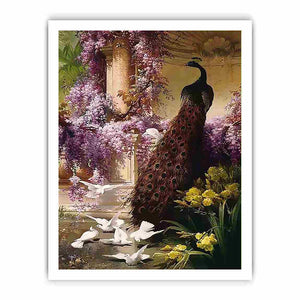
A Peacock and Doves in a Garden Painting by Eugene Bidau
A Peacock and Doves in a Garden Painting by Eugene Bidau is a refined meditation on harmony, contrast, and cultivated beauty, rendered with a sensitivity that bridges natural observation and symbolic poise. The painting belongs to a tradition in which animals, landscape, and garden architecture are not treated as isolated subjects, but as participants in a carefully balanced visual and moral order. Bidau’s work does not dramatize nature; it arranges it, allowing elegance, stillness, and meaning to unfold through compositional clarity and quiet restraint.
Eugene Bidau was known for his accomplished handling of animal subjects within composed environments, particularly gardens and park-like settings where nature and human design intersect. His paintings reflect a nineteenth-century sensibility that valued order, grace, and legibility, while remaining attentive to texture, posture, and subtle movement. In A Peacock and Doves in a Garden, Bidau demonstrates his ability to balance visual richness with compositional discipline, producing a scene that is both decorative and contemplative.
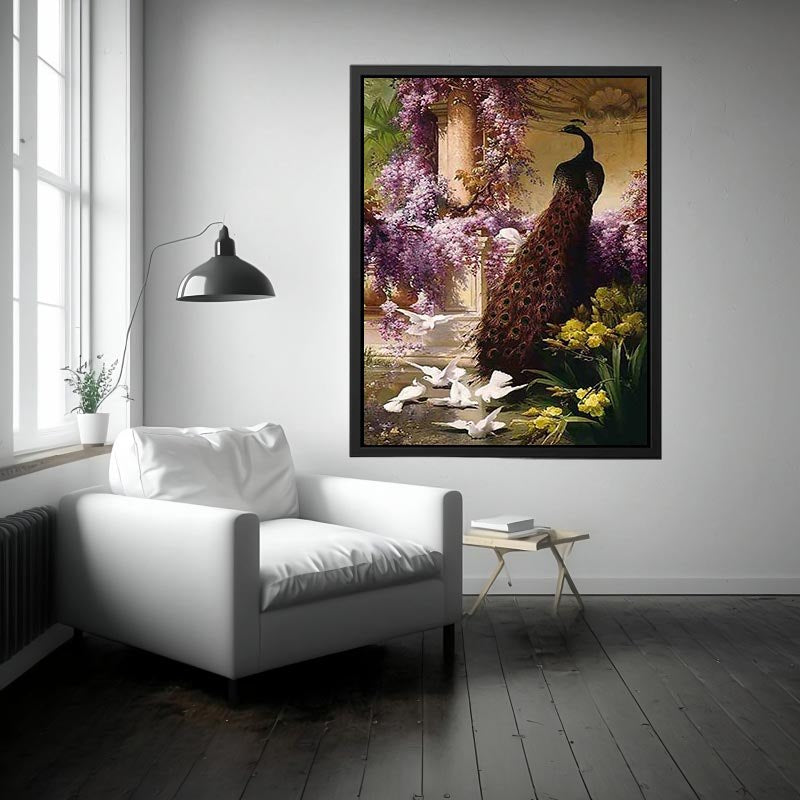
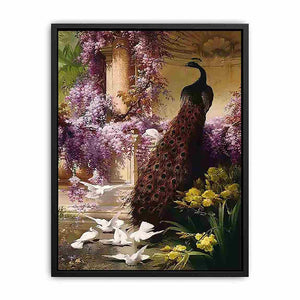
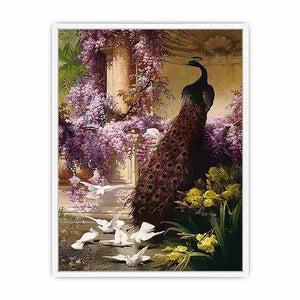
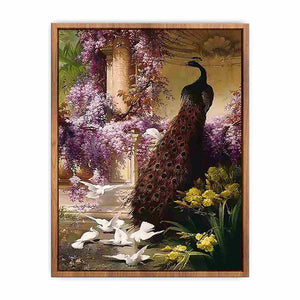
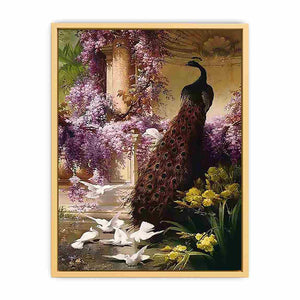
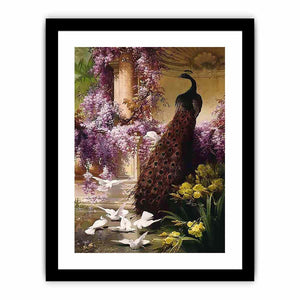
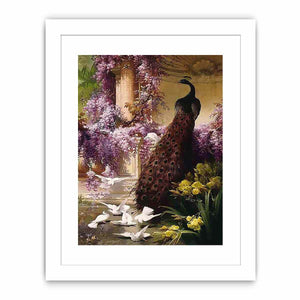
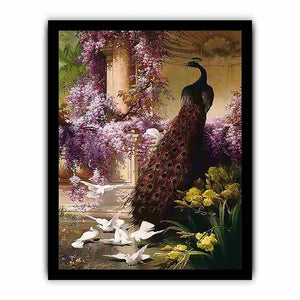
The subject itself is built upon contrast. The peacock, long associated with splendor, pride, and visual magnificence, occupies the space with measured authority. Its plumage, intricate and iridescent, introduces complexity and rhythm into the composition. Opposing this presence are the doves, symbols of peace, gentleness, and restraint. Their pale forms and calm demeanor establish a counterweight to the peacock’s ornamental intensity. Bidau’s choice to unite these creatures within a single garden setting creates a dialogue between display and serenity rather than conflict.
Compositionally, the painting is carefully structured to maintain equilibrium. The peacock’s form anchors the scene, its elongated body and cascading tail feathers guiding the viewer’s eye across the canvas. The doves are positioned to soften this movement, their rounded forms and quieter presence stabilizing the composition. The garden itself acts as a unifying framework, its paths, foliage, and architectural hints providing structure without imposing rigidity. Every element appears placed rather than incidental.
Perspective is gently managed, allowing the viewer to observe the scene from a respectful distance. The garden does not overwhelm the animals, nor do the animals dominate the space entirely. This balance reinforces the painting’s central theme: coexistence within cultivated order. Bidau avoids dramatic recession or theatrical framing, favoring spatial clarity that supports calm engagement.
Light is distributed evenly across the scene, revealing detail without dramatic emphasis. There is no single focal beam or symbolic illumination. Instead, light functions descriptively, enhancing texture and form while maintaining overall harmony. Feathers, stone, foliage, and ground are revealed with equal care, reinforcing the idea that no single element claims moral or visual dominance.
Colour plays a central expressive role. The peacock’s rich blues and greens introduce depth and visual complexity, while the doves’ pale tones provide relief and contrast. The surrounding garden is rendered in natural, subdued hues that frame rather than compete with the animals. Bidau’s palette is controlled and deliberate, ensuring that richness does not tip into excess. Colour serves balance, allowing diversity to coexist within unity.
Bidau’s handling of texture reflects careful observation. The peacock’s feathers are suggested through layered strokes that convey density and pattern without becoming overly ornamental. The doves’ plumage is rendered with softness and restraint, emphasizing calm presence. Vegetation and stone are treated with equal attentiveness, grounding the scene in physical reality. Technique remains disciplined, ensuring that surface detail supports rather than distracts from overall coherence.
Emotionally, A Peacock and Doves in a Garden conveys composure rather than drama. There is no sense of threat, pursuit, or agitation. The animals inhabit the space as though accustomed to its rhythms. This emotional steadiness invites contemplation, encouraging the viewer to consider the relationships between beauty, peace, and order. The painting does not instruct; it suggests.
Symbolically, the pairing of peacock and doves has long invited interpretation. Pride and humility, display and restraint, individuality and harmony are implied rather than declared. Bidau does not force allegory through gesture or narrative. Meaning arises organically through juxtaposition and balance. The garden setting reinforces this symbolism, representing cultivated nature as a space where differing qualities can coexist without domination.
Within Eugene Bidau’s artistic practice, this painting exemplifies his strength in orchestrating complex visual elements into unified compositions. While animal painting can easily lapse into anecdote or decoration, Bidau elevates the genre through structure and restraint. The work reflects a belief that beauty is most enduring when governed by balance rather than excess.
Culturally, the painting reflects a period when gardens functioned as symbols of order, leisure, and refinement. Within such spaces, animals were often depicted not as wild forces, but as participants in a shared aesthetic environment. Bidau’s work aligns with this tradition, offering an image of nature shaped by attentiveness rather than control.
In contemporary interiors across the United States, the United Kingdom, Canada, Australia, and Europe, A Peacock and Doves in a Garden integrates with elegance and versatility. In living rooms, it introduces color, refinement, and calm visual interest. In studies and private offices, it supports contemplation and balance. In galleries and luxury residences, it communicates appreciation for nineteenth-century animal painting that privileges harmony over spectacle.
The painting complements traditional interiors through its subject and compositional clarity, aligning naturally with classical furnishings and décor. At the same time, it works effectively in modern and minimalist spaces, where its organic forms and measured palette provide warmth without clutter. In eclectic environments, it functions as a unifying presence, bridging decorative richness and calm order.
The long-term artistic importance of A Peacock and Doves in a Garden lies in its affirmation of balance as an aesthetic and moral value. Bidau demonstrates that contrast need not result in tension, and that visual richness can coexist with restraint. The painting endures because it offers a vision of coexistence rendered through attentiveness rather than assertion.
Today, the work remains quietly compelling. It rewards sustained viewing, revealing relationships of form, color, and meaning that unfold gradually. Through disciplined composition, sensitive observation, and symbolic subtlety, Eugene Bidau created a painting that continues to speak across time, offering beauty not as spectacle, but as equilibrium.
Buy museum qulaity 400- 450 canvas prints, framed prints, and 100% oil paintings of A Peacock and Doves in a Garden by Eugene Bidau at Alpha Art Gallery, where world-famous masterpieces are recreated with museum-quality detail, refined craftsmanship, and premium materials.
Buy A Peacock and Doves in a Garden by Eugene Bidau at Alpha Art Gallery. Museum-quality art for collectors in the US, Canada, UK, Australia, and Europe.
FAQS
What animals are depicted in A Peacock and Doves in a Garden?
The painting features a peacock and several doves positioned within a cultivated garden setting.
What is the symbolic significance of the peacock and doves together?
They suggest a contrast between splendor and serenity, often interpreted as pride balanced by peace and restraint.
Is this painting purely decorative or symbolic?
It functions as both, offering visual elegance while allowing symbolic meaning to emerge through contrast and balance.
How does the garden setting contribute to the painting?
The garden provides structure and harmony, reinforcing themes of cultivated order and coexistence.
Where does this artwork work best in interior spaces?
It is well suited to living rooms, studies, offices, galleries, and refined residential interiors.
Is A Peacock and Doves in a Garden suitable for modern décor?
Yes, its balanced composition and natural palette integrate seamlessly into modern, traditional, and eclectic spaces.
Does the painting have lasting artistic value?
Its compositional harmony, symbolic subtlety, and refined execution ensure enduring relevance.