





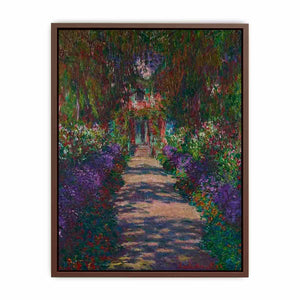


A Pathway in Monet's Garden in Giverny
Go kalles this summer with this vintage navy and white striped v-neck t-shirt from the Nike. Perfect for pairing with denim and white kicks for a stylish kalles vibe.

A Pathway in Monet's Garden in Giverny
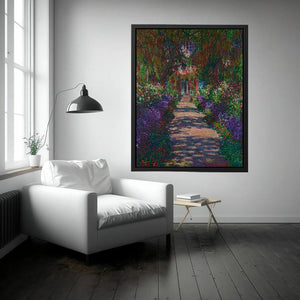
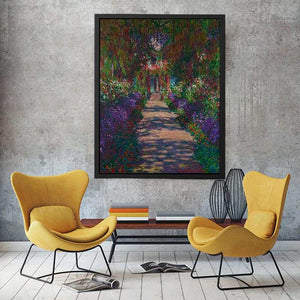
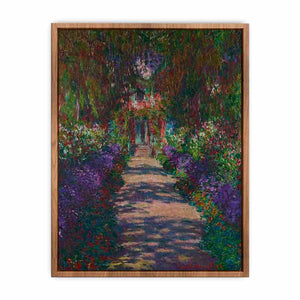
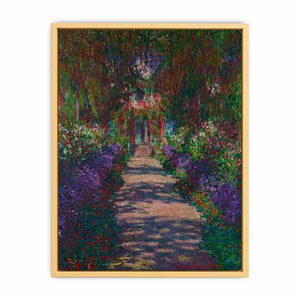
A Pathway in Monet's Garden in Giverny Painting by Claude Monet
A Pathway in Monet's Garden in Giverny Painting by Claude Monet is an intimate and luminous exploration of cultivated nature as lived experience, where observation, memory, and sustained attention converge. Painted during Monet’s long residence at Giverny, the work does not present the garden as a picturesque motif designed for display. Instead, it reveals the garden as an evolving laboratory of perception—an environment shaped by time, labor, and the artist’s unwavering commitment to seeing light as it moves through color and form. The pathway is not merely a compositional device; it is a record of daily passage, a visual trace of Monet’s own presence within the landscape he created and tended.
Claude Monet transformed Giverny into a site where painting and gardening became inseparable practices. By the time works such as this were conceived, Monet was no longer pursuing novelty or public provocation. His ambition had narrowed and deepened: to understand how repeated looking could yield ever more subtle truths. A Pathway in Monet's Garden in Giverny emerges from this discipline. The scene is familiar yet inexhaustible, shaped by repetition rather than spectacle, and by the belief that meaning resides in attentive continuity.
The subject presents a narrow path threading through dense plantings, bordered by flowering beds and foliage that encroach upon the walkway. The garden appears abundant, yet carefully orchestrated. Monet does not emphasize horticultural precision; instead, he allows growth to feel generous and immersive. The path invites entry without directing it toward a clear destination. It curves or recedes gently, encouraging the eye to wander rather than arrive. This openness reflects the garden’s function as a lived space rather than a formal design.
Compositionally, the painting is organized through organic rhythm rather than geometric order. The pathway provides a central axis, yet it is softened by the surrounding vegetation, which spills inward and outward in irregular patterns. Vertical stems, rounded blossoms, and leafy masses interlock across the surface, creating a sense of enclosure without confinement. Balance is achieved through distribution of color and density rather than symmetry, reinforcing the feeling of natural growth guided by attentive care.
Perspective is experiential and intimate. Monet positions the viewer at walking height, within the garden rather than outside it. Depth is suggested through overlapping forms and tonal variation, not through strict linear recession. Foreground and middle ground blend seamlessly, while the background dissolves into foliage and light. Space becomes a continuum of sensation, shaped by movement and proximity rather than measurement.
Color is the painting’s primary expressive force. Monet employs a rich yet harmonized palette of greens, punctuated by blossoms in whites, pinks, yellows, and blues. These colors are not local descriptions but responses to light filtered through leaves and petals. Green itself is varied endlessly—cool, warm, luminous, shadowed—demonstrating Monet’s conviction that color, when modulated attentively, can convey depth, texture, and atmosphere simultaneously.
Light permeates the scene rather than illuminating it from a single source. Sunlight filters through foliage, creating shifting patterns across the path and surrounding plants. There are no dramatic highlights or deep shadows; illumination is dispersed and continuous. This diffused light dissolves edges and softens contours, reinforcing the sense that the garden is alive with subtle movement. Light becomes an enveloping condition, binding all elements into a unified field.
Monet’s brushwork is responsive and varied. Short, rhythmic strokes suggest leaves and blossoms without isolating them into discrete forms. The path itself is articulated through horizontal and diagonal touches that convey texture and direction while remaining integrated with surrounding color. Paint remains visible, asserting the surface as an active site of construction. The viewer is reminded that this scene is not recorded but made, assembled stroke by stroke through sustained attention.
Emotionally, A Pathway in Monet's Garden in Giverny conveys quiet immersion rather than dramatic joy. There is pleasure here, but it is measured and contemplative. The painting invites lingering rather than excitement. Its mood reflects the satisfaction of familiarity—the calm that arises from knowing a place deeply and returning to it without expectation of novelty.
Psychologically, the work can be understood as a reflection of Monet’s inward turn during his later years. The garden offered structure, repetition, and renewal at a time when the artist increasingly withdrew from public life. Painting the pathway again and again allowed Monet to ground himself in daily ritual. The painting communicates this grounding through its lack of narrative urgency and its commitment to presence.
Symbolically, the pathway carries understated resonance. It suggests passage without destination, continuity without conclusion. Monet does not impose allegory, yet the image naturally evokes themes of time, return, and attentive movement through life. The path exists to be walked, not to be solved. Its meaning unfolds through experience rather than interpretation.
Within Monet’s artistic evolution, this painting exemplifies his mature synthesis of observation and construction. Having long mastered the depiction of transient effects, Monet here demonstrates confidence in restraint. He no longer needs to dramatize light or assert innovation. Instead, he refines perception through repetition, allowing subtle differences to carry significance. A Pathway in Monet's Garden in Giverny anticipates the serial thinking that would dominate his later work, where motif becomes secondary to sustained seeing.
Culturally, the painting affirms Impressionism’s most enduring contribution: the elevation of everyday environments into subjects of profound artistic inquiry. Monet’s garden is neither grand nor remote. It is domestic, cultivated, and deeply personal. By dedicating such attention to it, Monet asserts that meaning arises from care and continuity rather than from scale or rarity.
In contemporary interiors across the United States, the United Kingdom, Canada, Australia, and Europe, A Pathway in Monet's Garden in Giverny integrates with remarkable ease. In living rooms, it introduces calm movement and organic warmth. In studies and offices, it supports focus and reflective presence. In galleries and luxury residences, it signals appreciation for Impressionism at its most intimate and resolved.
The painting harmonizes naturally with modern and minimalist interiors, where its layered greens and gentle structure complement architectural simplicity. It also enriches traditional spaces, offering continuity through subject matter while maintaining modern sensitivity. In eclectic interiors, it acts as a unifying element, drawing disparate furnishings together through shared atmosphere.
The long-term artistic importance of A Pathway in Monet's Garden in Giverny lies in its demonstration that sustained attention can transform the familiar into the inexhaustible. Monet shows that a single place, revisited with patience, can yield endless variation. The painting endures because it models a way of seeing grounded in care, repetition, and respect for time.
Today, the work remains quietly compelling. In an era defined by speed and distraction, its slow attentiveness feels restorative. Through layered color, immersive light, and rhythmic brushwork, Claude Monet created a painting that does not merely depict a garden path, but preserves the experience of walking within it—present, unhurried, and profoundly attentive.
Buy museum qulaity 400- 450 canvas prints, framed prints, and 100% oil paintings of A Pathway in Monet's Garden in Giverny by Claude Monet at Alpha Art Gallery, where world-famous masterpieces are recreated with museum-quality detail, refined craftsmanship, and premium materials.
FAQS
What does A Pathway in Monet's Garden in Giverny depict?
It depicts a narrow garden path surrounded by dense plantings in Monet’s private garden at Giverny, emphasizing immersion and atmosphere.
Why did Monet paint his garden so often?
His garden served as a living laboratory where he could study light, color, and seasonal change through sustained observation.
Is this painting meant to be a literal record of the garden?
It reflects perceptual truth rather than precise horticultural detail, prioritizing sensation over documentation.
What mood does the painting convey?
It conveys calm immersion, continuity, and quiet attentiveness.
Where does this artwork work best in interior spaces?
It is well suited to living rooms, studies, offices, galleries, and refined residential interiors.
Is this painting suitable for modern décor?
Yes, its organic rhythm and layered greens integrate seamlessly into modern and minimalist environments.
Does the painting have lasting artistic significance?
It is valued as a mature example of Monet’s garden paintings, exemplifying sustained seeing and Impressionist refinement.
| 1. Select Type |
Canvas Print, Unframed Paper Print, Hand-Painted Oil Painting, Framed Paper Print |
|---|---|
| 2. Select Finish Option |
Rolled Canvas, Rolled- No Frame, Streched Canvas, Black Floating Frame, White Floating Frame, Brown Floating Frame, Black Frame with Matt, White Frame with Matt, Black Frame No Matt, White Frame No Matt, Streched, Natural Floating Frame, Champagne Floating Frame, Gold Floating Frame |
| 3. Select Size |
60cm X 90cm [24" x 36"], 76cm X 114cm [30" x 45"], 90cm X 120cm [36" x 48"], 100cm X 150cm [40" x 60"], 16.54 x 11.69"(A3), 23.39 x 16.54"(A2), 33.11 x 23.39"(A1), 46.81 x 31.11"(A0), 54" X 36", 50cm X 60cm [16" x 24"], 121cm X 182cm [48" x 72"], 135cm X 200cm [54" x 79"], 165cm x 205cm [65" x 81"], 183cm x 228cm [72" x 90"], 22cm X 30cm [9" x 12"], 30cm x 45Cm [12" x 18"], 45cm x60cm [16" x 24'], 75cm X 100cm [30" x 40"], 121cm x 193cm [48" x 76"], 45cm x 60cm [16" x 24'], 20cm x 25Cm [8" x 10"], 35cm x 50Cm [14" x 20"], 45cm x 60 cm [18" x 24"], 35cm x 53Cm [14" x 21"], 66cm X 101cm[26" x 40"], 76cm x 116cm [30"x 46"], 50cm X 60cm 16" x 24"] |