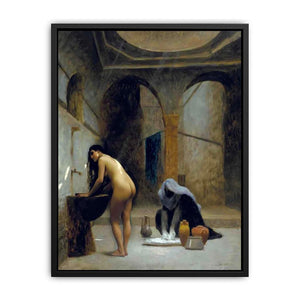
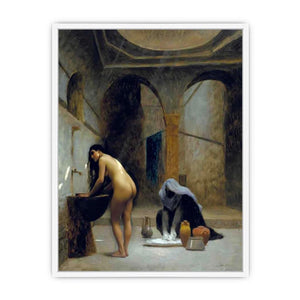
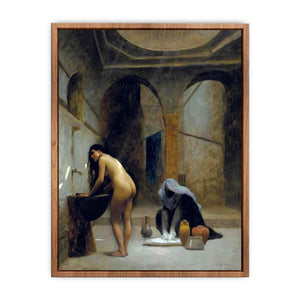
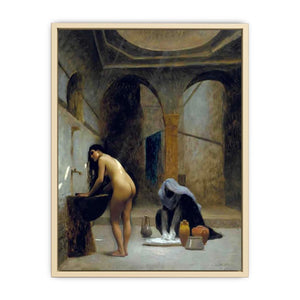
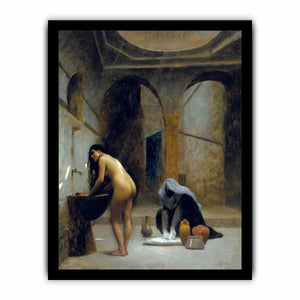
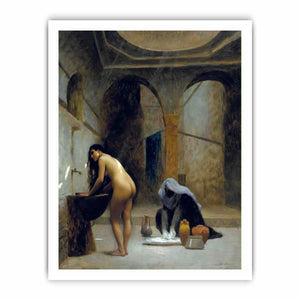
A Moorish Bath Turkish Woman Bathing Painting by Jean Léon Gérôme
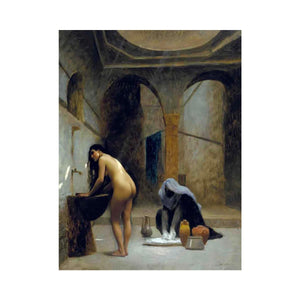
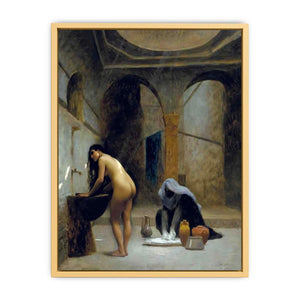
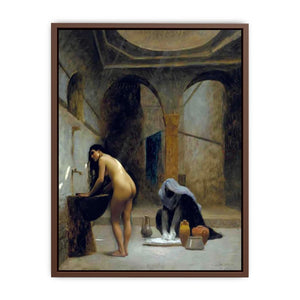
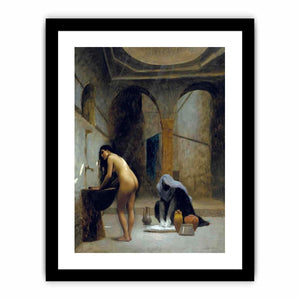
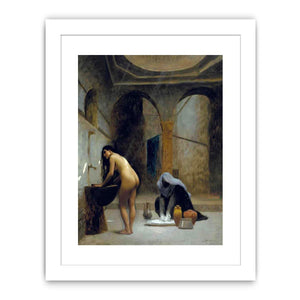
A Moorish Bath Turkish Woman Bathing Painting by Jean Léon Gérôme is a work of remarkable visual discipline and conceptual tension, in which academic precision intersects with nineteenth-century Orientalist imagination. Gérôme constructs an interior scene that appears calm, self-contained, and meticulously observed, yet beneath this surface lies a complex negotiation between intimacy, distance, and the act of viewing. The painting does not present narrative drama or overt sensuality. Instead, it offers a suspended moment of private ritual rendered with archaeological clarity and emotional restraint.
By the time this work was conceived, Jean-Léon Gérôme had established himself as one of the most technically rigorous artists of his era. Educated within the French академic tradition and deeply committed to finish, accuracy, and controlled composition, Gérôme approached his subjects with the mindset of a historian as much as a painter. His extensive travels in North Africa and the eastern Mediterranean informed a body of work that sought to translate unfamiliar interiors and customs into a visual language legible to Western audiences. A Moorish Bath Turkish Woman Bathing stands firmly within this context, exemplifying Gérôme’s belief that painting should reveal through precision rather than emotion.
The setting is a hammam, an interior space associated with cleansing, ritual, and privacy. Gérôme presents a solitary female figure engaged in bathing, an act both ordinary and culturally specific. Importantly, the scene is not animated by interaction or narrative. There are no attendants, no gestures of display, no theatrical cues. The figure is absorbed in her own activity, unaware of being observed. This compositional choice establishes a fundamental tension: the viewer is permitted access to a private space, yet the subject does not reciprocate awareness.
Compositionally, the painting is balanced and restrained. The architectural framework of the bath—stone walls, arched openings, and tiled surfaces—forms a stable enclosure around the figure. These elements are rendered with geometric clarity, emphasizing order and permanence. The woman is positioned calmly within this structure, her posture relaxed and natural. Gérôme avoids exaggerated pose or idealized gesture, grounding the figure in realism rather than fantasy.
Perspective places the viewer just outside the intimate circle of the subject’s activity. The vantage point is neither intrusive nor distant. This measured positioning is characteristic of Gérôme’s approach. He allows observation without interaction, reinforcing the sense that the painting is about looking itself. The viewer becomes a silent witness, not a participant, compelled to confront the ethics of observation without guidance or resolution.
Light is treated with exceptional discipline. It enters the space softly, illuminating surfaces evenly and revealing textures without dramatic emphasis. Stone, water, and skin are all rendered with equal clarity. Gérôme avoids the sensual chiaroscuro often associated with bathing scenes. Instead, light functions as an instrument of visibility and control. It exposes without dramatizing, maintaining a neutral, almost analytical atmosphere.
The color palette is restrained and harmonious. Warm stone tones, muted flesh colors, and subtle variations of light and shadow dominate the composition. There is no chromatic excess. Color supports material presence rather than emotional intensity. The overall effect is calm, measured, and contained, reinforcing the painting’s refusal of spectacle.
Gérôme’s technique is exacting to an extraordinary degree. Brushwork is smooth and nearly invisible, suppressing any trace of painterly gesture. Surfaces appear solid, cool, and permanent. The rendering of architectural materials demonstrates near-architectural accuracy, while the figure is modeled with anatomical precision rather than idealized softness. This technical restraint is central to the painting’s meaning. Gérôme asserts authority through finish, suggesting that control and clarity are the highest artistic virtues.
Symbolically, A Moorish Bath Turkish Woman Bathing operates within the broader framework of Orientalist representation. The bath, as a culturally specific interior inaccessible to Western experience, becomes a site of fascination. Gérôme presents it as ordered, quiet, and timeless, abstracted from historical change or social complexity. The figure is individualized yet anonymous, a representative presence rather than a psychological portrait. This abstraction allows the scene to function as an image of cultural difference rendered through Western systems of knowledge.
Psychologically, the painting is notable for its emotional neutrality. The woman does not express pleasure, vulnerability, or awareness. Her inward focus reinforces the sense of ritual rather than display. Gérôme resists sentimentalization, presenting the body as part of a larger spatial and cultural system. The absence of overt emotion invites prolonged looking while withholding emotional access.
Within Gérôme’s broader body of work, this painting aligns with his mature Orientalist interiors, where technical mastery and compositional order supersede narrative or dramatic tension. Unlike Romantic interpretations of the East that emphasized fantasy and excess, Gérôme’s approach insists on stability, surface accuracy, and controlled distance. Yet this very restraint amplifies the complexity of the work, exposing the power dynamics inherent in representation itself.
Culturally, the painting reflects nineteenth-century European fascination with private spaces and rituals of the Islamic world, filtered through academic realism. Baths, in particular, were recurring subjects in Orientalist art, symbolizing both cultural difference and imagined intimacy. Gérôme’s treatment distinguishes itself through its refusal of overt eroticism. Instead, it frames the scene as an object of study, raising enduring questions about access, observation, and authority.
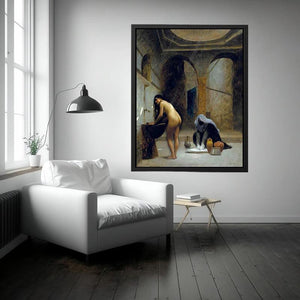
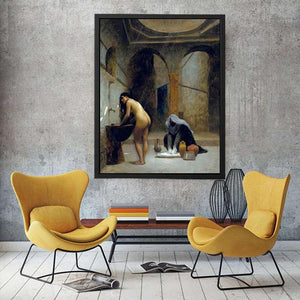
In contemporary interiors across the United States, the United Kingdom, Canada, Australia, and Europe, A Moorish Bath Turkish Woman Bathing integrates with exceptional sophistication. In living rooms, it introduces warmth, quietude, and architectural rhythm. In studies and offices, it conveys cultural curiosity and intellectual seriousness. In galleries and luxury residences, it anchors space with contemplative stillness, harmonizing with traditional, eclectic, and modern minimalist décor through its balanced composition and subdued palette.
The painting remains meaningful today because it invites critical reflection as much as aesthetic appreciation. In an age increasingly attentive to questions of representation and gaze, Gérôme’s work offers an opportunity to examine how images mediate cultural understanding. A Moorish Bath Turkish Woman Bathing does not instruct the viewer how to feel. It presents a scene with unwavering clarity and allows interpretation to unfold through sustained attention.
A Moorish Bath Turkish Woman Bathing Painting by Jean Léon Gérôme endures as a testament to academic precision and the complexities of cultural representation. Through compositional restraint, technical mastery, and intellectual distance, Gérôme transformed a private ritual into a timeless study of space, body, and observation. The painting does not narrate. It reveals.
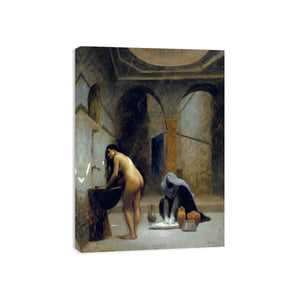
Buy museum qulaity 400- 450 canvas prints, framed prints, and 100% oil paintings of A Moorish Bath Turkish Woman Bathing by Jean Léon Gérôme at Alpha Art Gallery, where world-famous masterpieces are recreated with museum-quality detail, refined craftsmanship, and premium materials.
FAQs
What does A Moorish Bath Turkish Woman Bathing depict?
It depicts a solitary woman engaged in bathing within a hammam, presented as a quiet, private ritual.
Why is the painting considered Orientalist?
It represents a culturally specific interior of the Islamic world through a Western academic lens.
Is the painting intended to be sensual?
Gérôme avoids overt sensuality, emphasizing observation, material accuracy, and restraint.
What role does architecture play in the composition?
Architecture provides structure, order, and containment, framing the figure without dramatization.
Why is the woman shown unaware of the viewer?
Her inward focus reinforces the sense of privacy and heightens the tension of observation.
What distinguishes Gérôme’s technique in this work?
Invisible brushwork and meticulous finish create clarity and sculptural permanence.
Why does the painting remain relevant today?
It prompts reflection on gaze, representation, and cultural interpretation.
Where does this artwork work best in interiors?
It is ideal for living rooms, studies, galleries, and refined contemporary or traditional spaces.