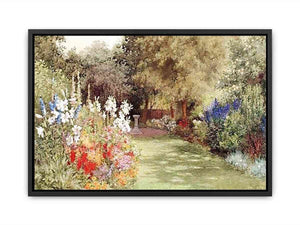
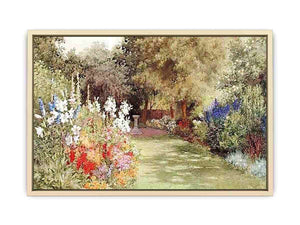
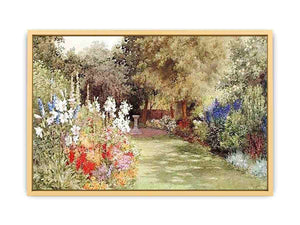
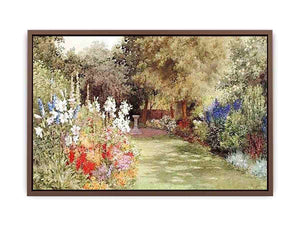
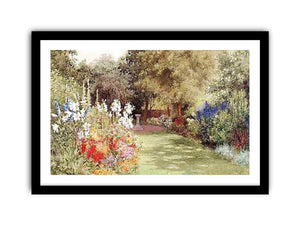
A Garden in July Painting by Violet Common
A Garden in July Painting by Violet Common is a work of quiet radiance and cultivated sensitivity, capturing the fullness of summer not as spectacle but as lived experience. The painting belongs to a tradition of late nineteenth- and early twentieth-century British art that valued intimacy, seasonal awareness, and attentive observation over grandeur. In this work, Common presents the garden as a space of rhythm and repose, where colour, light, and growth coexist in balanced harmony. The result is a painting that feels neither staged nor idealized, but gently inhabited.
Violet Common emerged at a moment when garden painting held particular cultural resonance in Britain, reflecting broader interests in domestic life, nature cultivation, and the aesthetic potential of everyday surroundings. Her work is distinguished by restraint and clarity rather than overt stylistic bravura. In A Garden in July, this sensibility is fully realized. Common does not treat the garden as a decorative motif; she treats it as a living environment shaped by time, care, and seasonal continuity.
The subject is a garden at the height of summer, when growth has reached maturity and colour is at its most assured. Common selects July not for its drama but for its balance. The composition does not convey the exuberant burst of spring or the decline of autumn, but a moment of sustained abundance. This temporal choice is essential to the painting’s emotional tone. July is presented as a period of equilibrium, when nature has settled into itself.
Compositionally, the painting is structured to guide the viewer gently through space. Paths, flower beds, and planted borders are arranged with natural order rather than formal symmetry. The eye moves fluidly from foreground to middle distance, encountering clusters of colour and texture without abrupt interruption. Common’s spatial organization reflects a garden shaped by thoughtful cultivation rather than rigid design, reinforcing the sense of lived presence.
Colour is central to the painting’s expressive power. Common employs a rich but controlled palette, allowing greens to dominate while punctuating the scene with warm floral tones. Reds, yellows, and soft whites appear not as isolated highlights but as integrated elements within the broader chromatic field. This restraint prevents visual excess, ensuring that colour contributes to atmosphere rather than decoration. The painting conveys warmth without glare, fullness without heaviness.
Light in A Garden in July is diffused and generous. There is no harsh midday brilliance or dramatic shadow. Instead, light settles evenly across foliage and ground, suggesting a calm summer day rather than a specific hour. This even illumination softens edges and enhances cohesion, allowing individual forms to remain distinct while participating in a unified whole. Light functions here as a binding element, reinforcing the painting’s sense of continuity and calm.
Common’s brushwork is attentive and economical. Forms are clearly articulated, yet never rigid. Leaves, stems, and blossoms are suggested through confident strokes rather than meticulous detail. This approach maintains visual vitality without sacrificing clarity. The surface of the painting retains a sense of movement, echoing the subtle motion of leaves and air rather than freezing the scene into stillness.
Spatial depth is achieved through tonal modulation and overlapping forms rather than linear perspective alone. Foreground elements are rendered with slightly stronger contrast, while distant areas soften gently. This creates a sense of immersion without theatrical recession. The viewer feels present within the garden, not positioned as an external observer. The painting invites entry rather than display.
Emotionally, A Garden in July conveys contentment and attentiveness. There is no overt narrative or human presence, yet the garden itself suggests care and habitation. The absence of figures does not imply emptiness; instead, it allows the viewer to inhabit the space imaginatively. The painting evokes the experience of pausing within a familiar environment, attentive to light, colour, and growth.
Symbolically, the garden has long functioned as a metaphor for cultivation, order, and harmony between human intention and natural process. Common engages this tradition quietly, without allegory. The garden is not a moral emblem but a lived space shaped by ongoing care. July, as a moment of fullness, suggests continuity rather than culmination. Meaning arises through balance rather than instruction.
Within Violet Common’s body of work, this painting exemplifies her commitment to subtle realism and seasonal sensitivity. She does not impose dramatic mood or stylized effect. Instead, she allows the subject to assert itself through attentive seeing. This discipline lends the painting lasting appeal, as it resists period-specific mannerism in favor of perceptual clarity.
Culturally, the painting reflects a broader appreciation for gardens as extensions of domestic and emotional life. At a time when industrialization and urban expansion altered daily experience, such images offered visual affirmation of continuity, care, and measured pace. Yet the painting’s appeal extends beyond its historical context. Its focus on balance, attention, and natural rhythm remains resonant in contemporary life.
In modern interiors across the United States, the United Kingdom, Canada, Australia, and Europe, A Garden in July integrates with exceptional ease. In living rooms, it introduces warmth and visual calm. In studies or private offices, it supports focus and reflection. In dining areas and transitional spaces, it reinforces themes of nourishment and continuity. In galleries and refined residences, it communicates sensitivity and cultivated taste.
The painting adapts naturally to traditional interiors, where its subject and tonal harmony align with classical design. At the same time, it complements modern and minimalist spaces, where its organic forms and restrained palette provide contrast without visual clutter. In eclectic environments, it serves as a unifying element, grounding diverse influences through shared atmosphere.
The long-term artistic importance of A Garden in July lies in its affirmation of attentiveness as an artistic value. Common demonstrates that significance can emerge from careful observation and balanced composition rather than dramatic intervention. The painting endures because it reflects a way of seeing grounded in patience, respect for natural process, and emotional equilibrium.
Today, A Garden in July remains quietly compelling. It does not demand attention; it rewards it. In capturing a moment of seasonal fullness with clarity and restraint, Violet Common created a work that continues to offer repose and recognition. The painting stands as a testament to the enduring power of gardens—not as symbols of escape, but as spaces of continuity, care, and lived beauty.
Buy museum qulaity 400- 450 canvas prints, framed prints, and 100% oil paintings of A Garden in July by Violet Common at Alpha Art Gallery, where world-famous masterpieces are recreated with museum-quality detail, refined craftsmanship, and premium materials.
FAQS
What season and atmosphere does A Garden in July convey?
It depicts mid-summer at a moment of balance and fullness, emphasizing calm abundance rather than dramatic change.
What distinguishes Violet Common’s approach to garden painting?
Her work is marked by restraint, attentiveness, and balanced colour, avoiding excess or overt stylization.
Is there symbolic meaning in the absence of figures?
Yes, it invites the viewer to inhabit the space imaginatively, suggesting presence through care rather than depiction.
How does light function in the painting?
Light is diffused and even, unifying the composition and reinforcing a sense of calm continuity.
Where does this painting work best in interior spaces?
It is well suited to living rooms, studies, dining areas, galleries, and refined residential interiors.
Is A Garden in July compatible with modern décor?
Yes, its restrained palette and organic composition integrate seamlessly into modern, traditional, and minimalist spaces.
Does the painting have lasting artistic value?
Its seasonal sensitivity, compositional balance, and timeless subject ensure enduring relevance.