A Forest Road Painting by Thomas Gainsborough
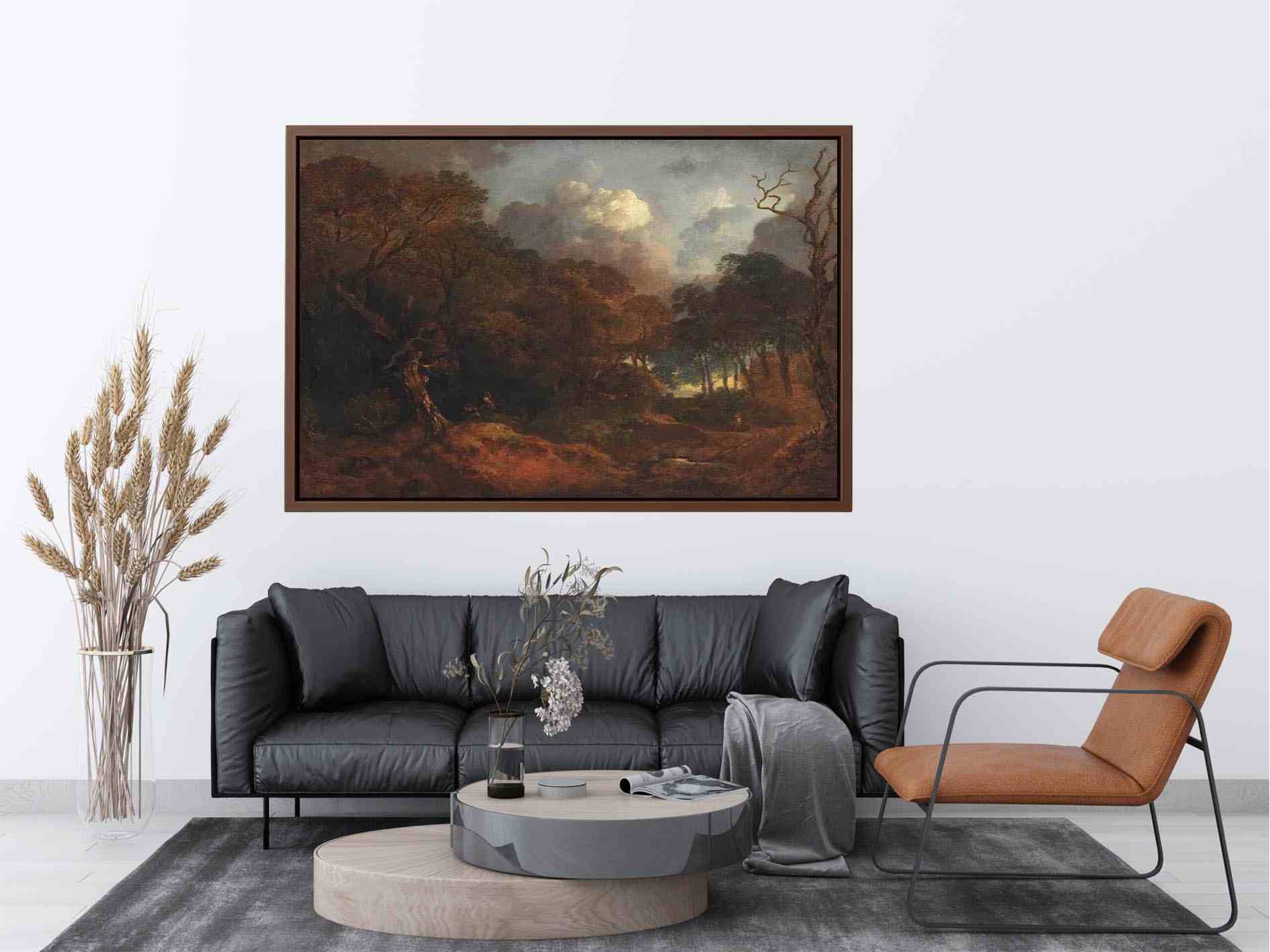
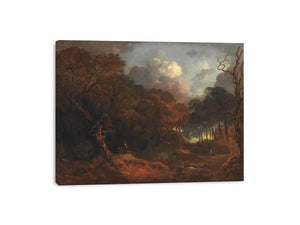
A Forest Road Painting by Thomas Gainsborough is a poetic meditation on nature, movement, and the quiet dignity of rural life, rendered with a sensitivity that reveals the artist’s deepest affinities. Created during a period when Gainsborough increasingly turned away from formal portraiture toward landscape as a vehicle for personal expression, the painting stands as a testament to his belief that nature, when observed with empathy and freedom, possesses its own emotional intelligence. Rather than depicting the countryside as an ordered estate or a topographical record, Gainsborough presents it as a living, breathing environment shaped by light, air, and passage.
Thomas Gainsborough approached landscape painting not as a secondary genre but as an essential expression of feeling and perception. Although celebrated in his lifetime for portraiture, he often remarked that landscape was his true passion. A Forest Road embodies this conviction. It is not an illustrative scene, nor a narrative tableau, but an evocation of place shaped by sensation rather than description. The road does not lead to a defined destination; it invites contemplation, movement, and inward reflection.
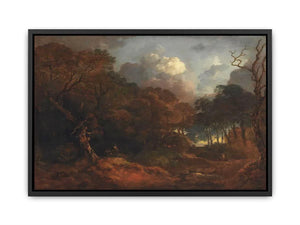
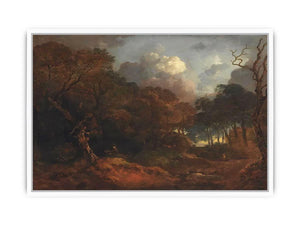
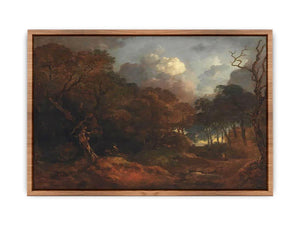
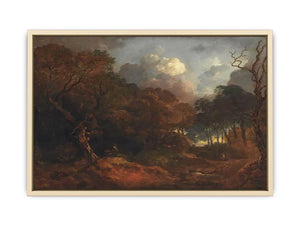
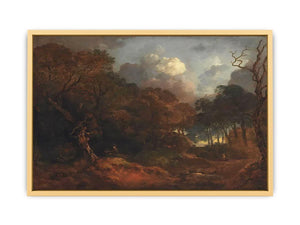
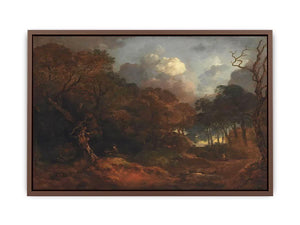
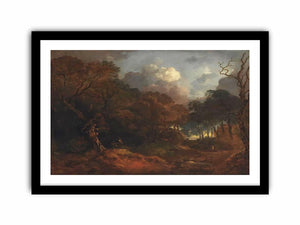
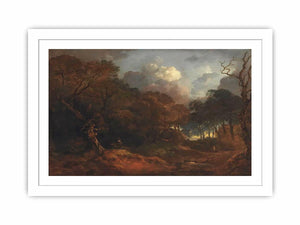
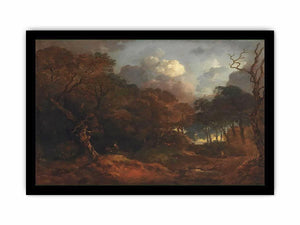
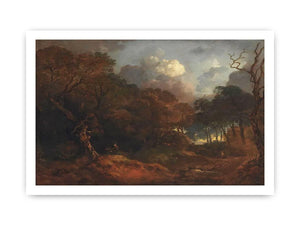
The subject is deceptively modest: a winding path cutting through woodland, bordered by trees whose forms dissolve into foliage and shadow. Figures, if present, are subordinate to the landscape, serving as indicators of scale rather than narrative focus. Gainsborough resists anecdote. The forest road is not a stage for drama or labor, but a conduit through nature—a space of transition where human presence remains gentle and temporary.
Compositionally, the painting is organized through rhythmic diagonals and soft verticals. The road curves naturally into the distance, guiding the eye inward without insistence. Trees rise and lean, their trunks forming a loose architectural frame that neither encloses nor constrains the scene. This balance between openness and enclosure creates a sense of intimacy without confinement, allowing the viewer to enter the landscape imaginatively.
Perspective is suggestive rather than exact. Gainsborough avoids strict linear recession, allowing depth to emerge through tonal modulation and overlapping forms. Foreground, middle ground, and background blend seamlessly, reinforcing the impression that the forest is continuous and immersive. Space is felt rather than measured, aligning with Gainsborough’s belief that emotional truth outweighs optical precision.
Color is restrained, earthy, and deeply harmonious. Gainsborough employs a palette of greens, browns, muted blues, and silvery highlights, modulated to suggest foliage, bark, and atmospheric depth. These colors are not applied decoratively. They respond to light and air, shifting subtly across the surface to convey movement and texture. The result is a landscape that feels alive, animated by internal rhythm rather than surface detail.
Light plays a central yet understated role. It filters gently through the trees, illuminating patches of road and foliage without dramatic contrast. Gainsborough does not spotlight forms; he allows light to drift and settle, creating a sense of natural continuity. This diffused illumination reinforces the painting’s contemplative tone, suggesting a moment of stillness within ongoing change.
Gainsborough’s brushwork is fluid, responsive, and visibly expressive. Leaves and branches are suggested through swift, confident strokes that dissolve into one another. The paint surface retains a sense of motion, as though the landscape were still forming before the viewer’s eyes. This painterly freedom distinguishes Gainsborough’s landscapes from more controlled or idealized traditions, aligning them instead with lived experience.
Emotionally, A Forest Road conveys calm introspection rather than pastoral idealization. There is no overt sentiment, no constructed idyll. The painting communicates through atmosphere—a sense of quiet passage, of time unfolding gently. It invites the viewer to slow down, to attend to the subtle relationships between light, earth, and air. The mood is neither melancholic nor celebratory; it is reflective, balanced, and deeply humane.
Psychologically, the forest road functions as a metaphor for movement without urgency. It suggests travel not as conquest or progress, but as presence. Gainsborough does not dramatize nature as sublime or threatening. Instead, he presents it as companionable—a space where human and natural rhythms can coexist without conflict. This vision reflects an Enlightenment-era sensibility tempered by personal lyricism.
Symbolically, the road carries no imposed allegory. Its meaning emerges organically from the scene itself. It may be read as a path through life, a moment of transition, or simply a place of quiet walking. Gainsborough leaves interpretation open, trusting the viewer’s experience to complete the image. This openness is central to the painting’s enduring appeal.
Within Gainsborough’s artistic development, A Forest Road exemplifies his mature landscape style, where observation, memory, and imagination converge. Unlike earlier works influenced by Dutch landscape traditions, this painting demonstrates greater freedom and emotional subtlety. It reveals an artist increasingly confident in allowing nature to dictate form rather than imposing compositional order upon it.
Culturally, the painting occupies an important position in the evolution of British landscape painting. Gainsborough helped establish landscape as a serious expressive genre, paving the way for later artists who would explore nature as a subject of emotional and philosophical depth. A Forest Road contributes to this legacy by demonstrating that intimacy and scale can coexist without grandeur or spectacle.
In contemporary interiors across the United States, the United Kingdom, Canada, Australia, and Europe, A Forest Road offers timeless versatility. In living rooms, it introduces calm and organic balance. In studies and offices, it supports contemplation and intellectual ease. In galleries and luxury residences, it signals refined appreciation for early landscape painting grounded in sensitivity rather than display.
The painting integrates seamlessly into traditional interiors, where its classical restraint and natural subject resonate with established aesthetics. It also complements modern and minimalist spaces, where its muted palette and atmospheric depth provide warmth without visual excess. In eclectic environments, it serves as a grounding presence, harmonizing diverse elements through shared natural tone.
The long-term artistic importance of A Forest Road lies in its affirmation that landscape painting can be both personal and universal. Gainsborough demonstrates that nature need not be monumental to be meaningful. By attending closely to atmosphere, movement, and quiet presence, he created a work that continues to speak across centuries.
Today, A Forest Road remains deeply relevant. In a world increasingly distanced from natural rhythms, its vision of unhurried passage and gentle observation feels restorative. Through fluid brushwork, balanced composition, and emotional restraint, Thomas Gainsborough created a painting that endures as an invitation—to walk, to look, and to remain attentive to the world as it quietly unfolds.
Buy museum qulaity 400- 450 canvas prints, framed prints, and 100% oil paintings of A Forest Road by Thomas Gainsborough at Alpha Art Gallery, where world-famous masterpieces are recreated with museum-quality detail, refined craftsmanship, and premium materials.
FAQS
What does A Forest Road by Thomas Gainsborough depict?
It depicts a winding path through woodland, emphasizing atmosphere, movement, and quiet natural presence.
Why is this painting important within Gainsborough’s work?
It reflects his deep personal commitment to landscape painting as an expressive art form.
Is the scene meant to represent a specific location?
No, it is an evocation of countryside rather than a precise topographical record.
What mood does the painting convey?
It conveys calm introspection, balance, and gentle continuity.
Where does this artwork work best in interior spaces?
It is well suited to living rooms, studies, offices, galleries, and refined residential interiors.
Is A Forest Road suitable for modern décor?
Yes, its muted palette and atmospheric depth integrate seamlessly into modern and minimalist spaces.
Does the painting have lasting artistic significance?
It is valued as a key example of early British landscape painting grounded in emotional sensitivity and painterly freedom.