


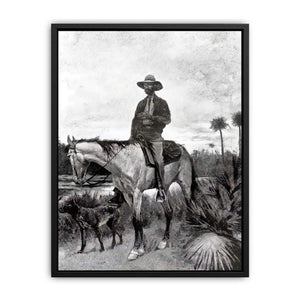



A Cracker cowboy
Go kalles this summer with this vintage navy and white striped v-neck t-shirt from the Nike. Perfect for pairing with denim and white kicks for a stylish kalles vibe.

A Cracker cowboy
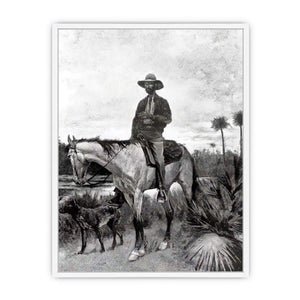
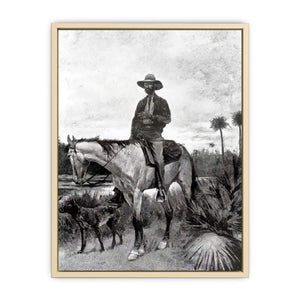
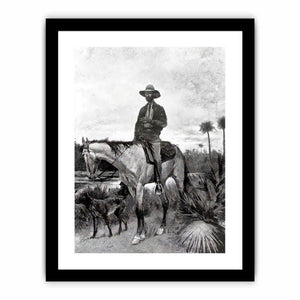
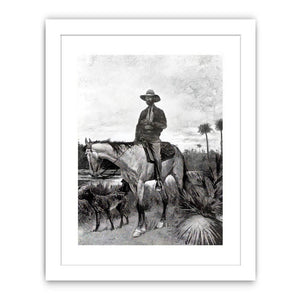
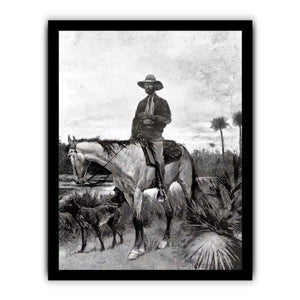
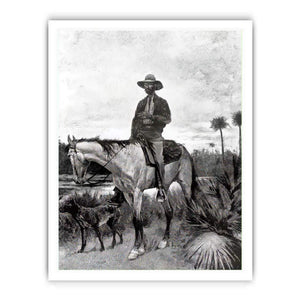
A Cracker Cowboy Painting by Frederic Remington
A Cracker Cowboy stands as one of Frederic Remington’s most nuanced and culturally attentive depictions of American frontier life, a painting in which regional identity, adaptation, and quiet endurance replace the more familiar imagery of Western spectacle. Rather than presenting the cowboy as a figure of speed, confrontation, or dramatic heroism, Remington turns his focus to a distinct Southern variant of frontier labour—the Florida “cracker” cowboy—whose environment, methods, and posture reflect a different relationship to land and work. The painting expands the visual language of the American cowboy, challenging the dominance of the Great Plains narrative and asserting a broader, more complex frontier reality.
Frederic Remington’s authority as an interpreter of American frontier life rested on his insistence that the West was not monolithic. By the late nineteenth century, he understood that regional differences shaped not only landscape, but behaviour, equipment, and rhythm of life. The cracker cowboy, named for the crack of his long whip rather than for cornmeal, emerged from the subtropical environment of Florida and the Deep South, where cattle herding demanded patience, resilience, and adaptation to heat, marshland, and dense vegetation. A Cracker Cowboy reflects Remington’s recognition that frontier identity was shaped as much by environment as by mythology.
The composition is notably restrained. The cowboy is presented without urgency or theatrical gesture, often seated calmly on horseback or positioned with deliberate stillness. This compositional choice signals a departure from Remington’s more kinetic works. Here, movement is implied rather than enacted. The figure’s posture suggests familiarity with routine rather than readiness for conflict. The horse, similarly composed, appears accustomed to slow progress through difficult terrain rather than explosive speed across open plains. Together, rider and mount embody endurance rather than dominance.
Perspective reinforces this sense of grounded realism. The viewer encounters the cracker cowboy at a measured distance, allowing observation without intrusion. There is no dramatic foreshortening or elevated viewpoint designed to magnify presence. Instead, Remington positions the figure within the landscape as one element among others. Space unfolds horizontally, reflecting the flatness and density of Southern terrain rather than the vast vertical horizons of the Western plains. This spatial treatment underscores the painting’s regional specificity.
Light in A Cracker Cowboy is functional and unembellished. Remington avoids dramatic contrasts or heroic illumination. Instead, light clarifies form, texture, and posture with steady consistency. The effect is one of visibility rather than emphasis. The cowboy is not spotlighted; he is revealed as part of his environment. This approach reinforces the painting’s documentary quality, aligning with Remington’s commitment to observational truth over romantic invention.
Colour plays a crucial role in establishing atmosphere and identity. The palette is dominated by earthy greens, browns, and muted tones that reflect the humid, vegetation-rich environment of the South. Unlike the dusty yellows and open blues of Western desert scenes, these colours suggest density, moisture, and enclosure. The cowboy’s clothing blends into this palette, prioritising function over display. Colour here affirms adaptation—everything in the scene is shaped by climate and terrain.
Remington’s brushwork remains controlled and economical. Details are selective, emphasising structure and material rather than ornament. The horse’s musculature is rendered with practical clarity, while the rider’s form is articulated through posture rather than facial expression. This restraint directs attention to the overall relationship between figure and environment rather than to individualised drama. Technique serves understanding, not spectacle.
Symbolically, A Cracker Cowboy operates as a corrective to simplified frontier mythology. The cracker cowboy does not embody conquest or expansion. He represents continuity—work carried out over generations in challenging conditions that reward patience more than bravado. The long whip associated with cracker cowboys, often included as a defining attribute, symbolises communication and control at a distance rather than force. Remington’s depiction honours this quiet expertise, recognising a form of mastery rooted in knowledge rather than dominance.
Emotionally, the painting conveys calm resilience. There is no visible tension, no immediate threat. The mood is one of attentiveness shaped by routine. The cracker cowboy appears self-contained, alert to environment rather than to spectacle. This emotional register invites reflection rather than excitement, offering a contemplative counterbalance to Remington’s more dramatic compositions. It suggests that much of frontier life was defined by persistence rather than crisis.
Within Remington’s broader artistic development, A Cracker Cowboy demonstrates his expanding ethnographic sensitivity. While he is often associated with the imagery of the Western frontier, this painting confirms his awareness that American frontier life extended well beyond the Rocky Mountains and the Plains. By documenting Southern cowboy culture with the same seriousness he afforded Western subjects, Remington contributes to a more inclusive and accurate visual history of American labour and identity.
Culturally, the painting holds enduring importance as a recognition of regional diversity within the American cowboy tradition. It challenges the notion that cowboy identity was uniform, highlighting how geography, climate, and tradition produced distinct forms of expertise. A Cracker Cowboy preserves a way of life that was already under threat from modernisation, fencing, and industrial agriculture, making it both a historical record and a cultural statement.
In contemporary interiors, A Cracker Cowboy integrates with understated authority and narrative depth. In studies and libraries, it communicates cultural literacy and appreciation for nuanced history. In living rooms and private collections, it offers quiet presence rather than overt drama, making it particularly suitable for spaces that value authenticity over spectacle. In galleries and luxury residences across the United States, United Kingdom, Canada, Australia, and Europe, the painting complements rustic, traditional, and modern interiors alike. Its restrained palette and contemplative mood allow it to anchor a space without overwhelming it.
The enduring relevance of A Cracker Cowboy lies in its refusal to simplify. Remington presents the cowboy not as a universal symbol, but as a regional worker shaped by environment and tradition. The painting endures because it recognises a universal truth within that specificity: that dignity often resides in adaptation, patience, and routine rather than in conquest or display. In A Cracker Cowboy, Frederic Remington expands the story of the American frontier, offering a quieter, deeper vision of endurance that continues to resonate wherever work, land, and identity remain inseparable.
Buy museum qulaity 400- 450 canvas prints, framed prints, and 100% oil paintings of A Cracker Cowboy by Frederic Remington at Alpha Art Gallery, where world-famous masterpieces are recreated with museum-quality detail, refined craftsmanship, and premium materials.
FAQS
What does A Cracker Cowboy by Frederic Remington depict?
It depicts a Southern “cracker” cowboy, highlighting a regional form of American frontier labour distinct from the Western plains tradition.
What is a cracker cowboy?
A cracker cowboy was a cattle herder from Florida and the Deep South, named for the crack of his long whip rather than for food.
Why is this painting important within Remington’s work?
It expands his vision of the frontier by acknowledging regional diversity and non-Western cowboy traditions.
How does this painting differ from Remington’s action scenes?
It emphasises stillness, routine, and endurance rather than speed, pursuit, or conflict.
What role does environment play in the artwork?
The dense, earthy landscape shapes posture, colour, and mood, reinforcing adaptation to Southern terrain.
Is A Cracker Cowboy historically grounded?
Yes, it reflects real Southern cowboy practices and Remington’s commitment to observational accuracy.
Is this painting suitable for contemporary interiors?
Yes, its restrained composition and earthy palette suit traditional, rustic, and modern spaces.
Why does A Cracker Cowboy remain relevant today?
Its focus on regional identity, quiet expertise, and adaptation continues to resonate beyond its historical context.
| 1. Select Type |
Canvas Print, Unframed Paper Print, Hand-Painted Oil Painting, Framed Paper Print |
|---|---|
| 2. Select Finish Option |
Rolled Canvas, Rolled- No Frame, Streched Canvas, Black Floating Frame, White Floating Frame, Brown Floating Frame, Black Frame with Matt, White Frame with Matt, Black Frame No Matt, White Frame No Matt, Streched, Natural Floating Frame, Champagne Floating Frame, Gold Floating Frame |
| 3. Select Size |
60cm X 90cm [24" x 36"], 76cm X 114cm [30" x 45"], 90cm X 120cm [36" x 48"], 100cm X 150cm [40" x 60"], 16.54 x 11.69"(A3), 23.39 x 16.54"(A2), 33.11 x 23.39"(A1), 46.81 x 31.11"(A0), 54" X 36", 50cm X 60cm [16" x 24"], 121cm X 182cm [48" x 72"], 135cm X 200cm [54" x 79"], 165cm x 205cm [65" x 81"], 183cm x 228cm [72" x 90"], 22cm X 30cm [9" x 12"], 30cm x 45Cm [12" x 18"], 45cm x60cm [16" x 24'], 75cm X 100cm [30" x 40"], 121cm x 193cm [48" x 76"], 45cm x 60cm [16" x 24'], 20cm x 25Cm [8" x 10"], 35cm x 50Cm [14" x 20"], 45cm x 60 cm [18" x 24"], 35cm x 53Cm [14" x 21"], 66cm X 101cm[26" x 40"], 76cm x 116cm [30"x 46"], 50cm X 60cm 16" x 24"] |