A Bit of Roman Aqueduct Painting by George Inness
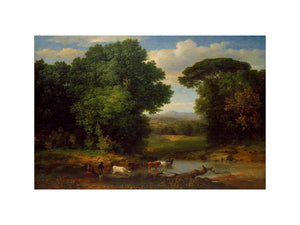
A Bit of Roman Aqueduct stands as one of George Inness’s most quietly profound meditations on time, memory, and the relationship between human endeavour and the natural world. Painted during Inness’s early engagement with European landscapes, the work reflects his evolving belief that landscape painting was not merely a record of place, but a means of expressing spiritual truth. Rather than treating the Roman aqueduct as a monument of historical grandeur, Inness presents it as a fragment—weathered, partially reclaimed by nature, and absorbed into the surrounding landscape. The painting does not celebrate empire; it contemplates endurance, transience, and the slow reconciliation between human construction and the natural order.
George Inness emerged as one of the most philosophically driven landscape painters of nineteenth-century America. Deeply influenced by European art, particularly the Barbizon School, and later by the spiritual ideas of Emanuel Swedenborg, Inness believed that art should communicate inner reality rather than surface description. A Bit of Roman Aqueduct belongs to a period when Inness was moving away from topographical precision toward a more poetic and interpretive vision. The subject of the aqueduct—once a marvel of engineering—offered him an ideal motif through which to explore the passage of time and the limits of human permanence.
The composition is deliberately understated. The aqueduct does not dominate the canvas; it emerges gently from the landscape, partially obscured by vegetation and softened by atmosphere. Its arches, though still recognisable, are no longer assertive. Instead of rising triumphantly against the sky, they seem to yield to the surrounding earth, as though time itself has moderated their presence. Inness positions the structure as one element among many, refusing to grant it compositional supremacy. Nature and architecture coexist, neither in conflict nor in harmony, but in quiet negotiation.
Perspective in A Bit of Roman Aqueduct is intimate and grounded. The viewer is placed at a human scale, close enough to sense texture and age, yet far enough to perceive the aqueduct as part of a broader environmental rhythm. There is no dramatic elevation or panoramic sweep. Space unfolds gently, guiding the eye across land, stone, and foliage without abrupt transition. This measured perspective encourages contemplation rather than awe, aligning with Inness’s belief that landscape should invite inward reflection.
Light plays a central expressive role. Inness employs a subdued, diffused illumination that dissolves sharp edges and unifies forms. The light does not dramatise the aqueduct or isolate it as a focal point. Instead, it bathes the entire scene evenly, suggesting a moment of quiet equilibrium. Shadows are soft, transitions gradual. This atmospheric treatment reinforces the sense that the aqueduct belongs to the landscape not as a monument, but as a remnant—its significance altered by time and light.
Colour is restrained and harmonised. Earthy browns, muted greens, soft greys, and warm ochres dominate the palette, binding stone and soil into a cohesive whole. Inness avoids strong contrasts or saturated hues, favouring tonal unity over visual assertion. The aqueduct’s stone echoes the colours of the surrounding land, visually reinforcing the idea that human constructions ultimately return to nature’s chromatic language. Colour here functions symbolically, dissolving boundaries between the built and the natural.
Inness’s brushwork is subtle and suggestive rather than descriptive. Forms are defined through tonal relationships rather than sharp outline. Surfaces appear softened, as though viewed through memory rather than direct observation. This approach distances the painting from archaeological documentation and situates it within a poetic register. The aqueduct is not rendered as an object to be studied, but as a presence to be felt. Technique serves mood and meaning, not precision.
Symbolically, A Bit of Roman Aqueduct operates as a meditation on impermanence. The Roman aqueduct, once a symbol of imperial power, engineering mastery, and human order, is shown here stripped of dominance. It survives, but only as fragment. Nature has not destroyed it violently; it has absorbed it patiently. Inness does not frame this absorption as loss alone. There is no sense of decay as tragedy. Instead, the painting suggests continuity—human effort subsumed into a larger, enduring natural cycle.
Emotionally, the painting conveys calm reflection rather than nostalgia or melancholy. There is no mourning for vanished empire, no celebration of ruin. The mood is contemplative and reconciled. Viewers often experience a sense of quiet acceptance, as though the painting affirms that meaning does not reside in permanence, but in relationship. The aqueduct’s survival as fragment becomes more resonant than its former completeness.
Within Inness’s artistic evolution, A Bit of Roman Aqueduct marks a significant step toward his mature spiritual landscapes. While earlier works demonstrated strong European influence and attention to structure, this painting reveals his growing interest in atmosphere, mood, and metaphysical suggestion. It anticipates his later American landscapes, where specific locations dissolve into expressions of inner state. The aqueduct here functions less as subject than as catalyst for reflection.
Culturally, the painting reflects nineteenth-century America’s complex relationship with Europe. For American artists, Roman ruins symbolised both artistic heritage and historical distance. Inness does not approach the aqueduct with reverence for classical authority. Instead, he interprets it through a modern sensibility that values spiritual insight over historical dominance. The painting thus bridges Old World subject matter with New World philosophical independence.
In contemporary interiors, A Bit of Roman Aqueduct integrates with exceptional subtlety and intellectual depth. In living rooms, it offers calm presence and historical resonance without visual heaviness. In studies and offices, it supports reflection, balance, and cultural awareness. In galleries and luxury residences across the United States, United Kingdom, Canada, Australia, and Europe, the painting complements traditional, modern, and minimalist interiors alike. Its muted palette and atmospheric unity allow it to anchor a space gently, rewarding sustained viewing rather than immediate impact.
The enduring relevance of A Bit of Roman Aqueduct lies in its refusal to dramatise history. Inness does not depict triumph or ruin; he depicts continuity. The painting endures because it speaks to a timeless human awareness: that all human achievements exist within a larger natural and temporal order, and that meaning emerges not from dominance, but from harmony with that order. In this work, George Inness offers a vision of history softened by time, nature, and contemplation—a vision that continues to resonate wherever viewers seek depth beyond surface and permanence beyond power.
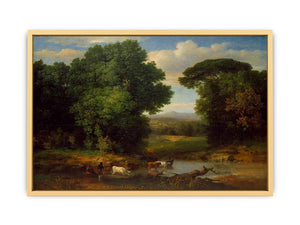
Buy museum qulaity 400- 450 canvas prints, framed prints, and 100% oil paintings of A Bit of Roman Aqueduct by George Inness at Alpha Art Gallery, where world-famous masterpieces are recreated with museum-quality detail, refined craftsmanship, and premium materials.
FAQS
What does A Bit of Roman Aqueduct by George Inness depict?
It depicts a fragment of a Roman aqueduct integrated into a natural landscape, emphasising atmosphere and quiet presence.
Why did Inness choose a Roman aqueduct as a subject?
The aqueduct allowed him to explore themes of time, impermanence, and the relationship between human structures and nature.
Is this painting a historical or archaeological study?
No, it is a poetic and spiritual interpretation rather than a precise historical record.
What emotional tone defines the artwork?
The tone is calm, reflective, and reconciled, without drama or nostalgia.
How does Inness use light in this painting?
Light is diffused and atmospheric, unifying forms rather than highlighting individual elements.
Does the aqueduct symbolise decline or continuity?
It suggests continuity, showing how human creations are absorbed into nature over time.
Is A Bit of Roman Aqueduct suitable for contemporary interiors?
Yes, its restrained palette and contemplative mood suit modern, traditional, and minimalist spaces.
Why does A Bit of Roman Aqueduct remain relevant today?
Its meditation on impermanence, harmony, and the passage of time continues to resonate across cultures and eras.