A Bend In The Road Painting by Paul Cézanne
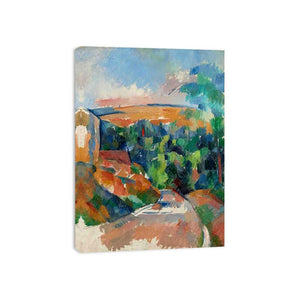
A Bend In The Road Painting by Paul Cézanne is a quietly radical meditation on perception, structure, and the act of seeing, one that reveals how profoundly Cézanne reshaped the language of landscape painting. Created during the artist’s mature period, the work appears modest in subject matter: a country road curving through a wooded landscape. Yet this apparent simplicity is deceptive. The painting is not about travel, narrative, or scenery in the conventional sense. It is about how visual experience is organized, how nature can be translated into pictorial form, and how meaning can emerge from sustained attention rather than dramatic incident.
The artist who brought this vision into being, Paul Cézanne, occupies a foundational position in the transition from nineteenth-century painting to modern art. Cézanne rejected both academic illusionism and the fleeting optical effects favored by Impressionism. His ambition was deeper and more exacting: to construct an image of nature that was stable, coherent, and intellectually rigorous. In A Bend In The Road, this ambition is fully realized. The landscape is not observed casually; it is built patiently, through color, form, and spatial tension.
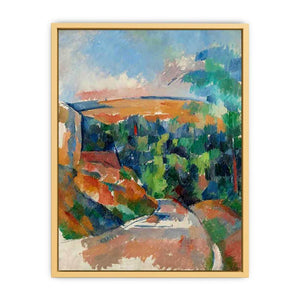
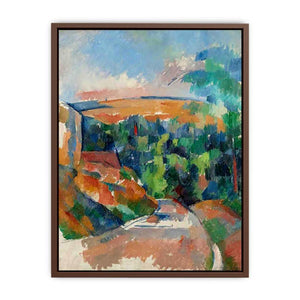
The subject of the painting—a road that curves out of sight—immediately disrupts expectations. Roads in traditional landscape art often function as invitations, leading the eye toward a clear destination or focal point. Cézanne’s road does the opposite. The bend interrupts forward movement and denies closure. The viewer cannot see where the road leads, and this refusal of narrative resolution is essential. The painting insists that significance lies not in arrival, but in perception itself. The bend becomes a structural and philosophical device, guiding the eye while withholding certainty.
Compositionally, the painting is constructed through carefully balanced forces. The road curves diagonally across the canvas, its pale surface cutting through darker masses of earth and foliage. Vertical tree forms counterbalance this movement, anchoring the composition and preventing it from dissolving into mere flow. Cézanne does not subordinate these elements to linear perspective. Instead, he treats them as interlocking planes, each asserting its presence while contributing to the overall harmony. The composition feels stable, yet never static—a dynamic equilibrium achieved through restraint.
Perspective in A Bend In The Road is deliberately ambiguous. Depth is suggested, but it is never fully resolved. Cézanne allows spatial relationships to remain slightly unsettled, creating a tension between recession and flatness. This ambiguity draws attention to the act of seeing itself. The viewer becomes aware that space is not simply recorded, but constructed. The painting does not offer the comfort of illusion; it offers the challenge of engagement.
Light is integrated into form rather than treated as an external effect. Cézanne does not dramatize sunlight or atmospheric conditions. Instead, light is absorbed into color and structure, contributing to the solidity of objects. Shadows are built through modulated tones rather than sharp contrasts. This approach gives the landscape a sense of permanence, as if it exists outside the fleeting conditions of weather or time. Light here is structural, reinforcing volume and balance.
The color palette is restrained yet extraordinarily nuanced. Cézanne employs earthy greens, muted browns, soft blues, and warm ochres, carefully modulated and placed in relation to one another. Color does not dissolve form, as in Impressionism; it defines it. Each brushstroke contributes to the architecture of the painting, building mass and rhythm rather than surface sparkle. The road itself is articulated through subtle tonal shifts that distinguish it from the surrounding terrain without isolating it.
Cézanne’s technique is unmistakable and purposeful. Brushstrokes are visible, deliberate, and repetitive, creating a surface that is both tactile and intellectual. There is no attempt to conceal the process of painting. On the contrary, the viewer is invited to recognize how the image is made. This transparency is central to Cézanne’s philosophy. Painting, for him, was not about illusion, but about coherence—about bringing order to perception without falsifying it.
Symbolically, A Bend In The Road is understated yet resonant. The curving road has often been interpreted as a metaphor for uncertainty, transition, or the unfolding nature of experience. Cézanne does not insist on such readings, yet the absence of a visible destination invites reflection. The painting suggests that understanding is provisional, that perception unfolds gradually rather than all at once. Meaning resides in attention, not in conclusion.
Psychologically, the painting conveys concentration and calm. There are no figures, no narrative events, no emotional cues. Yet the scene feels intensely present. Cézanne’s landscapes often seem to think rather than perform. They hold themselves in balance, testing relationships between form and color, refusing excess. This intellectual quiet is one of the painting’s most enduring qualities. The viewer is not entertained; they are engaged.
Within Cézanne’s broader body of work, A Bend In The Road aligns closely with his late landscapes, in which nature is treated as a system of forms to be understood rather than a spectacle to be admired. These works would profoundly influence the development of Cubism and modern abstraction. Artists such as Picasso and Braque recognized in Cézanne a new grammar of vision—one that replaced illusion with structure and narrative with analysis. The road that bends in this painting marks not only a turn in the landscape, but a turning point in art history.
Culturally, the painting reflects a modern sensibility emerging at the end of the nineteenth century: a move away from certainty, linear progress, and narrative closure. Cézanne’s landscape does not explain itself. It requires time, patience, and sustained looking. In doing so, it anticipates the concerns of twentieth-century art, where perception, structure, and ambiguity would become central themes.
In contemporary interiors across the United States, the United Kingdom, Canada, Australia, and Europe, A Bend In The Road integrates with exceptional elegance and relevance. In living rooms, it introduces calm movement and visual depth without dominating the space. In studies and offices, it communicates thoughtfulness, discipline, and intellectual clarity. In galleries and luxury residences, it anchors interiors with modernist authority, harmonizing seamlessly with traditional, modern, minimalist, and eclectic décor through its balanced palette and structural refinement.
The painting remains meaningful today because it mirrors how modern life is experienced—not as a straight path, but as a series of turns that require awareness rather than certainty. Cézanne’s vision reminds the viewer that understanding is built slowly, through attention to relationships and form. A Bend In The Road does not lead forward decisively. It teaches how to see.
A Bend In The Road Painting by Paul Cézanne endures as a quietly transformative work in the history of art. Through structural composition, disciplined color, and philosophical restraint, Cézanne transformed a simple landscape motif into a profound inquiry into perception itself. The road curves away, but meaning remains firmly present.
Buy museum qulaity 400- 450 canvas prints, framed prints, and 100% oil paintings of A Bend In The Road by Paul Cézanne at Alpha Art Gallery, where world-famous masterpieces are recreated with museum-quality detail, refined craftsmanship, and premium materials.
FAQs
What does A Bend In The Road depict?
It depicts a curving country road within a natural landscape, presented as a study of perception rather than narrative.
Why is the road shown bending out of sight?
The bend interrupts linear progress, emphasizing attention and structure over destination.
How does Cézanne treat space in this painting?
He keeps space deliberately ambiguous, balancing depth with flatness to highlight the act of seeing.
What role does color play in the composition?
Color defines form and structure through carefully modulated tones rather than smooth blending.
Why is there no human presence in the scene?
Cézanne removes figures to focus entirely on nature and perception without narrative distraction.
How does this painting relate to modern art?
It anticipates Cubism and abstraction by redefining how space and form are constructed.
Why does the painting feel calm but intellectually demanding?
Its restraint, lack of narrative, and visible structure require sustained, thoughtful viewing.
Where does this artwork work best in interiors?
It is ideal for living rooms, studies, offices, galleries, and spaces seeking calm, depth, and modernist refinement.