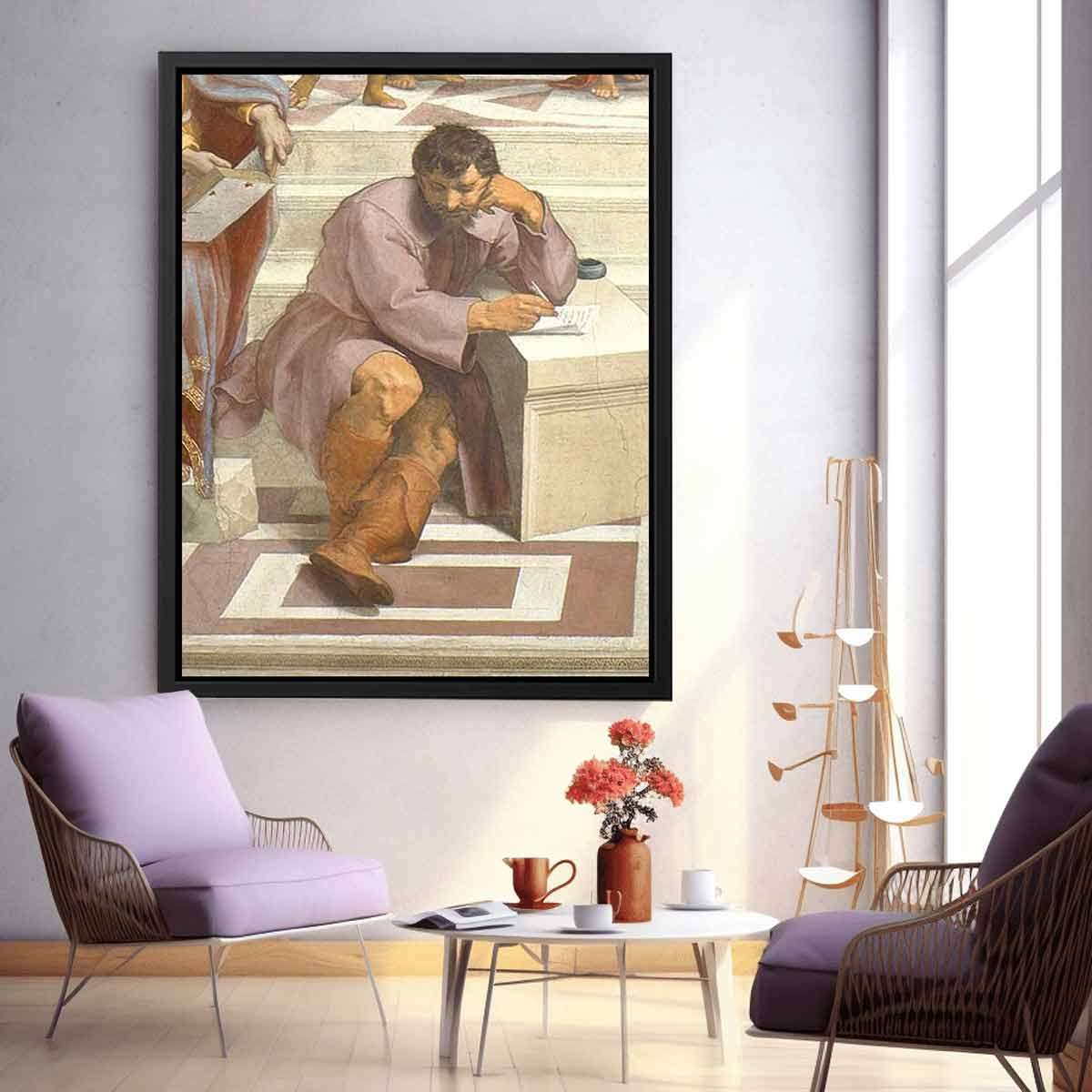
School of Athens by Raphael is one of the most celebrated masterpieces of the Italian High Renaissance. Painted in the Vatican, the monumental fresco brings together philosophers and thinkers from classical antiquity within an ideal architectural setting. The work is a powerful visual expression of knowledge, reason, philosophy, and Renaissance humanism.
At the center stand Plato and Aristotle, whose contrasting gestures and ideas establish the intellectual focus of the composition. Around them Raphael arranged numerous philosophers, mathematicians, scholars, and thinkers, creating one of the most ambitious group scenes in Western art.
About the School of Athens
The fresco forms part of Raphael's decoration of the Vatican's Stanza della Segnatura. The room's imagery brings together theology, philosophy, poetry, and law, presenting different forms of knowledge as complementary aspects of intellectual culture.
Raphael's architecture is as important as the figures. The monumental arches and vaulted spaces create an ideal classical environment, while perspective lines lead the viewer toward the central philosophers.
Plato and Aristotle
Plato is traditionally shown pointing upward, suggesting the world of ideal forms and transcendent reality. Aristotle gestures horizontally toward the earthly world, reflecting his emphasis on observation and the natural world.
Their contrasting gestures provide a simple visual summary of two major philosophical traditions while creating a powerful compositional axis at the center of the fresco.
Renaissance Humanism
The School of Athens reflects Renaissance admiration for classical learning. Humanist scholars studied ancient philosophy, literature, mathematics, and science, and Raphael transformed that intellectual culture into a monumental visual celebration.
The fresco therefore represents more than a gathering of historical figures. It expresses the Renaissance belief that reason, learning, and the study of antiquity could enrich contemporary culture.
Raphael's Architecture and Perspective
The grand architecture provides depth, scale, and visual order. Strong perspective lines converge toward the central figures, while the symmetrical structure organizes the large number of participants.
This architectural harmony is characteristic of Raphael's High Renaissance style, where complexity is controlled through proportion and balance.
Choosing a School of Athens Reproduction
Alpha Art Gallery offers contemporary reproductions inspired by Raphael's School of Athens as canvas prints, fine art prints, framed prints, and 100% hand-painted oil painting reproductions. Professional artists individually paint each hand-painted reproduction, creating real brushwork, painted texture, visual depth, and natural handmade variation.
Explore the canvas prints and oil paintings collections.
Displaying School of Athens Wall Art
The monumental composition is especially suited to studies, libraries, offices, galleries, classrooms, and interiors inspired by classical architecture and intellectual history. Large formats can emphasize the architectural scale and numerous figures.
Frequently Asked Questions
Who painted the School of Athens?
The fresco was painted by Raphael, one of the leading artists of the High Renaissance.
Who are the central figures?
The central figures are traditionally identified as Plato and Aristotle.
Where is the School of Athens?
The original fresco is in the Vatican's Stanza della Segnatura.
What does the painting represent?
It represents philosophy and the pursuit of knowledge, while celebrating classical learning and Renaissance humanism.
Bring Renaissance Philosophy Into Your Space
School of Athens unites philosophy, architecture, classical antiquity, and Renaissance artistic ideals. It remains an enduring symbol of intellectual curiosity and the cultural achievements of the High Renaissance.