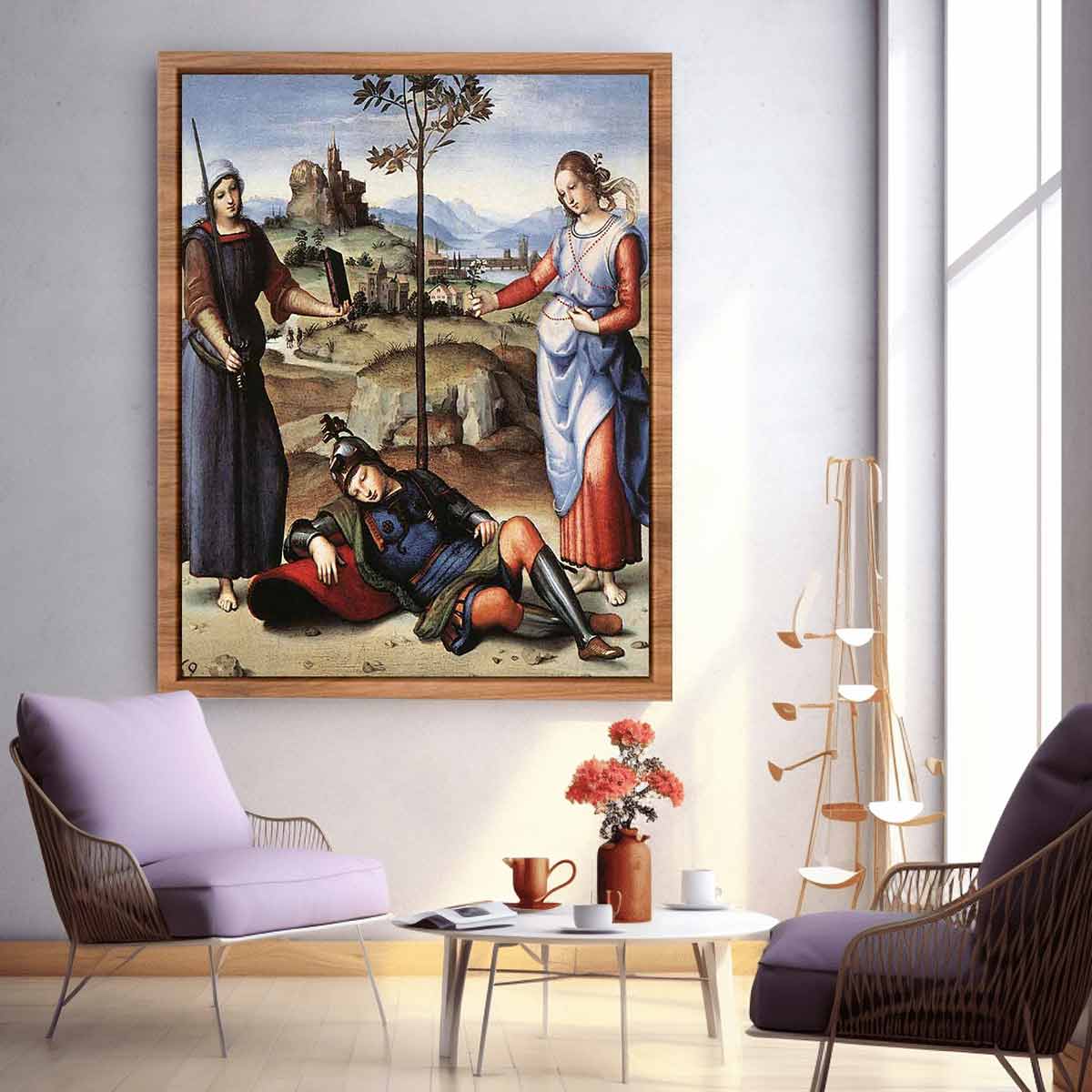
Allegory (The Knight's Dream) by Raphael is a celebrated Renaissance allegory that presents a sleeping knight between two female personifications representing contrasting paths. The small painting combines a poetic landscape with symbolic figures to explore ideas of virtue, pleasure, duty, and moral choice.
Attributed to Raphael's early period, the work demonstrates his ability to turn a compact composition into a sophisticated meditation on human character. The knight sleeps while the allegorical figures offer different possibilities, creating an image that invites interpretation rather than presenting a single literal narrative.
The Knight's Dream
The sleeping knight is traditionally understood as a figure confronted by a moral choice. One female figure represents Virtue, associated with discipline and honorable achievement, while the other represents Pleasure or worldly delight.
The arrangement transforms the painting into a visual reflection on the choices that shape a person's life. The knight's dream becomes an allegorical space in which competing values can be contemplated.
Raphael and Renaissance Allegory
Allegory was an important part of Renaissance visual culture. Artists used personifications, objects, gestures, and landscapes to express abstract concepts such as wisdom, justice, virtue, love, and fame.
Raphael's ability to create graceful figures and harmonious compositions made him particularly suited to this type of subject. Even in a small panel, he creates a clear relationship between figures and landscape.
Virtue and Pleasure
The contrast between the two female figures is central to the painting's meaning. Virtue is traditionally associated with a difficult but honorable path, while Pleasure offers a more immediately attractive alternative.
The painting does not need dramatic action to communicate this tension. The sleeping knight becomes the silent center of the moral dilemma, while the two figures visually embody the choices before him.
Choosing a Raphael Reproduction
Alpha Art Gallery offers contemporary reproductions inspired by The Knight's Dream as canvas prints, fine art prints, framed prints, and 100% hand-painted oil painting reproductions. Professional artists individually paint each oil reproduction, creating real brushwork, painted texture, visual depth, and natural handmade variation.
Explore the canvas prints and oil paintings collections.
Displaying The Knight's Dream
The allegorical subject is particularly suitable for studies, libraries, offices, bedrooms, reading rooms, and interiors where classical or philosophical artwork can become a conversation piece.
Frequently Asked Questions
Who painted The Knight's Dream?
The work is attributed to Raphael.
What does The Knight's Dream mean?
The painting is traditionally interpreted as a moral allegory involving a choice between Virtue and Pleasure.
Where is The Knight's Dream?
The work is associated with the National Gallery in London.
Is this a religious painting?
It is primarily an allegorical and moral work rather than a straightforward religious narrative.
Bring Renaissance Allegory Into Your Space
The Knight's Dream combines graceful Renaissance figures, symbolic meaning, and a peaceful landscape to explore one of the enduring questions of human life: which path should we choose?