
John Constable

Sketch of a Lane at East Bergholt, c.1810 Painting

South Archway of the ruined tower of East Bergholt Church Painting

The Heuwagen, Study Painting

Salisbury Cathedral Seen Above the Close Wall Painting

East Bergholt Church: North Archway of the Ruined Tower Painting

Shoreham Bay near Brighton, 1824 Painting Painting

Old Sarum at Noon, 1829 Painting

Study for The Leaping Horse (detail) Painting Painting

View in Borrowdale 2 Painting Painting

View of East Bergholt, c.1813 Painting

Shipping in the Thames Painting

Cottage, Rainbow, Mill Painting

The Entrance to the Village of Edensor Painting

Salisbury Cathedral from the North West, 1829 Painting

Shipping on the Thames, c.1818 Painting

The Entrance into Gillingham, Dorset Painting

Scene on a River I Painting

Study of Trees in a Park Painting

Landscape Ploughing Scene In Suffolk Painting

Farm Buildings and Bridge near Salisbury Painting

Porch of Feering Church, 28th June, 1814 Painting

Dedham Church seen from across the River Stour with overhanging cloud, c.1810 Painting

London from Hampstead Heath Painting

Salisbury Cathedral from the long bridge with an angler in the foreground Painting

East Bergholt, 1808 Painting

Cloud Study with Trees, 1821 Painting


Rushes by a Pool, c.1821 Painting

Barges on the Stour with Dedham Church in the Distance, 1811 Painting

Salisbury Cathedral: from the meadows Painting

Windsor Castle from the River 2 Painting

Water Meadows Near Salisbury Painting

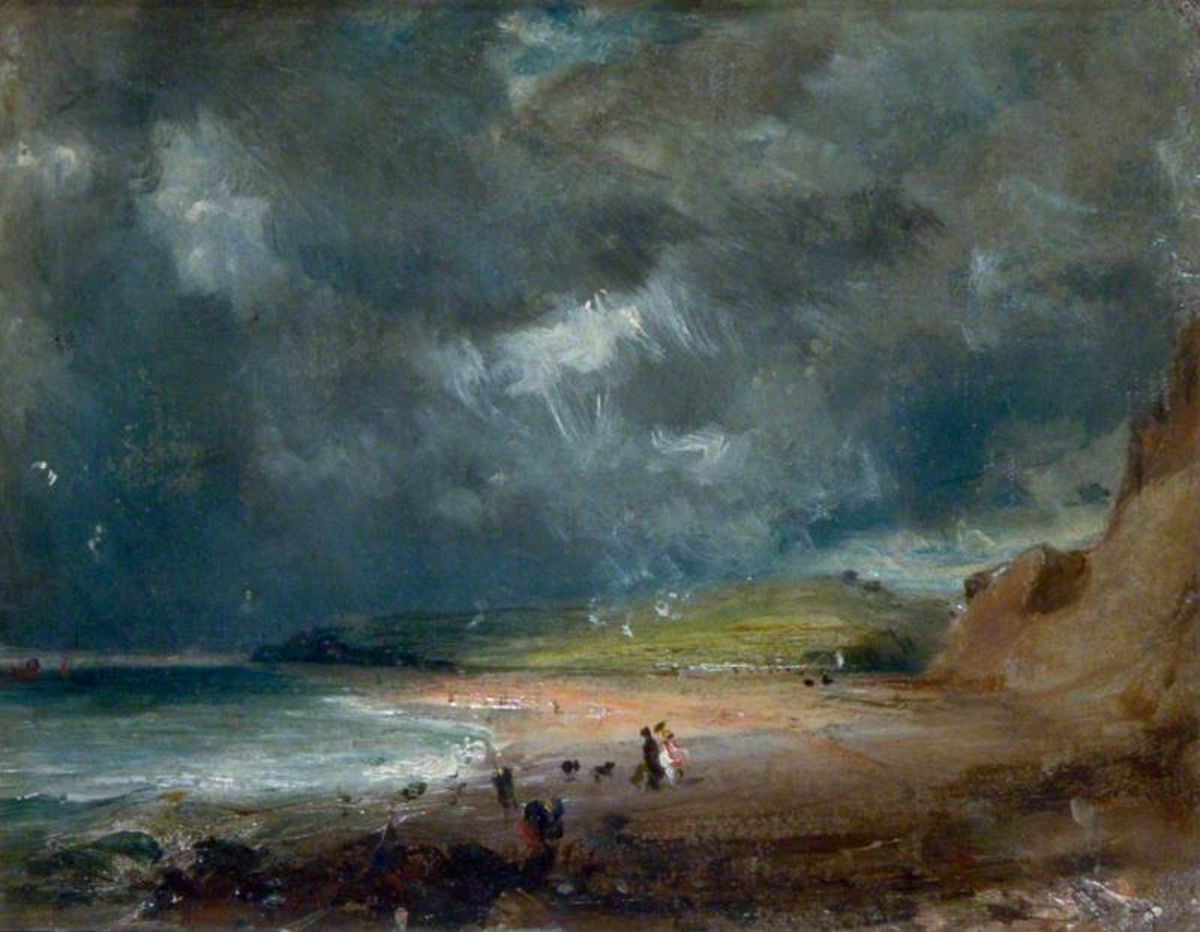
Sketch for Weymouth Bay Painting

View on the River Severn at Worcester 1835 Painting

Brighton Beach 2 Painting

A View on the Stour Painting

A Lock on the Stour Painting

Woodland View in Suffolk Painting


The Valley of the Stour with Dedham in the Distance, 1836-37 Painting

Study of Hollyhocks, c.1826 Painting

Mrs. James Pulham, Sr. (or Frances Amys) Painting
John Constable: English Landscape Painter
Introduction:
The well-known English painter and draftsman John Constable was born on June 11, 1776, in East Bergholt, Suffolk, to Ann and Golding Constable, who were wealthy grain traders. As a pioneer of "Romanticism," it is known for its picturesque landscape. Painters like Delacroix and Gericault often praised Constable's art as "great," which also influenced the French Barbizon painters and the "Impressionists" alike.
During his early studies at Dedham Grammar School, John Constable showed his artistic inclination and worked with his father for a year after graduating. During this time, he realized that his real passion was art and therefore went to study at the Royal Academy in London in 1793.
He influenced famous artists there like Jacob van Ruisdael, Claude Lorrain, and Thomas Girtin Constable. His banner style began to display his inspirations, which come straight from nature.
Famous Paintings by John Constable:
According to John, art should capture the phenomenon of nature and its whims in its entirety, such as the changing colors of the sky and the magic of the golden rays of the sun dancing on flora and fauna. He used places he was familiar with, especially in his native Suffolk and in others like Salisbury, Brighton, and Hampstead as reference. He was equally skilled with oil and watercolor.
Interrupted brushstrokes characterized John's art to capture the effect of bright, sparkling light. Some of his creations from this period are "Dedham Vale (1802)", "A Church Porch (The Church Porch, East Bergholt) (1809)," "Dedham Vale: Morning (1811)", "Landscape: Boys Fishing (1813) "," Boatbuilding (1814) "," Wivenhoe Park (1816) "," Weymouth Bay (1816) "and" Flatford Mill (1817) ". In 1816 John lost his mother; he married Maria Bricknell and was blessed with seven children in the same year.
Interestingly, although the painting depicts a true Suffolk landscape, John painted it in his London studio. "The Hay Wain" is considered to be the greatest British masterpiece. The beautiful painting caused a sensation when it was exhibited in the Paris Salon in 1824 and received the gold medal from Charles X of France and was became an inspiration to Eugene Delacroix and other new generations of French Romantic artists.
Recently "The Hay Wain" was named the UK's second-best painting in a 2005 UK poll organized by the Today Show. The painting is on display with great respect at the National Gallery in London.
Other beautiful and famous paintings that Constable created are "Dedham Vale" (1802), which again depicts the landscape of his homeland, and "Stonehenge" (1835), a brilliant watercolor that is distinguished by a double rainbow and likewise one of the best watercolors ever created are considered to be.
Although his works of art are extremely popular in British art today, Constable was not financially successful during his lifetime. He sold more of his paintings in France than in his own country, England. His most famous painting remains "The Hay Cart." John received more recognition in France than in his home country.
"The Hay Wagon (1821)" was exhibited in the Paris Salon in 1824, for which he received a gold medal from the French king at the time. In 1829 Constable was appointed to the Royal Academy. There are some of John's well-known works from this period "Hadleigh Castle" (1829), "Old Sarum" (1829), and "Salisbury Cathedral, from the Meadows" (1831).
Conclusion:
Despite the recognition and reward of his critics, John fought for commercial success. He had to face the lack of funds and resources and struggled to make ends meet all his life. In 1828 John Constable lost his wife due to tuberculosis; unable to cope with this personal loss, he died unexpectedly on March 31, 1837.