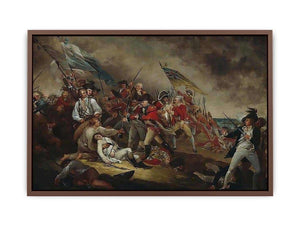
The Death of General Warren at the Battle of Bunker Hill on 17 June 1775 Painting by John Trumbull
The Death of General Warren at the Battle of Bunker Hill on 17 June 1775 Painting by John Trumbull stands as one of the most solemn and morally charged images in the canon of American historical painting. Executed with disciplined restraint and intellectual gravity, the work transforms a violent battlefield death into a meditation on sacrifice, civic virtue, and the ethical foundations of a nation in formation. Trumbull does not seek to overwhelm the viewer with spectacle or chaos; instead, he offers a carefully ordered vision in which individual loss acquires collective meaning.
John Trumbull approached the subject with uncommon authority. As a participant in the American Revolutionary War and a painter trained in the traditions of European academic history painting, he possessed both lived experience and formal rigor. His ambition was not merely commemorative. Trumbull believed that the visual arts could educate public memory, shaping how foundational events were understood across generations. In this painting, he selects not the triumph of victory but the gravity of loss, asserting that national identity is forged as much through sacrifice as through success.
The scene depicts the moment of death of General Joseph Warren during the Battle of Bunker Hill, one of the earliest major engagements of the American Revolutionary War. Warren, a prominent patriot leader, chose to fight as a volunteer rather than accept command, a decision that rendered his death especially symbolic. Trumbull places Warren at the compositional center, his fallen body supported by comrades as British forces press forward. The moment is suspended between action and aftermath, allowing reflection to eclipse violence.
Compositionally, the painting is meticulously structured. Trumbull arranges figures in a balanced yet dynamic configuration, ensuring that the viewer’s attention is drawn immediately to Warren’s body without isolating it from the broader conflict. The diagonal movement of advancing troops and retreating defenders creates tension, while the central grouping around Warren establishes emotional focus. This interplay between motion and stillness underscores the painting’s thematic core: the collision of historical momentum with personal sacrifice.
The treatment of the human figure reflects Trumbull’s academic discipline. Bodies are idealized yet anatomically credible, their gestures restrained rather than exaggerated. Warren’s posture is dignified even in death, his expression calm rather than contorted. Trumbull resists sensationalism, presenting death not as grotesque spectacle but as solemn consequence. This restraint elevates the scene from mere battle illustration to ethical statement.
Light plays a decisive role in shaping meaning. Trumbull employs controlled illumination that subtly emphasizes the central figures without resorting to theatrical contrast. Warren’s form is gently highlighted, guiding the eye while maintaining overall compositional harmony. The surrounding battlefield recedes into moderated shadow, reinforcing the sense that the painting’s true subject is not combat itself, but the cost it exacts. Light here functions as moral clarity rather than dramatic device.
Colour is similarly disciplined. Earthy browns, muted reds, and subdued blues dominate the palette, anchoring the scene in historical plausibility and emotional gravity. Trumbull avoids vivid or decorative colour that might aestheticize violence. Instead, chromatic restraint reinforces seriousness and respect. The palette unifies figures and environment, suggesting that individual fate and historical circumstance are inseparable.
One of the painting’s most significant features is its treatment of opposing forces. Trumbull depicts British officers and soldiers with composure rather than caricature, reflecting his belief in historical balance. This choice lends the painting ethical complexity. The conflict is not reduced to villainy and virtue; it is presented as a tragic confrontation shaped by conviction and circumstance. Warren’s death thus becomes a universal statement on the cost of principle rather than a narrowly partisan image.
Symbolically, The Death of General Warren operates on multiple levels. On the surface, it records a specific historical event. Beneath this, it functions as an allegory of civic sacrifice. Warren’s voluntary participation and composed death embody Enlightenment ideals of duty, reasoned courage, and commitment to collective good. Trumbull presents martyrdom not as fanaticism, but as measured resolve grounded in moral choice.
Within Trumbull’s broader body of work, this painting occupies a central position. While he produced numerous scenes of Revolutionary history, few achieve the same balance of narrative clarity and ethical depth. The painting demonstrates his conviction that history painting should instruct as well as commemorate, offering viewers a framework for understanding the values underlying political independence.
Culturally, the painting has played a formative role in shaping American historical consciousness. It reframes the Battle of Bunker Hill not as a tactical outcome, but as a moral episode. By centering on Warren’s death, Trumbull emphasizes that the Revolution’s meaning lies not solely in victory, but in the willingness to accept loss for principle. This emphasis has ensured the painting’s endurance beyond its immediate historical context.
In contemporary interiors across the United States, the United Kingdom, Canada, Australia, and Europe, The Death of General Warren at the Battle of Bunker Hill on 17 June 1775 commands respect and reflection. In living rooms, it introduces intellectual depth and historical seriousness. In studies, libraries, and offices, it aligns naturally with spaces devoted to history, governance, and ethical inquiry. In galleries and curated residences, it asserts cultural literacy and appreciation for disciplined narrative art.
The painting integrates seamlessly into traditional interiors, where its classical composition and historical subject resonate with established aesthetics. At the same time, it retains power in modern and minimalist environments, where its structural clarity and moral gravity provide contrast and focus. In eclectic spaces, it serves as an anchor of meaning, grounding diverse elements in shared historical reflection.
The long-term artistic importance of The Death of General Warren lies in its refusal to simplify history. Trumbull does not glorify violence or indulge sentimentality. He presents loss with dignity and conviction, trusting viewers to engage with complexity rather than consume spectacle. This integrity ensures the painting’s continued relevance as both art and historical meditation.
Today, the painting remains profoundly resonant. In an era often drawn to simplified narratives of heroism, Trumbull’s vision offers a more demanding truth: that nationhood is shaped through sacrifice willingly borne and morally considered. The Death of General Warren at the Battle of Bunker Hill on 17 June 1775 endures not because it dramatizes death, but because it dignifies purpose, securing John Trumbull’s place as one of the most intellectually rigorous narrators of early American history.
Buy museum qulaity 400- 450 canvas prints, framed prints, and 100% oil paintings of The Death of General Warren at the Battle of Bunker Hill on 17 June 1775 by John Trumbull at Alpha Art Gallery, where world-famous masterpieces are recreated with museum-quality detail, refined craftsmanship, and premium materials.
FAQS
What historical event does this painting depict?
It portrays the death of General Joseph Warren during the Battle of Bunker Hill in 1775, an early and symbolic moment of the American Revolutionary War.
Why is General Warren’s death considered significant?
Warren was a prominent patriot leader who chose to fight as a volunteer, making his death a powerful symbol of civic sacrifice.
How does Trumbull differ from typical battle painters in this work?
He emphasizes restraint, dignity, and moral reflection rather than chaos or spectacle.
Is the painting historically accurate?
While idealized in composition, Trumbull researched uniforms, figures, and context to maintain historical credibility.
What artistic tradition does the painting follow?
It belongs to European academic history painting adapted to American revolutionary subject matter.
Where does this artwork work best in interior spaces?
It is well suited to studies, libraries, offices, galleries, and formal living spaces that value historical depth.
Why does this painting remain relevant today?
Its focus on sacrifice, ethical commitment, and the human cost of political ideals continues to resonate across generations.