The Daughters of Edward Darley Boit Painting by John Singer Sargent
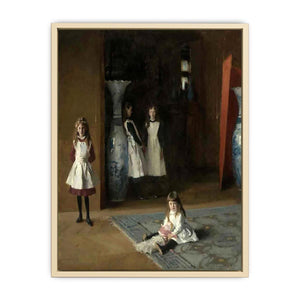
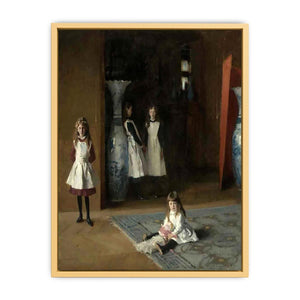
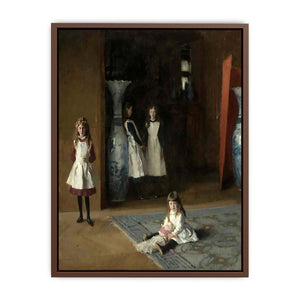
The Daughters of Edward Darley Boit Painting by John Singer Sargent is among the most psychologically complex and formally innovative portraits of the late nineteenth century, a work that quietly dismantles the conventions of family portraiture while anticipating the visual language of modernism. Painted in 1882, the canvas depicts four young sisters within a vast interior, yet it refuses sentiment, hierarchy, or narrative reassurance. Instead, Sargent constructs a charged environment in which space, silence, and separation speak as powerfully as the figures themselves. The result is a painting that does not describe childhood; it contemplates it.
By the early 1880s, John Singer Sargent was widely celebrated for his virtuoso society portraits, admired for their bravura technique and social acuity. Yet The Daughters of Edward Darley Boit marks a decisive departure from those expectations. Commissioned as a family portrait, the painting subverts the genre from within. Sargent rejects the traditional arrangement of figures in a unified, forward-facing group and instead disperses the children across a cavernous interior, allowing psychological distance and individuality to replace cohesion.
The historical context of the painting is essential to its radical nature. Late nineteenth-century family portraits typically emphasized lineage, harmony, and continuity. Children were often idealized as symbols of innocence or familial unity. Sargent dismantles these assumptions. The Boit sisters are not aligned, not engaged with one another, and not arranged for easy viewing. They inhabit the same space, yet remain profoundly separate. The painting reflects a modern understanding of childhood as a series of distinct interior states rather than a single shared identity.
Compositionally, the work is daring and unconventional. Two of the girls stand close to the viewer, while the other two recede into the shadowed depths of the room. This spatial distribution creates a powerful sense of psychological progression—from proximity to withdrawal, from visibility to obscurity. The figures are not organized by age or status, but by distance and light. Sargent uses space as a metaphor for growth, separation, and the unknowability of inner life.
Perspective reinforces this effect. The viewer is positioned at a slight remove, neither fully inside the family circle nor outside it. The expansive interior dominates the composition, dwarfing the figures and emphasizing their vulnerability within it. This is not a cozy domestic scene. It is an interior that absorbs and isolates, suggesting that identity is shaped as much by environment as by relationship. The room becomes an active psychological force.
Light plays a crucial and unsettling role. It falls unevenly across the canvas, illuminating some figures while allowing others to dissolve into shadow. This selective illumination creates a visual hierarchy that is not moral or narrative, but existential. Visibility here is temporary and conditional. Sargent does not use light to clarify relationships; he uses it to complicate them. The viewer is made acutely aware of what can and cannot be fully seen.
The color palette is restrained and sober. Muted browns, greys, and soft whites dominate the interior, creating a subdued atmosphere that resists warmth or sentimentality. The girls’ pale dresses catch the light briefly, standing out against the darker surroundings, yet even these highlights feel fragile. Color does not decorate the scene; it stabilizes its mood. Everything is calibrated toward restraint.
Sargent’s technique is precise and economical. Brushwork is controlled, particularly in the handling of faces and fabric, yet never stiff. The figures are rendered with clarity, but without overt emphasis on expression. Faces remain neutral, almost unreadable. This restraint is deliberate. Sargent refuses to tell the viewer how to feel about the children. He presents them as presences rather than characters, allowing ambiguity to persist.
Psychologically, the painting is profoundly unsettling in its quietness. The sisters do not interact overtly. Their gazes do not converge. Each appears absorbed in her own interior world. The absence of visible affection or play is not a critique; it is an observation. Sargent recognizes that childhood contains solitude as well as innocence, distance as well as intimacy. The painting captures this complexity without judgment.
Within Sargent’s broader oeuvre, The Daughters of Edward Darley Boit stands as one of his most forward-looking works. Its flattened spatial logic, emphasis on negative space, and psychological ambiguity anticipate twentieth-century developments in painting. Comparisons have often been drawn to Diego Velázquez’s Las Meninas, particularly in the way space and presence are used to destabilize the viewer’s expectations. Yet Sargent’s vision is distinctly modern, rooted in psychological realism rather than courtly complexity.
Culturally, the painting represents a turning point in the depiction of family and childhood. It rejects the idealized domestic narrative in favor of a more honest, if more disquieting, portrayal of individuality and separation. In doing so, it aligns with broader late nineteenth-century shifts toward interiority, psychology, and the fragmentation of traditional social structures.
In contemporary interiors across the United States, the United Kingdom, Canada, Australia, and Europe, The Daughters of Edward Darley Boit carries exceptional intellectual and visual authority. In studies and offices, it conveys depth, introspection, and cultural seriousness. In galleries and refined private residences, it anchors space with psychological gravity and compositional daring. Its subdued palette and monumental scale allow it to integrate seamlessly into traditional, modern, minimalist, and eclectic décor, where it rewards sustained, thoughtful engagement.
The painting remains deeply relevant today because it addresses enduring questions about identity, growth, and emotional distance. In an era increasingly attentive to the inner lives of children and the complexities of family dynamics, Sargent’s vision feels prescient rather than dated. The Daughters of Edward Darley Boit does not reassure. It observes—and in observing honestly, it endures.
The Daughters of Edward Darley Boit Painting by John Singer Sargent stands as one of the most intellectually rigorous portraits of the nineteenth century. Through radical composition, psychological restraint, and masterful control of space and light, Sargent transformed a family commission into a timeless meditation on individuality and presence. The painting does not explain its subjects. It allows them their distance.
Buy museum qulaity 400- 450 canvas prints, framed prints, and 100% oil paintings of The Daughters of Edward Darley Boit by John Singer Sargent at Alpha Art Gallery, where world-famous masterpieces are recreated with museum-quality detail, refined craftsmanship, and premium materials.
FAQs
What does The Daughters of Edward Darley Boit depict?
It depicts four sisters within a large interior, emphasizing psychological distance rather than family unity.
Why is the composition considered unusual?
Sargent disperses the figures across space instead of grouping them traditionally, creating tension and ambiguity.
Is this painting a conventional family portrait?
No, it deliberately subverts the conventions of family portraiture.
What role does space play in the painting?
Space functions as a psychological element, separating and defining the figures.
Why are some figures placed in shadow?
Selective shadow reinforces themes of visibility, withdrawal, and inner life.
How does this work differ from Sargent’s society portraits?
It abandons social performance in favor of psychological complexity and restraint.
Why does the painting remain important today?
Its exploration of childhood, individuality, and emotional distance remains deeply relevant.
Where does this artwork work best in interiors?
It is ideal for galleries, studies, libraries, and refined residential spaces that support contemplative viewing.