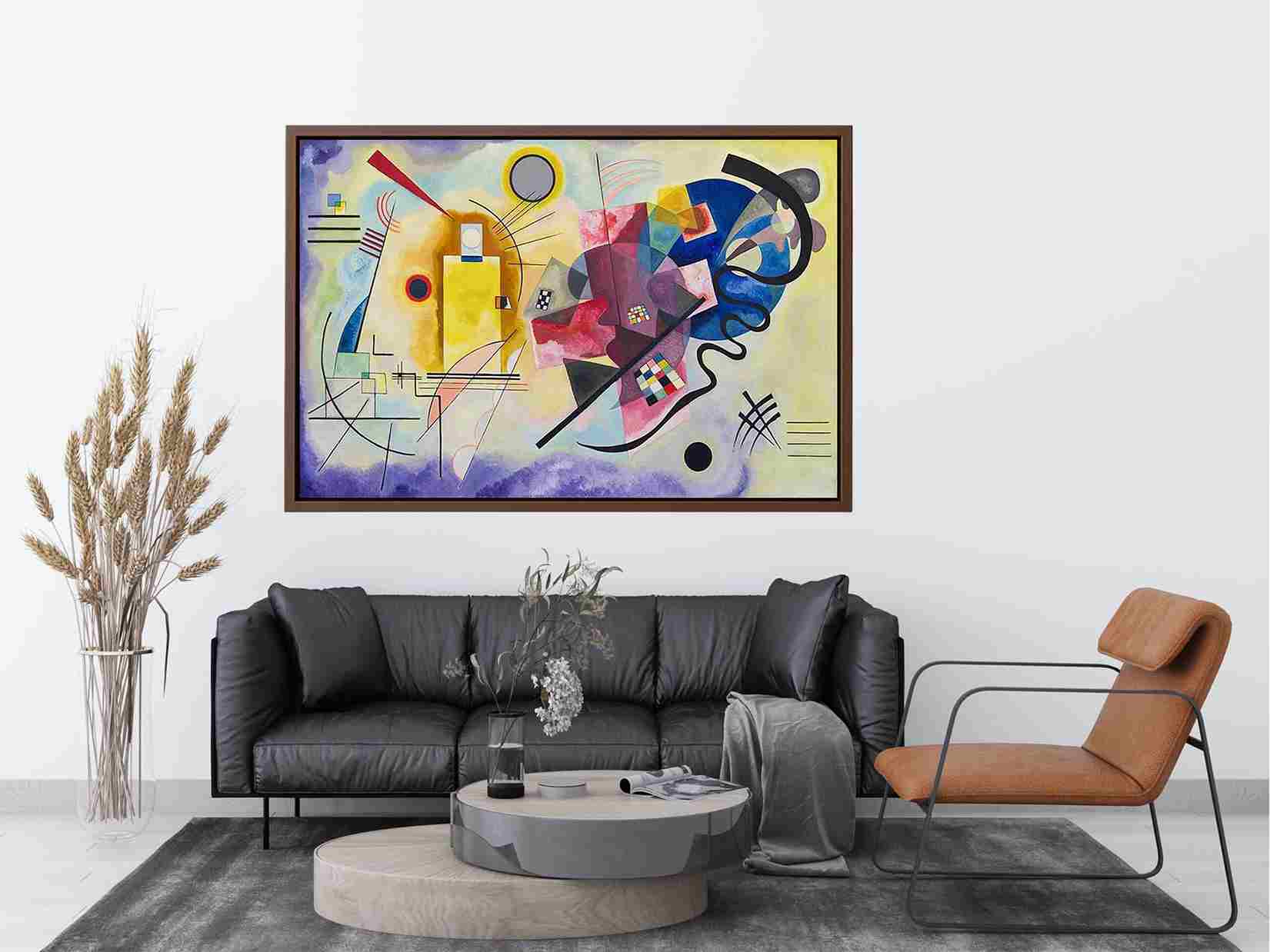
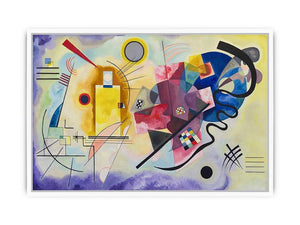
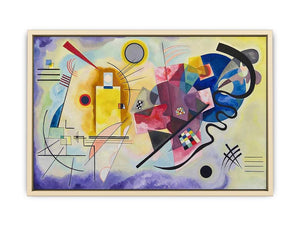
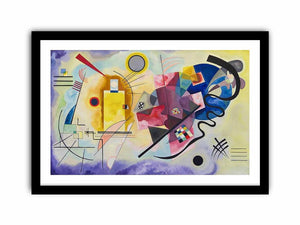
Yellow Red Blue Painting by Wassily Kandinsky
Yellow Red Blue stands as one of Wassily Kandinsky’s most decisive and intellectually charged statements on abstraction, a painting in which colour, form, and spatial tension are orchestrated into a visual language independent of representation. Created in 1925, during Kandinsky’s mature years at the Bauhaus, the work reflects a moment when his lifelong search for a universal, spiritual grammar of painting had reached a point of crystalline clarity. This is not abstraction as decoration or stylistic experiment; it is abstraction as thought made visible, a composition that operates according to its own internal logic while remaining profoundly responsive to human perception and emotion.
By the mid-1920s, Kandinsky had moved beyond the expressive turbulence of his early abstract works and toward a more structured, analytical approach. His involvement with the Bauhaus placed him in direct dialogue with architecture, design, mathematics, and theory, all of which shaped the visual discipline evident in Yellow Red Blue. Yet the painting never collapses into cold geometry. Instead, it reveals Kandinsky’s conviction that order and intuition are not opposites, but complementary forces. Structure, in his hands, becomes a means of intensifying emotional and spiritual resonance rather than suppressing it.
The composition is organised through a dynamic opposition between geometric and organic forms. On one side, rigid shapes—rectangles, lines, and measured angles—assert stability, logic, and containment. On the other, circles, curves, and irregular forms introduce movement, elasticity, and rhythm. Kandinsky does not resolve this opposition; he sustains it. The painting exists in a state of energetic balance, where tension is not a problem to be solved but a condition to be experienced.
Colour functions as the primary expressive force. Yellow, red, and blue are not chosen arbitrarily; they represent fundamental chromatic energies within Kandinsky’s theoretical framework. Yellow advances aggressively, radiating outward with sharp intensity. Blue recedes, creating depth and introspection. Red occupies a mediating role, dense and forceful, anchoring the composition while generating internal pressure. These colours are not symbolic in a narrative sense; they operate psychologically, affecting perception through contrast, vibration, and spatial interaction.
Kandinsky’s handling of colour demonstrates exceptional discipline. Each hue is precisely calibrated in saturation and placement, ensuring that no single element overwhelms the whole. Colour relationships create spatial effects without reliance on traditional perspective. Depth is achieved through chromatic tension rather than illusionistic modelling. The viewer does not look into a depicted space; instead, space unfolds through interaction. This approach marks a radical rethinking of pictorial depth, one that aligns painting more closely with music than with architecture.
Line plays an equally critical role. Straight lines cut decisively across the surface, establishing direction and resistance. Curved lines introduce counter-movement, softening and redirecting energy. Kandinsky treats line as an active agent rather than a boundary. Lines do not simply contain shapes; they generate motion and rhythm, guiding the viewer’s eye across the canvas in carefully choreographed paths. This rhythmic quality reinforces Kandinsky’s belief that painting, like music, unfolds over time through perception.
The spatial organisation of Yellow Red Blue is deliberately non-hierarchical. There is no central focal point demanding dominance. Instead, the eye moves continuously, drawn from one interaction to another. This decentralisation reflects Kandinsky’s rejection of classical compositional authority. Meaning is not located in a single motif; it emerges through relationship. The painting invites prolonged engagement, revealing new alignments and tensions with each viewing.
Texture is restrained but purposeful. Kandinsky avoids painterly excess, allowing surface variation to support structure rather than distract from it. Brushwork is controlled, often smooth, reinforcing clarity and legibility. Where texture does appear, it serves to modulate colour intensity or soften transitions. The surface remains active without becoming expressive in a gestural sense. This restraint underscores the painting’s intellectual seriousness.
Symbolically, Yellow Red Blue resists fixed interpretation. Kandinsky rejected literal symbolism, arguing that abstraction could communicate directly through sensation rather than representation. Yet the painting’s internal logic suggests a worldview shaped by balance, opposition, and synthesis. The coexistence of order and freedom, stability and movement, echoes broader philosophical concerns of the early twentieth century, when artists sought new systems of meaning in the wake of profound cultural disruption.
Emotionally, the painting is both charged and composed. It does not overwhelm the viewer with chaos, nor does it settle into decorative calm. Instead, it sustains a heightened state of alertness. The viewer is made aware of perception itself—of how colour advances or retreats, how form asserts or yields. This self-awareness is central to the painting’s power. Kandinsky does not ask the viewer to recognise something; he asks them to experience something.
Within Kandinsky’s artistic evolution, Yellow Red Blue represents a synthesis of his spiritual ideals and his Bauhaus discipline. Earlier works pursued abstraction through intuition and expressive force. Here, intuition has been refined by structure. The painting demonstrates that abstraction, when grounded in rigorous thought, can achieve both emotional depth and formal coherence. It stands as a mature affirmation of Kandinsky’s belief that art could function as a universal language.
The painting’s cultural importance extends far beyond its historical moment. Yellow Red Blue remains a cornerstone of abstract art because it articulates principles that continue to shape visual culture: the autonomy of form, the expressive power of colour, and the possibility of meaning without representation. Viewers across the United States, the United Kingdom, Canada, Australia, and Europe continue to engage with its clarity and intensity, finding in it a visual experience that feels both timeless and contemporary.
In interior spaces, Yellow Red Blue functions as an anchor of intellectual energy. In living rooms, it introduces dynamism and conceptual depth without narrative distraction. In studies and offices, it reinforces values of clarity, innovation, and disciplined creativity. In galleries and luxury residences, it signals sophisticated engagement with one of the foundational works of modern abstraction.
The painting integrates seamlessly into traditional, modern, minimalist, and eclectic décor. In traditional settings, it provides a striking counterpoint that energises classical surroundings. In modern interiors, it resonates with architectural clarity and design-conscious space. Minimalist environments benefit from its structured intensity, while eclectic spaces draw cohesion from its balanced complexity.
The enduring relevance of Yellow Red Blue lies in its refusal to compromise between intellect and emotion. Kandinsky demonstrates that abstraction can be rigorous without being cold, expressive without being chaotic. The painting remains meaningful because it addresses fundamental questions about how we perceive, organise, and respond to the world.
To live with Yellow Red Blue is to engage daily with one of the twentieth century’s most articulate visual systems. Through its disciplined composition, chromatic authority, and philosophical depth, the painting continues to affirm Kandinsky’s vision of art as a language capable of speaking directly to the human mind and spirit. It stands as a lasting testament to abstraction not as escape, but as a profound form of understanding.
Buy museum qulaity 400- 450 canvas prints, framed prints, and 100% oil paintings of Yellow Red Blue by Wassily Kandinsky at Alpha Art Gallery, where world-famous masterpieces are recreated with museum-quality detail, refined craftsmanship, and premium materials.
FAQS
What is the core idea behind Yellow Red Blue?
The painting explores how colour and form interact to create meaning without representation, operating through perception rather than narrative.
Why did Kandinsky use primary colours so prominently?
He believed primary colours carried distinct psychological energies that could structure space and emotion directly.
Is Yellow Red Blue connected to music or sound?
Conceptually, yes. Kandinsky often compared abstraction to music, where meaning unfolds through rhythm and harmony rather than depiction.
How does this painting differ from Kandinsky’s earlier abstract works?
It reflects greater structural discipline and clarity, influenced by his Bauhaus years, while retaining emotional intensity.
Is Yellow Red Blue suitable for contemporary interiors?
Yes. Its balance of structure and colour makes it highly adaptable to modern, minimalist, and eclectic spaces.
What emotional response does the painting typically evoke?
It creates heightened alertness and engagement rather than calm or narrative emotion.
Does this artwork have lasting artistic value?
As a foundational work of abstract art, it holds enduring historical, theoretical, and cultural significance.
Where is the best place to display Yellow Red Blue?
It is especially effective in living rooms, studies, offices, and gallery spaces that value intellectual and visual energy.