








View of Vetheuil
Go kalles this summer with this vintage navy and white striped v-neck t-shirt from the Nike. Perfect for pairing with denim and white kicks for a stylish kalles vibe.

View of Vetheuil
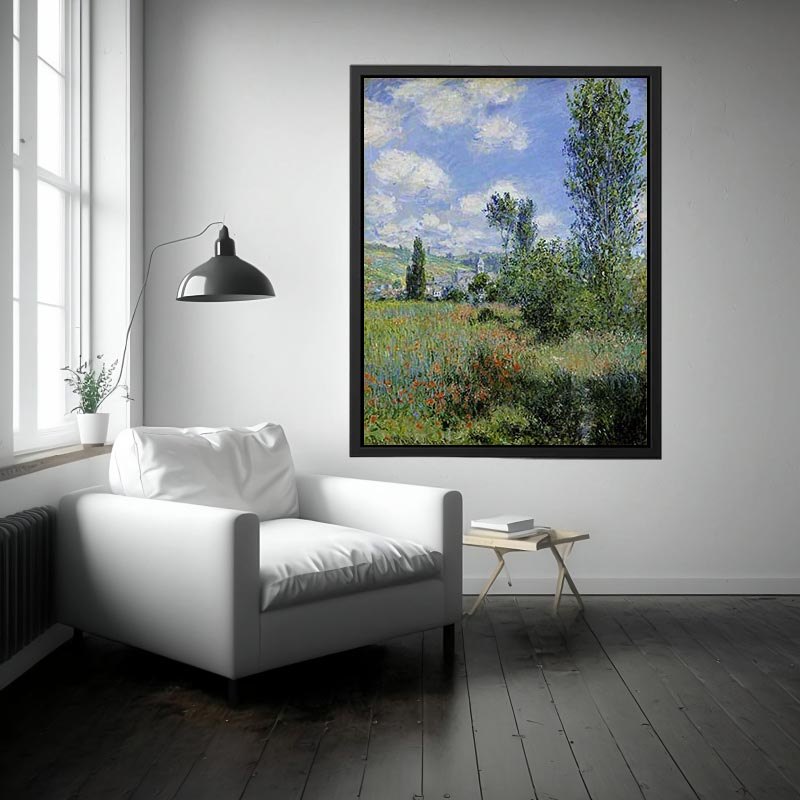
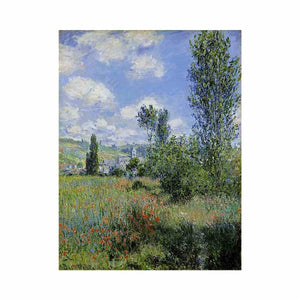
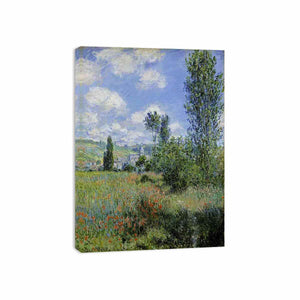
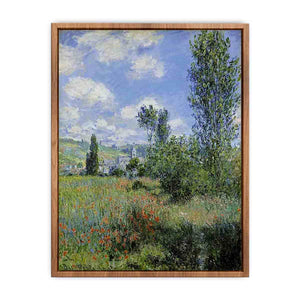
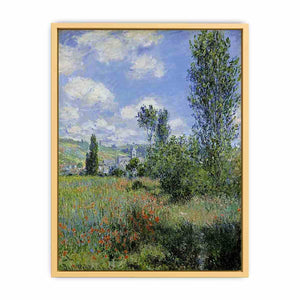
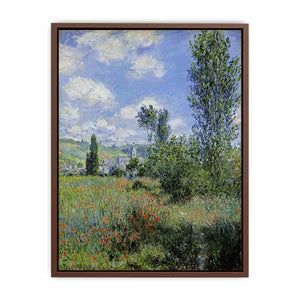
View of Vétheuil Painting by Claude Monet
View of Vétheuil Painting by Claude Monet is a sustained meditation on place, time, and lived experience, rendered through the language of light and atmosphere that Monet refined into one of the most consequential artistic visions of the modern era. Painted during the years when Vétheuil served as both refuge and hardship for the artist, the work transcends topographical description to become a record of perception shaped by continuity, memory, and daily observation. In this painting, the village is not a picturesque motif; it is an inhabited reality, seen repeatedly, patiently, and with increasing emotional depth.
Claude Monet settled in Vétheuil in the late 1870s, a period marked by financial difficulty and personal loss, yet also by artistic consolidation. The village on the Seine became a site of sustained engagement, where Monet could observe the slow transformations of landscape under shifting conditions of light and season. View of Vétheuil emerges from this immersion. It reflects not a single, dramatic moment, but the accumulated knowledge of looking—of returning to the same motif until it reveals its essential rhythms.
The subject presents the village of Vétheuil rising gently from the riverbank, its clustered houses and church integrated into the surrounding terrain. Architecture and landscape are inseparable. Buildings do not dominate the scene; they participate in it, softened by light and distance. The river, often present in Monet’s views of Vétheuil, functions as both foreground and connective tissue, reflecting sky and village alike, binding the composition into a unified visual field.
Compositionally, the painting is structured through horizontals and gentle vertical accents. The river establishes a broad horizontal plane, while the village ascends in measured steps, culminating in the vertical emphasis of the church. This structure provides stability without rigidity. Monet avoids dramatic diagonals or theatrical framing, opting instead for a balanced arrangement that mirrors the calm continuity of the place itself. The eye moves naturally across the canvas, guided by tonal shifts rather than imposed hierarchy.
Perspective is atmospheric rather than linear. Monet does not insist on precise architectural delineation or measured recession. Depth is created through modulation of color and value, allowing forms to recede softly into the surrounding air. Foreground, middle ground, and background remain distinct yet permeable, reinforcing the sense that the scene is unified by light rather than separated by distance.
Color is central to the painting’s expressive power. Monet employs a restrained yet luminous palette—cool blues, soft greens, muted ochres, and gentle greys—each hue adjusted to register light rather than local color. The village walls absorb and reflect surrounding tones, preventing them from appearing static or solid. Color here is relational; it exists in dialogue with neighboring hues, creating a surface alive with subtle vibration.
Light is the true subject of View of Vétheuil. It does not strike dramatically or isolate forms; it permeates the entire scene, dissolving edges and softening contours. Monet captures light as a condition rather than an event—diffused, enveloping, and continuous. Shadows are not dark interruptions but chromatic variations, reinforcing the painting’s unity and calm.
Monet’s brushwork is responsive and economical. Individual strokes remain visible, yet they cohere into a seamless whole. Water is suggested through horizontal movements, architecture through short, steady touches, foliage through clustered marks that imply texture without detail. This variety of touch reflects Monet’s sensitivity to the differing behaviors of surfaces under light, reinforcing the painting’s observational integrity.
Emotionally, View of Vétheuil conveys quiet endurance rather than idyllic serenity. There is calm, but it is earned rather than assumed. The village appears stable and grounded, yet not monumental. Monet’s vision acknowledges the weight of time—the sense that this place has persisted through countless days much like the one depicted. The mood is reflective, marked by acceptance and attentiveness rather than exuberance.
Psychologically, the painting can be read as a record of belonging shaped by necessity. Vétheuil was not chosen for its grandeur; it became significant through repetition and lived experience. Monet’s sustained engagement with the village suggests a form of attachment rooted in familiarity rather than romance. The painting communicates this through its lack of spectacle and its commitment to continuity.
Symbolically, the work resists overt metaphor. The village does not stand in for an abstract idea; it remains itself. Yet its repeated depiction across Monet’s oeuvre allows it to function as a symbol of duration—of time observed rather than conquered. In this sense, View of Vétheuil reflects Monet’s broader artistic project: to honor the present moment while acknowledging its passage.
Within Monet’s artistic evolution, this painting occupies an important position between early Impressionist experimentation and later serial investigation. Here, Monet demonstrates confidence in his ability to convey atmosphere without excess. He no longer needs to assert novelty; instead, he refines perception. View of Vétheuil shows an artist committed to depth through repetition, laying the groundwork for his later series devoted to singular motifs under changing conditions.
Culturally, the painting exemplifies Impressionism’s shift away from historical or mythological subject matter toward the lived landscape. Monet elevates an ordinary village into a subject of sustained artistic inquiry, asserting that meaning resides in attention rather than grandeur. This approach reshaped the hierarchy of subjects in Western art, granting everyday places enduring significance.
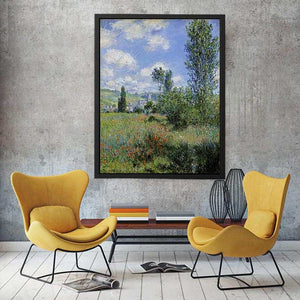
In contemporary interiors across the United States, the United Kingdom, Canada, Australia, and Europe, View of Vétheuil offers exceptional versatility. In living rooms, it introduces calm continuity and visual balance. In studies and offices, it supports focus and reflective thought. In galleries and luxury residences, it signals appreciation for Impressionism at its most thoughtful and restrained.
The painting integrates seamlessly into modern and minimalist interiors, where its tonal subtlety and horizontal structure complement architectural clarity. It also enriches traditional spaces, offering continuity through subject matter while maintaining modern sensitivity. In eclectic interiors, it functions as a stabilizing presence, harmonizing diverse elements through shared atmosphere.
The long-term artistic importance of View of Vétheuil lies in its affirmation that repeated looking can deepen meaning. Monet demonstrates that a place, observed patiently, can reveal infinite variation. The painting endures because it teaches a way of seeing—one grounded in attentiveness, humility, and respect for time.
Today, View of Vétheuil remains deeply resonant. In a world defined by speed and novelty, its quiet persistence feels restorative. Through measured composition, luminous color, and immersive light, Claude Monet created a painting that preserves not only a view, but a lived relationship between artist and place—enduring, attentive, and profoundly human.
Buy museum qulaity 400- 450 canvas prints, framed prints, and 100% oil paintings of View of Vétheuil by Claude Monet at Alpha Art Gallery, where world-famous masterpieces are recreated with museum-quality detail, refined craftsmanship, and premium materials.
FAQS
What does View of Vétheuil by Claude Monet depict?
It depicts the village of Vétheuil along the Seine, observed through light, atmosphere, and spatial harmony.
Why was Vétheuil important to Monet?
Vétheuil was a place of prolonged residence and observation, shaping Monet’s mature approach to landscape.
Is this painting a realistic view of the village?
It reflects perceptual truth rather than architectural precision, emphasizing atmosphere over detail.
What mood does the painting convey?
It conveys quiet reflection, continuity, and calm endurance.
Where does this artwork work best in interior spaces?
It suits living rooms, studies, offices, galleries, and refined residential interiors.
Is View of Vétheuil suitable for modern décor?
Yes, its tonal restraint and balanced composition integrate beautifully into modern and minimalist spaces.
Does the painting have lasting artistic significance?
It is valued as a mature Impressionist work that exemplifies Monet’s sustained engagement with place and light.
| 1. Select Type |
Canvas Print, Unframed Paper Print, Hand-Painted Oil Painting, Framed Paper Print |
|---|---|
| 2. Select Finish Option |
Rolled Canvas, Rolled- No Frame, Streched Canvas, Black Floating Frame, White Floating Frame, Brown Floating Frame, Black Frame with Matt, White Frame with Matt, Black Frame No Matt, White Frame No Matt, Streched, Natural Floating Frame, Champagne Floating Frame, Gold Floating Frame |
| 3. Select Size |
60cm X 90cm [24" x 36"], 76cm X 114cm [30" x 45"], 90cm X 120cm [36" x 48"], 100cm X 150cm [40" x 60"], 16.54 x 11.69"(A3), 23.39 x 16.54"(A2), 33.11 x 23.39"(A1), 46.81 x 31.11"(A0), 54" X 36", 50cm X 60cm [16" x 24"], 121cm X 182cm [48" x 72"], 135cm X 200cm [54" x 79"], 165cm x 205cm [65" x 81"], 183cm x 228cm [72" x 90"], 22cm X 30cm [9" x 12"], 30cm x 45Cm [12" x 18"], 45cm x60cm [16" x 24'], 75cm X 100cm [30" x 40"], 121cm x 193cm [48" x 76"], 45cm x 60cm [16" x 24'], 20cm x 25Cm [8" x 10"], 35cm x 50Cm [14" x 20"], 45cm x 60 cm [18" x 24"], 35cm x 53Cm [14" x 21"], 66cm X 101cm[26" x 40"], 76cm x 116cm [30"x 46"], 50cm X 60cm 16" x 24"] |