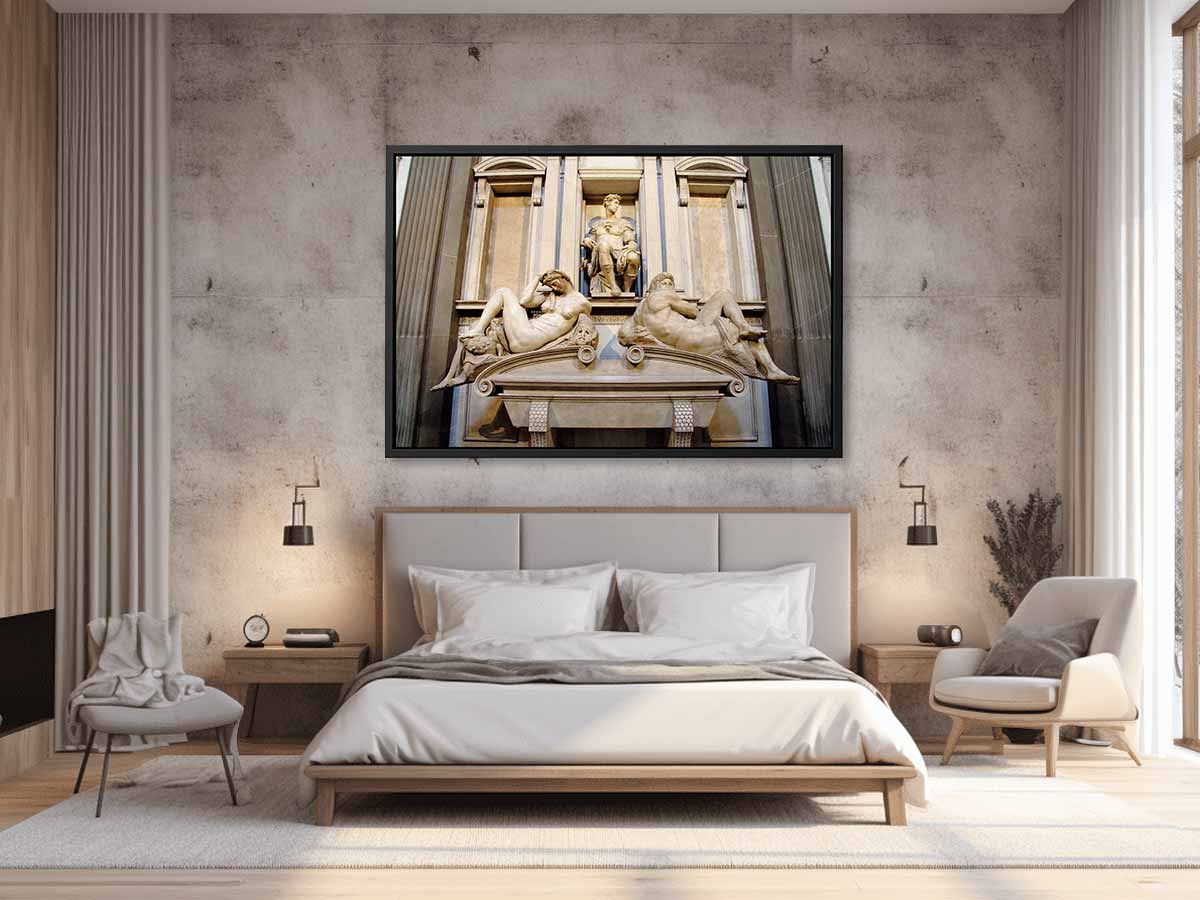
Tomb Monument of Giuliano di Lorenzo de' Medici, Ornamented with Night and Day Along with a Statue of Giuliano by Michelangelo Buonarroti is one of the defining sculptural ensembles of the Medici Chapels in Florence. Created as part of Michelangelo’s monumental funerary architecture for the Medici family, the composition combines the seated statue of Giuliano de’ Medici with the allegorical figures of Night and Day reclining above the sarcophagus. Alpha Art Gallery offers this celebrated Michelangelo artwork as a museum-quality canvas print, fine art print, framed print, or 100% hand-painted oil painting reproduction.
The original monument is not for sale. It remains an integral part of the Medici Chapels in Florence. Alpha Art Gallery reproductions are contemporary artworks inspired by Michelangelo’s Renaissance masterpieces.
About Michelangelo’s Tomb of Giuliano de’ Medici
The tomb monument of Giuliano de’ Medici forms part of the New Sacristy, also known as the Medici Chapel, designed by Michelangelo for the Medici family in Florence. The monument commemorates Giuliano de’ Medici, Duke of Nemours, and is positioned opposite the tomb of Lorenzo de’ Medici, Duke of Urbino.
Michelangelo designed the tomb as a unified architectural and sculptural composition. Giuliano appears seated within an architectural niche above the sarcophagus, while the allegorical figures of Night and Day recline on the curved lid beneath him.
The supplied catalog classifies the work as Michelangelo, Michelangelo Buonarroti, Renaissance - High, Mannerism, Renaissance Sculpture, Architecture, and Medici Chapels.
Who Was Giuliano de’ Medici?
Giuliano de’ Medici was a member of Florence’s powerful Medici family and the son of Lorenzo de’ Medici, known as Lorenzo the Magnificent. Michelangelo’s monument commemorates Giuliano in an idealized, commanding form rather than presenting a strictly naturalistic portrait.
The seated figure wears armor and holds a baton, attributes that contribute to the image of military and civic authority.
The Night and Day Sculptures
Two of the most famous elements of the monument are the allegorical figures of Night and Day. They recline on the curved sarcophagus beneath Giuliano’s seated figure, creating a striking contrast between the horizontal movement of the allegories and the vertical authority of the central statue.
Day is represented as a powerful male figure, while Night appears as a reclining female figure. Michelangelo gives both figures monumental physical presence, turning abstract concepts of time into extraordinary studies of the human body.
Time, Mortality, and the Medici Tombs
The Medici Chapel monuments are fundamentally funerary works, and the imagery of time is central to their meaning. Night and Day suggest the continuous passage of time surrounding the deceased ruler.
Within a funerary monument, personifications of Night and Day naturally evoke the cycle of existence and the inevitable movement of time.
Michelangelo’s Integration of Sculpture and Architecture
One of the greatest achievements of the Giuliano monument is the way sculpture and architecture are inseparable. Michelangelo designed the architectural environment so that the sculpture, sarcophagus, niches, pilasters, and surrounding surfaces form a unified composition.
The seated Giuliano is framed by the architecture, while Night and Day extend horizontally across the curved sarcophagus. Architectural lines establish a strong vertical structure, while the reclining figures introduce powerful diagonal and horizontal rhythms.
The New Sacristy and Medici Chapels
The New Sacristy was conceived by Michelangelo as a funerary chapel for members of the Medici family. It forms part of the larger Medici Chapels complex associated with the Basilica of San Lorenzo in Florence.
Michelangelo’s design creates an unusually concentrated environment in which architecture, sculpture, light, proportion, and symbolism interact.
High Renaissance and Mannerist Characteristics
The monument belongs to Michelangelo’s High Renaissance achievement while also anticipating important characteristics associated with Mannerism. The idealized anatomy, monumental scale, and classical vocabulary reflect Renaissance principles, while complex poses and unusual spatial relationships contribute to its later influence.
The Statue of Giuliano de’ Medici
The seated statue of Giuliano is one of the central visual elements of the monument. Michelangelo presents him as a commanding figure seated above the allegories, with a posture that conveys authority and composure.
The armor contributes to the military character of the representation, while the baton reinforces his status. The figure is idealized and monumental, designed to participate in the symbolic structure of the tomb.
Michelangelo’s Mastery of the Human Figure
The Medici tombs provide an exceptional demonstration of Michelangelo’s fascination with the human body. Night and Day are conceived on a monumental scale, with muscular anatomy and complex poses that reveal the artist’s sculptural understanding of the figure.
The bodies are not merely anatomical demonstrations. Michelangelo uses anatomy to communicate weight, tension, movement, and emotional presence.
Why the Giuliano Monument Is Important
The tomb of Giuliano de’ Medici is important because Michelangelo transformed a funerary commission into an integrated work of art combining architecture, sculpture, portraiture, allegory, and symbolism.
Night and Day introduce the theme of time, while Giuliano represents the deceased ruler in idealized monumental form. Architecture establishes order and hierarchy.
Where Is the Original Tomb Monument?
The original monument is located in the New Sacristy of the Medici Chapels in Florence, Italy. The Medici Chapels preserve Michelangelo’s celebrated funerary monuments.
Because the monument is permanently integrated into the chapel architecture, it is not a movable artwork available for private purchase. Alpha Art Gallery reproductions provide a way to display imagery inspired by this historic Michelangelo masterpiece in contemporary interiors.
Choosing a Reproduction Format
| Format |
Visual Character |
Ideal For |
| Canvas Print |
Strong wall presentation emphasizing architecture and sculptural forms |
Living rooms, studies, offices, galleries and statement walls |
| Fine Art Print |
Refined printed presentation focused on Michelangelo’s sculptural composition |
Collectors and Renaissance art displays |
| Framed Print |
Finished presentation with framing options where available |
Libraries, formal interiors, studies and gallery walls |
| Hand-Painted Oil Reproduction |
Individually painted interpretation with genuine brushwork and painted texture |
Collectors seeking handmade artwork |
Canvas Prints of Michelangelo’s Giuliano de’ Medici Tomb
A canvas print can provide a strong contemporary presentation of Michelangelo’s Medici Chapel monument. The architectural structure and large sculptural forms translate particularly well into a wall display.
Fine Art and Framed Prints
A fine art print offers a refined way to display the monument while preserving attention on Michelangelo’s sculptural and architectural composition. A framed print provides a more formal finished appearance.
Hand-Painted Oil Painting Reproduction
Alpha Art Gallery offers 100% hand-painted oil painting reproductions created individually by professional artists using oil on canvas. A painted interpretation can emphasize the contrast between the architectural setting, seated figure, and reclining allegories.
Collectors interested in this format can explore the broader selection of oil painting reproductions.
Where to Display the Giuliano de’ Medici Monument
The monumental and architectural character of this artwork makes it especially appropriate for libraries, studies, living rooms, home offices, reception areas, formal hallways, and gallery-style interiors.
Why Choose Alpha Art Gallery?
Alpha Art Gallery offers museum-quality canvas prints, fine art prints, framed prints, and 100% hand-painted oil painting reproductions. Multiple sizes and frame options are available where offered.
Hand-painted reproductions are individually created by professional artists using oil on canvas. Alpha Art Gallery also provides secure packaging, worldwide delivery, and free worldwide shipping on all orders, with production facilities in the USA, Australia, United Kingdom, and Canada.
Explore this artwork alongside other celebrated historic works through the gallery’s Famous Paintings collection.
Frequently Asked Questions
Who created the tomb monument of Giuliano de’ Medici?
The tomb monument was designed and sculpted by Michelangelo Buonarroti as part of the Medici Chapel project in Florence.
Who was Giuliano de’ Medici?
Giuliano de’ Medici was a member of the powerful Medici family of Florence and the son of Lorenzo de’ Medici.
What are Night and Day?
Night and Day are allegorical sculptures created by Michelangelo for the Giuliano de’ Medici tomb. They recline on the sarcophagus beneath the seated statue of Giuliano and evoke the passage of time.
Where is Michelangelo’s Giuliano de’ Medici tomb?
The original monument is in the New Sacristy of the Medici Chapels in Florence, Italy.
Can I buy this Michelangelo artwork as a canvas print?
Yes. Alpha Art Gallery offers the artwork as a museum-quality canvas print.
Is a hand-painted oil reproduction available?
Yes. Alpha Art Gallery offers 100% hand-painted oil painting reproductions created individually by professional artists using oil on canvas.
Is the Alpha Art Gallery reproduction the original Medici Chapel monument?
No. The original monument remains in Florence. Alpha Art Gallery offers contemporary reproductions intended for wall display.
Bring Michelangelo’s Giuliano de’ Medici Monument Into Your Space
Michelangelo’s Tomb Monument of Giuliano de’ Medici brings together Renaissance sculpture, architecture, portraiture, and allegory in a single extraordinary composition. The seated Giuliano presides over the reclining figures of Night and Day, creating a meditation on power, time, mortality, and memory. Choose canvas for strong architectural wall presence, fine art or framed print for a refined presentation, or a hand-painted oil reproduction when the physical qualities of individually painted artwork are especially important to you.