Throughgoing Line Painting by Wassily Kandinsky
Throughgoing Line stands as one of Wassily Kandinsky’s most intellectually distilled and pedagogically significant works, a painting in which abstraction is reduced to its structural essence without sacrificing emotional resonance. Created in 1923, during Kandinsky’s formative years at the Bauhaus, the work reflects a moment when his lifelong search for a universal visual language had entered a phase of exceptional clarity. In this painting, line is no longer a supporting element or expressive accent; it becomes the governing principle through which space, rhythm, and meaning are generated.
By the early 1920s, Kandinsky had already transformed modern art through his pioneering commitment to abstraction. His earlier works explored spiritual intensity through turbulent colour and organic movement. At the Bauhaus, however, his thinking evolved toward analysis, order, and communicable principles. Throughgoing Line emerges directly from this environment. It is not a retreat from feeling, but a refinement of it. Kandinsky sought to demonstrate that emotion and intellect could coexist within a disciplined visual system, and that abstraction could be both rigorous and alive.
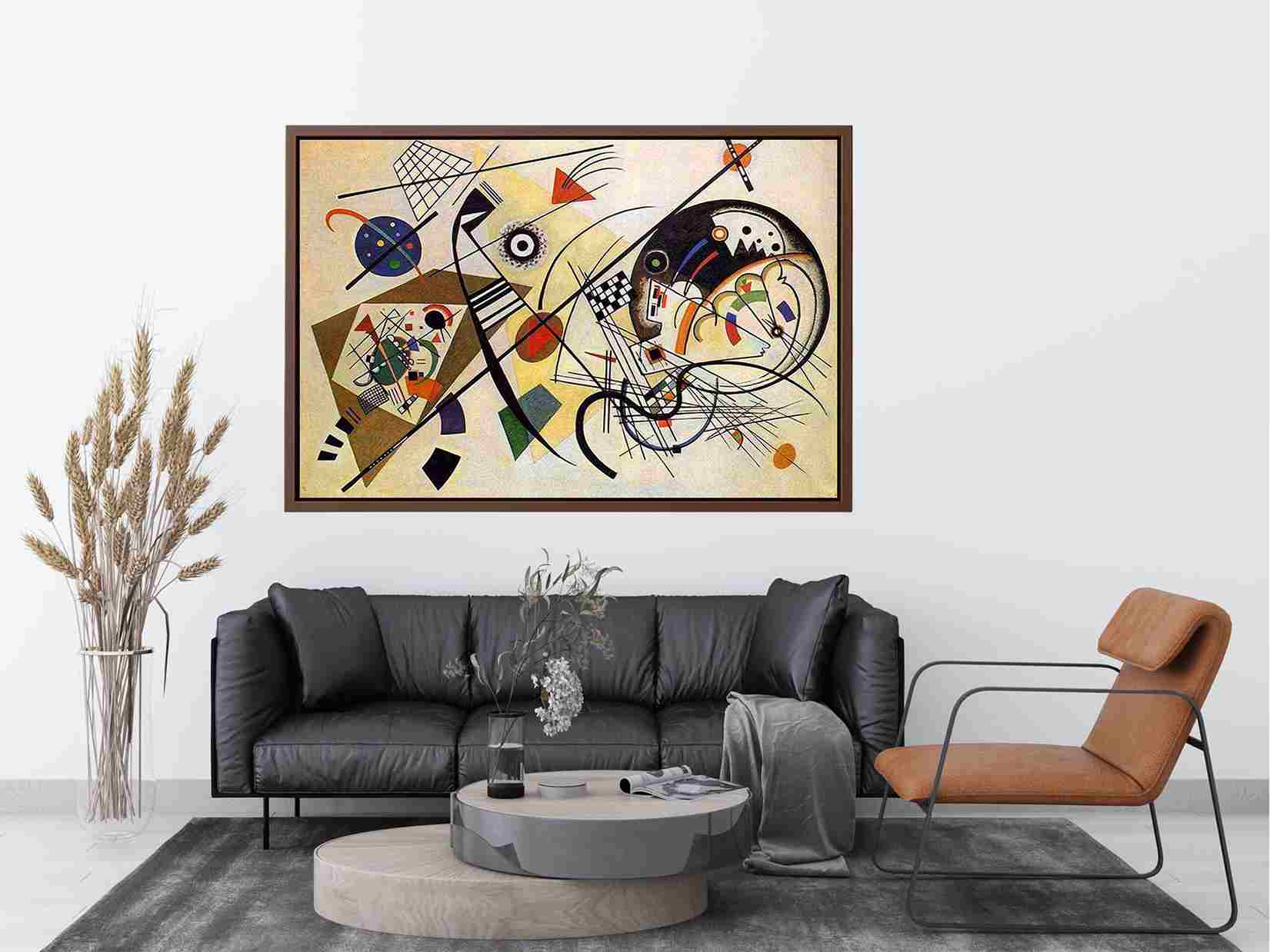
The composition is organised around the concept implied by the title itself: the continuous line that traverses the pictorial field, linking disparate elements into a unified whole. This line does not dominate through thickness or drama. Instead, it asserts itself through continuity, guiding the eye across the canvas and establishing coherence among shapes and colours that might otherwise remain isolated. Kandinsky understood the line as an active force, capable of carrying direction, tension, and duration. In Throughgoing Line, it functions as a connective intelligence rather than a boundary.
Geometric forms populate the composition with measured precision. Circles, angles, and linear segments are arranged in deliberate relationship, creating a sense of balance without symmetry. Kandinsky avoids centralisation. There is no single focal point demanding authority. Instead, the painting unfolds as a field of interactions, where each element gains meaning through its relation to the others. This decentralised structure reflects Kandinsky’s rejection of hierarchical composition in favour of relational thinking.
Colour is employed with restraint and purpose. Unlike the saturated intensity of his pre-war abstractions, Kandinsky here favours a controlled palette of blues, reds, yellows, blacks, and neutrals. Each colour is carefully calibrated in scale and placement, ensuring that chromatic contrast supports structural clarity. Blue recedes, creating calm depth; red introduces density and emphasis; yellow punctuates space with alert energy. Colour does not overwhelm the composition; it articulates it.
Light is not depicted as a natural phenomenon. There is no illusion of illumination or shadow. Instead, brightness and depth arise through contrast and juxtaposition. Kandinsky eliminates atmospheric effects to focus attention on perceptual relationships. Space is constructed conceptually rather than optically, emerging from the interaction of line, form, and colour. The viewer does not enter a depicted environment; they engage with a visual system.
The surface of Throughgoing Line is notably controlled. Brushwork is subdued, allowing forms to remain crisp and legible. Kandinsky deliberately avoids expressive texture that might distract from structural intent. This restraint underscores the painting’s pedagogical dimension. It is not meant to impress through painterly flourish, but to clarify principles. Yet this clarity never feels mechanical. The painting remains dynamic, its energy generated through rhythm rather than gesture.
Emotionally, Throughgoing Line is composed and alert. It does not overwhelm the viewer, nor does it recede into neutrality. Instead, it sustains a quiet tension, encouraging active looking and thoughtful engagement. The viewer becomes aware of movement across the surface, of pauses and accelerations guided by line. This temporal quality reflects Kandinsky’s long-standing comparison between painting and music, where meaning unfolds over time through structure and rhythm.
Symbolically, the painting resists fixed interpretation. Kandinsky rejected literal symbolism, believing that abstract relationships could communicate directly with the inner life. Yet the idea of the “throughgoing” line suggests continuity, connection, and coherence—values central to Kandinsky’s philosophy. The painting proposes that meaning arises not from isolated forms, but from their sustained interaction within an ordered whole.
Within Kandinsky’s artistic development, Throughgoing Line represents a mature synthesis of his spiritual aspirations and Bauhaus discipline. Earlier works explored abstraction through intuition and emotional force; later works refined geometry and order. Here, Kandinsky achieves balance. The painting demonstrates that abstraction can be analytical without becoming cold, and expressive without descending into chaos. It stands as a quiet affirmation of his belief that art could function as a universal language grounded in perception and structure.
The cultural importance of Throughgoing Line lies in its influence beyond painting. Its principles resonated with architects, designers, and educators associated with the Bauhaus, shaping modern visual culture across Europe and beyond. Today, viewers across the United States, the United Kingdom, Canada, Australia, and Europe continue to engage with its clarity and relevance. The painting feels contemporary because it addresses enduring questions about connection, order, and perception.
In interior spaces, Throughgoing Line introduces intellectual calm and visual coherence. In living rooms, it provides a focal point that rewards sustained looking rather than immediate consumption. In studies and offices, it reinforces values of clarity, continuity, and disciplined creativity. In galleries and luxury residences, it signals a refined engagement with one of the most thoughtful expressions of abstract art.
The painting integrates seamlessly into traditional, modern, minimalist, and eclectic décor. Traditional interiors benefit from its contrast, which energises classical surroundings. Modern and minimalist spaces resonate with its structural clarity and restrained palette. Eclectic environments find cohesion in its ordered relationships, which anchor diverse visual elements without competing for attention.
The enduring relevance of Throughgoing Line lies in its insistence that abstraction is not an escape from meaning, but a method for discovering it. Kandinsky demonstrates that connection itself can be a subject, and that continuity can generate depth. The painting remains meaningful because it teaches the viewer how to see relationships, not objects.
To live with Throughgoing Line is to engage daily with one of Kandinsky’s most lucid and instructive works. Through its disciplined composition, measured colour, and philosophical restraint, the painting continues to affirm abstraction as a language of thought and perception. It stands as a testament to Kandinsky’s conviction that art, at its highest level, reveals order not by imposing it, but by making it visible.
Buy museum qulaity 400- 450 canvas prints, framed prints, and 100% oil paintings of Throughgoing line by Wassily Kandinsky at Alpha Art Gallery, where world-famous masterpieces are recreated with museum-quality detail, refined craftsmanship, and premium materials.
FAQS
What is the central idea of Throughgoing Line?
The painting explores continuity and connection through line as a governing structural force in abstraction.
Why is line so important in this work?
Kandinsky viewed line as an active element capable of directing movement, rhythm, and meaning across the composition.
Is Throughgoing Line connected to Kandinsky’s Bauhaus period?
Yes. It reflects the analytical clarity and pedagogical focus that defined his Bauhaus years.
Does the painting represent anything from the real world?
No. Kandinsky intended it to communicate through abstract relationships rather than depiction.
How does colour function in Throughgoing Line?
Colour supports structure, creating balance and emphasis without overwhelming the composition.
Is this painting suitable for contemporary interiors?
Yes. Its clarity and restraint make it especially effective in modern, minimalist, and design-led spaces.
What emotional atmosphere does the painting create?
It conveys calm alertness and intellectual focus rather than dramatic intensity.
Does Throughgoing Line have lasting artistic significance?
As a key Bauhaus-era work, it holds enduring importance in the history of abstract art and visual theory.