The Polish Rider 1655 Painting by Rembrandt Van Rijn
The Polish Rider stands among the most hauntingly ambiguous and emotionally resonant works associated with Rembrandt Van Rijn, a painting that resists definitive interpretation while inviting profound reflection. Painted around 1655, during a period of inward concentration and artistic independence, the work occupies a liminal space between portrait, history painting, and moral allegory. It is neither a straightforward depiction of a known individual nor a clear narrative episode. Instead, it presents a solitary figure in motion, suspended between departure and arrival, certainty and doubt, presence and passage.
By the mid-1650s, Rembrandt’s career had entered a markedly different phase from the public triumphs of his earlier years. Financial difficulty, personal loss, and changing tastes had reduced his prominence in Amsterdam’s civic commissions, yet these pressures coincided with a deepening of artistic purpose. Freed from the demands of display and conformity, Rembrandt turned increasingly toward works that explored the inner condition of humanity. The Polish Rider emerges from this context as a painting of quiet intensity, shaped less by external expectation than by introspective inquiry.
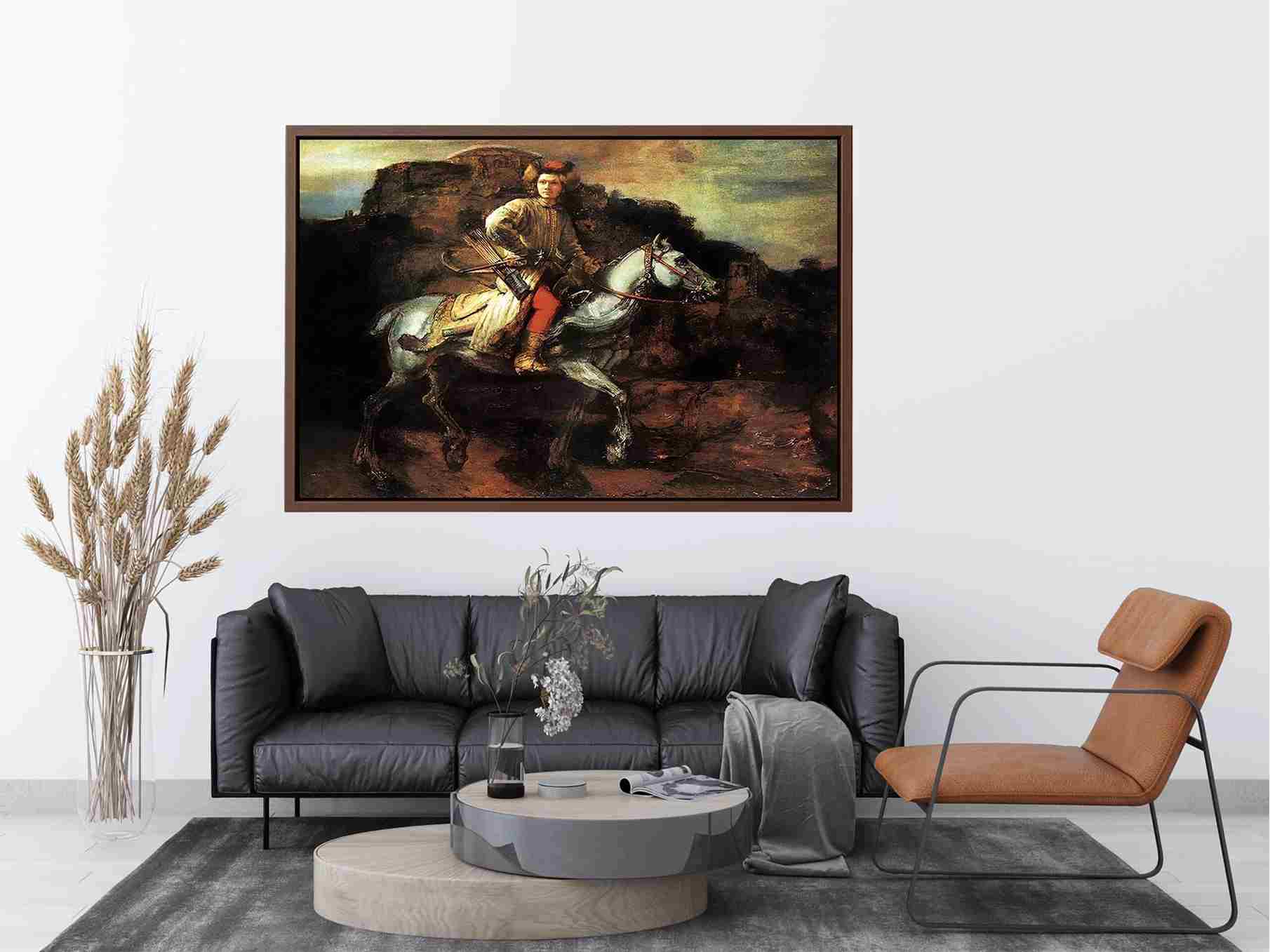
The figure rides through a shadowed landscape, mounted on a pale horse that advances with measured resolve. The rider’s youth is unmistakable, yet his expression is serious, inward, and unresolved. He is neither triumphant nor defeated. His posture suggests alertness rather than aggression, vigilance rather than bravado. This ambiguity is central to the painting’s enduring fascination. The rider is defined not by action completed, but by action underway, a life in motion rather than a destiny fulfilled.
Compositionally, the painting is spare yet deliberate. The rider occupies a central but not dominating position within the canvas. The surrounding landscape is rendered with restraint, offering suggestion rather than detail. A darkened sky and uneven terrain provide an atmosphere of uncertainty without overt threat. The horse moves forward steadily, anchoring the composition with calm physicality, while the rider’s upper body remains subtly detached, as though his thoughts extend beyond the visible path.
Light is handled with characteristic subtlety. Rembrandt does not dramatise the scene through sharp contrasts. Instead, illumination falls gently upon the rider’s face, hands, and garments, allowing form to emerge gradually from shadow. This soft chiaroscuro creates an emotional rather than theatrical tension. The light reveals presence while preserving mystery, reinforcing the sense that the rider’s inner life remains partially concealed.
Colour contributes significantly to the painting’s psychological tone. Muted earth tones, deep browns, soft greys, and subdued golds dominate the palette. There is no decorative excess, no chromatic display meant to assert status or spectacle. The colours serve to unify figure and landscape, binding the rider to his environment rather than elevating him above it. The effect is contemplative, grounded, and quietly grave.
Rembrandt’s brushwork here is notably free yet controlled. Surfaces are suggested rather than meticulously defined. The rider’s clothing, the horse’s musculature, and the surrounding terrain are rendered through layered strokes that retain the vitality of the painter’s hand. This tactile quality reinforces the painting’s sense of immediacy, as though the scene is unfolding before the viewer rather than preserved as a fixed moment.
Symbolically, The Polish Rider has long resisted singular explanation, and this resistance is central to its power. Some have interpreted the figure as a soldier, others as a messenger, a pilgrim, or a figure of moral resolve. Rather than confirming any one identity, the painting sustains openness. The rider becomes an archetype rather than an individual, a representation of youth confronted with uncertainty, responsibility, or transition. His journey appears less geographical than existential.
Emotionally, the painting is marked by restraint and introspection. There is no overt drama, no clear conflict depicted. Yet the mood is unmistakably serious. The rider’s gaze, turned slightly inward, suggests reflection rather than observation. He does not engage the viewer directly, nor does he fully withdraw. This balance creates a sense of quiet tension, inviting the viewer to consider what lies behind and ahead of him.
Within Rembrandt Van Rijn’s broader body of work, The Polish Rider aligns with his late explorations of moral presence and psychological depth. During this period, Rembrandt increasingly favoured ambiguity over clarity, suggestion over declaration. He trusted the viewer to engage actively with the painting, to find meaning through contemplation rather than instruction. This work exemplifies that trust, offering no answers, only presence.
The painting’s cultural resonance has endured precisely because of its openness. Viewers across centuries and cultures have found their own reflections within it. For audiences in the United States, the United Kingdom, Canada, Australia, and Europe, The Polish Rider continues to speak as an image of transition, responsibility, and inward resolve. It resonates in times of uncertainty because it does not deny doubt; it dignifies it.
In interior settings, The Polish Rider carries a contemplative authority. In living rooms, it introduces depth and seriousness without heaviness. In studies and offices, it encourages reflection, focus, and moral consideration. In galleries and luxury residences, it communicates refined engagement with art that values psychological and philosophical depth over display.
The painting integrates seamlessly into both traditional and modern interiors. In classical settings, its tonal restraint and historical gravity feel natural and grounded. In minimalist or contemporary spaces, its subdued palette and introspective presence create a powerful visual anchor, drawing attention inward rather than outward. Its presence transforms a space into one of thought and quiet resolve.
The enduring importance of The Polish Rider lies in its refusal to resolve itself into narrative certainty. It does not explain who the rider is, where he comes from, or where he is going. In doing so, it mirrors the human condition itself. Life, Rembrandt suggests, is lived in motion, under partial light, guided as much by inner resolve as by visible direction.
To live with The Polish Rider is to engage daily with one of Rembrandt Van Rijn’s most searching and quietly profound visions. It is a painting that does not command attention through spectacle, but earns it through presence. Through its restrained composition, luminous subtlety, and emotional depth, the work endures as a meditation on youth, responsibility, and the courage to move forward without certainty.
Buy museum qulaity 400- 450 canvas prints, framed prints, and 100% oil paintings of The Polish Rider 1655 by Rembrandt Van Rijn at Alpha Art Gallery, where world-famous masterpieces are recreated with museum-quality detail, refined craftsmanship, and premium materials.
FAQS
What is the central meaning of The Polish Rider?
The painting explores transition, responsibility, and inner resolve, presenting a figure defined by journey rather than destination.
Is The Polish Rider a portrait of a specific individual?
No definitive identity is known; it is widely understood as an archetypal figure rather than a named historical subject.
Why is the painting considered ambiguous?
Rembrandt avoids narrative clarity, allowing gesture, mood, and atmosphere to suggest meaning without explicit explanation.
How does light contribute to the painting’s impact?
Soft, selective illumination reveals presence while preserving mystery, reinforcing psychological depth rather than drama.
Is The Polish Rider suitable for modern interiors?
Yes. Its restrained palette and contemplative tone integrate powerfully into both modern and traditional spaces.
What emotional response does the painting evoke?
It encourages reflection, seriousness, and quiet introspection rather than immediate emotional release.
Does this artwork have lasting cultural value?
As one of Rembrandt’s most enigmatic and philosophically rich works, it holds enduring artistic and cultural significance.
Where is the best place to display this painting?
It is especially effective in studies, offices, living rooms, and gallery environments where contemplation and depth are valued.