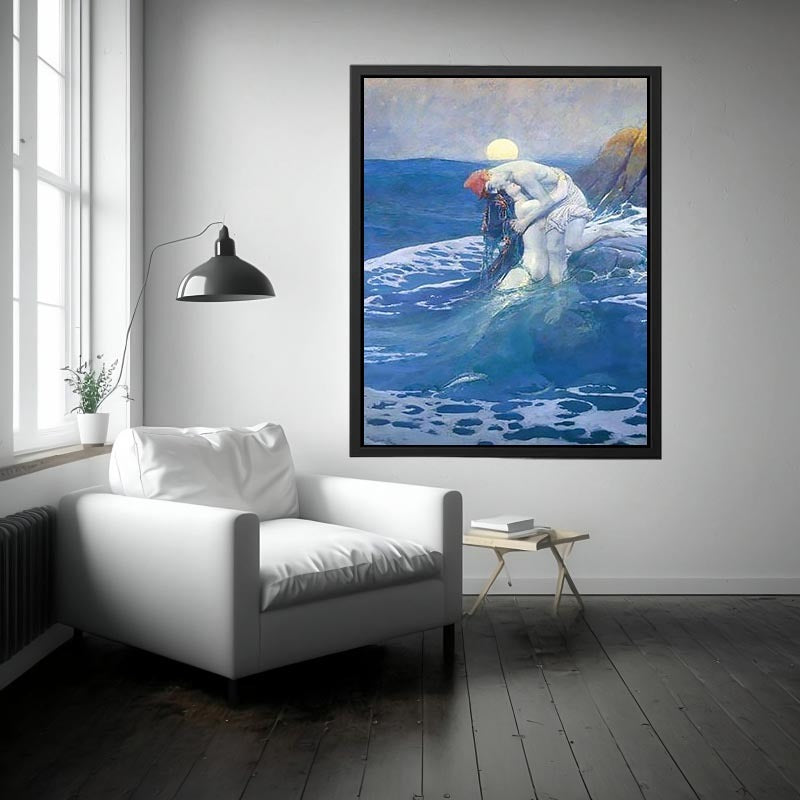
The Mermaid Painting by Howard Pyle
The Mermaid Painting by Howard Pyle is a work of rare psychological nuance and narrative restraint, presenting myth not as spectacle but as a quiet encounter between imagination, nature, and the human impulse to believe. Created by an artist best known for shaping the visual language of legend and storytelling in American art, this painting reveals Pyle at his most introspective. Rather than dramatizing the mermaid as an object of fantasy or seduction, he renders her as a presence—elusive, watchful, and deeply embedded within the rhythms of the natural world.
Howard Pyle occupies a foundational position in American visual culture, not only as a painter and illustrator but as a thinker who believed that images could educate the moral imagination. His approach to myth was never ornamental. He treated legendary subjects as vessels for psychological truth, ethical ambiguity, and narrative tension. The Mermaid reflects this philosophy with exceptional clarity. It does not resolve the mystery of its subject; it preserves it.
The composition is deliberately understated. The mermaid is not centrally enthroned nor theatrically revealed. Instead, she emerges partially from her environment, integrated into rock, water, and shadow. This choice denies the viewer a complete or comfortable view, reinforcing the idea that the mythical cannot be fully possessed by sight alone. Pyle composes the scene to feel discovered rather than presented, as though the viewer has stumbled upon a moment never meant to be witnessed.
The mermaid’s posture and expression are key to the painting’s psychological depth. She does not beckon, threaten, or perform. Her gaze is ambiguous—alert, curious, perhaps wary. This ambiguity is essential. Pyle refuses to define her role within a fixed narrative of danger or desire. Instead, she exists in a state of suspension, neither entirely benevolent nor hostile. The viewer is left to negotiate meaning through perception rather than instruction.
Environment plays a dominant role in shaping the painting’s mood. The sea is not depicted as an abstract backdrop but as a living presence, rendered with weight and movement. Water, rock, and sky interact through subtle tonal shifts, creating an atmosphere of isolation and quiet tension. The natural world does not frame the mermaid; it absorbs her. This integration suggests that the mythical arises organically from nature rather than standing apart from it.
Light is employed with exceptional subtlety. Illumination does not spotlight the figure or dramatize her form. Instead, light reveals selectively, allowing parts of the mermaid to emerge while others recede into shadow. This partial visibility reinforces the painting’s central theme: that myth exists at the edge of perception. Light here is not revelation, but suggestion.
Colour is restrained and purposeful. Pyle avoids bright or decorative hues, favoring muted blues, greens, and earthy tones that bind figure and setting into a unified emotional register. Flesh tones are subdued, avoiding idealization. The palette supports the painting’s contemplative tone, ensuring that attention remains on atmosphere and presence rather than visual excess.
Pyle’s brushwork is controlled yet expressive. Forms are defined clearly enough to anchor reality, yet softened at the edges to maintain ambiguity. This balance allows the painting to hover between realism and imagination. The mermaid feels physically present, yet never fully tangible. This tension is central to the work’s enduring power.
Symbolically, The Mermaid operates on several levels. On one level, it draws from maritime folklore in which mermaids embody the unknown—beauty entwined with danger, allure bound to loss. On a deeper level, the painting functions as a meditation on human longing for what lies beyond comprehension. The mermaid becomes a mirror for curiosity itself, representing the desire to encounter something other than the familiar, even at the cost of certainty.
Within Pyle’s artistic development, this painting reveals a quieter, more introspective dimension of his imagination. While he is often associated with scenes of action, adventure, and moral confrontation, The Mermaid demonstrates his capacity for restraint. Narrative here is implied rather than enacted. The drama lies not in movement, but in awareness—in the charged stillness between observer and observed.
Culturally, the painting holds lasting relevance because it resists simplification of myth. It neither romanticizes nor demystifies the mermaid. Instead, it preserves her ambiguity, allowing the image to evolve with each viewer’s interpretation. This openness ensures that the painting remains psychologically alive rather than historically fixed.
In contemporary interiors across the United States, the United Kingdom, Canada, Australia, and Europe, The Mermaid integrates with refined subtlety. In living rooms, it introduces quiet mystery and narrative depth. In studies or libraries, it complements spaces devoted to reflection, literature, and imagination. In galleries and curated residences, it communicates cultural discernment and appreciation for narrative art grounded in atmosphere rather than spectacle.
The painting adapts seamlessly to traditional interiors, where its mythic subject and subdued palette align with classical sensibilities. At the same time, it works powerfully in modern and minimalist spaces, where its restraint and psychological tension provide contrast without visual noise. In eclectic environments, it serves as a contemplative anchor, inviting sustained engagement.
The long-term artistic importance of The Mermaid lies in its affirmation that myth does not require exaggeration to endure. Pyle demonstrates that the most compelling visions often emerge through restraint, suggestion, and trust in the viewer’s imagination. The painting endures because it does not explain its mystery; it protects it.
Today, The Mermaid remains profoundly resonant. In an age saturated with explicit imagery and instant resolution, Pyle’s vision offers an alternative mode of seeing—one that values pause, uncertainty, and the quiet power of the unknown. Through psychological subtlety, atmospheric control, and narrative intelligence, Howard Pyle created a work that continues to speak across time, securing The Mermaid as a lasting meditation on myth, perception, and the boundaries of human understanding.
Buy museum qulaity 400- 450 canvas prints, framed prints, and 100% oil paintings of The Mermaid by Howard Pyle at Alpha Art Gallery, where world-famous masterpieces are recreated with museum-quality detail, refined craftsmanship, and premium materials.
FAQS
What is the central theme of The Mermaid by Howard Pyle?
The painting explores ambiguity, myth, and human curiosity, presenting the mermaid as a symbol of the unknown rather than a fixed narrative figure.
How does Pyle’s mermaid differ from traditional depictions?
She is portrayed with restraint and psychological depth, avoiding romanticized or overtly dramatic interpretation.
Is the painting meant to illustrate a specific story?
No, it suggests mythic encounter rather than depicting a defined literary episode, allowing open interpretation.
What role does the environment play in the painting?
The sea and surrounding landscape are integral, absorbing the figure and reinforcing mystery and isolation.
Where does this artwork work best in interior spaces?
It is ideal for living rooms, studies, libraries, galleries, and refined residential interiors.
Is The Mermaid suitable for modern décor?
Yes, its subdued palette and atmospheric restraint integrate seamlessly into modern, traditional, and minimalist spaces.
Does The Mermaid have lasting artistic value?
Its psychological nuance, narrative openness, and mastery of atmosphere ensure enduring relevance across generations.