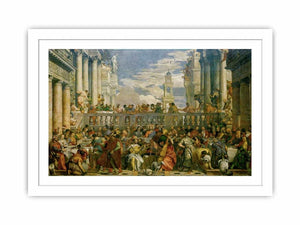
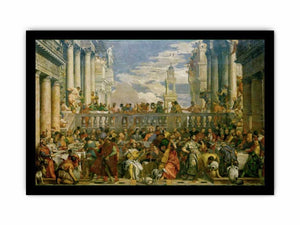
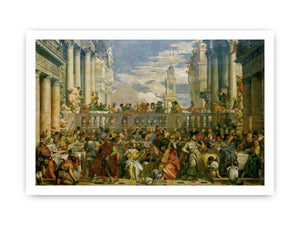
The Marriage Feast at Cana, c.1562 Painting by Paolo Veronese (Caliari)
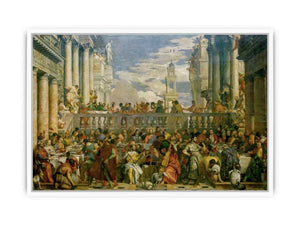
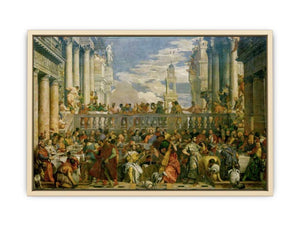
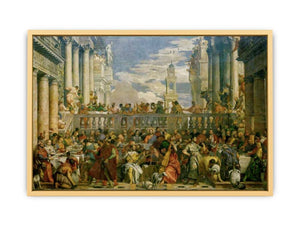
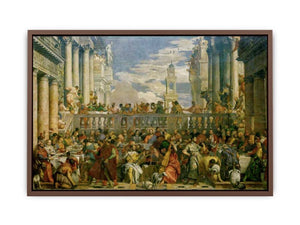
The Marriage Feast at Cana, c.1562 Painting by Paolo Veronese (Caliari) is one of the most opulent, intellectually ambitious, and visually commanding works of the Venetian Renaissance, a painting in which sacred narrative is transformed into a grand meditation on society, spectacle, and the theatrical possibilities of painting itself. Executed for the refectory of the Benedictine monastery of San Giorgio Maggiore in Venice, the work stands not merely as an illustration of Christ’s first miracle, but as a monumental synthesis of faith, power, ceremony, and human presence. Veronese does not isolate the divine from the world; he immerses it within the full complexity of contemporary life.
The artist responsible for this extraordinary vision, Paolo Veronese, was unrivaled in his ability to orchestrate scale, color, and architectural illusion into cohesive pictorial theatre. Trained in Verona and active in Venice, Veronese absorbed the city’s love of pageantry, light, and grandeur, translating these qualities into paintings that expanded the boundaries of religious art. In The Marriage Feast at Cana, his mastery reaches its zenith. The canvas does not ask for quiet devotion; it demands engagement, observation, and reflection.
The subject derives from the Gospel of John, recounting Christ’s miracle of turning water into wine at a wedding feast in Cana. Traditionally, this miracle symbolized divine grace and transformation. Veronese retains this theological foundation but radically expands its context. Rather than focusing narrowly on Christ and the miracle, he stages the event as a vast contemporary banquet attended by hundreds of figures—nobles, servants, musicians, foreigners, and dignitaries—each absorbed in their own activity. The sacred is present, but it does not dominate through isolation. It exists within the fabric of communal life.
Compositionally, the painting is astonishing in its scale and control. Veronese constructs the scene as a vast architectural stage framed by classical columns, arcades, and terraces that recede into luminous depth. This architecture does more than provide setting; it organizes the immense crowd into a legible, harmonious order. Horizontal bands of figures stretch across the canvas, anchored by the long banquet table at the center. Despite the density of activity, the composition never collapses into chaos. Every figure, gesture, and object participates in a carefully balanced visual rhythm.
Perspective is employed with extraordinary confidence. The architectural backdrop creates a sense of monumental depth, while the elevated viewpoint allows the viewer to survey the entire scene as if witnessing a grand civic spectacle. The painting functions almost like a public square, inviting the eye to wander freely among countless episodes unfolding simultaneously. There is no single narrative focus; meaning emerges through accumulation. Veronese trusts the viewer’s intelligence to navigate complexity.
Light is one of the painting’s most unifying forces. Bathed in clear Venetian daylight, the scene glows with an even, radiant illumination that reveals textures, fabrics, and architectural surfaces without dramatic contrast. Light here is celebratory rather than mystical. It affirms the visibility of the world rather than withdrawing into shadow. The miracle occurs not in darkness, but in full view—an act woven seamlessly into daily life.
The color palette exemplifies Venetian richness at its most refined. Veronese employs luminous blues, deep crimsons, soft whites, shimmering golds, and subtle flesh tones to create an orchestration of color that is both sumptuous and disciplined. Color is not merely decorative; it structures space, distinguishes social roles, and guides the viewer’s attention across the vast composition. The harmony of hues reinforces the painting’s sense of abundance and order.
Veronese’s technique is confident, fluid, and authoritative. Figures are rendered with clarity and elegance, their gestures expressive yet controlled. Drapery flows with sculptural precision, reflecting Veronese’s deep understanding of form and movement. Despite the immense scale of the work, the handling remains consistent throughout. No area is neglected, no figure reduced to mere filler. This uniformity of attention affirms the painting’s underlying humanism.
Symbolically, The Marriage Feast at Cana operates on multiple levels. At its core, it celebrates transformation—water into wine, ordinary gathering into sacred event. Yet Veronese extends this symbolism into the realm of culture and society. The diversity of figures suggests a world interconnected by trade, diplomacy, and ceremony. The presence of musicians—often identified as portraits of contemporary Venetian artists, including Veronese himself—introduces a self-reflective dimension. Art, like wine, becomes a medium of transformation and communion.
Psychologically, the painting is remarkable for its equilibrium. There is no tension, no visible anxiety, no dramatic revelation. Even Christ, seated calmly at the center, does not dominate through gesture or expression. His presence is defined by stillness rather than command. The miracle unfolds quietly, almost unnoticed by the surrounding guests. This restraint underscores Veronese’s vision of the divine as integrated rather than imposed—a grace that enters the world without disruption.
Within Veronese’s career, The Marriage Feast at Cana represents the fullest realization of his artistic philosophy. It exemplifies his belief that religious painting could be expansive, inclusive, and magnificently worldly without sacrificing spiritual depth. The work stands as a counterpoint to the austerity favored by other strands of Counter-Reformation art. Veronese asserts that beauty, abundance, and visual pleasure are not distractions from faith, but expressions of it.
Culturally, the painting occupies a pivotal place in the history of Western art. It redefined the scale and ambition of narrative painting, influencing generations of artists who recognized that complexity and grandeur could coexist with clarity. Its fusion of sacred story with contemporary life reflects Renaissance confidence in human culture as a legitimate arena for divine meaning. The painting does not retreat from the world. It embraces it.
In contemporary interiors across the United States, the United Kingdom, Canada, Australia, and Europe, The Marriage Feast at Cana functions as a statement of unparalleled cultural authority. In galleries and grand living spaces, it commands attention through scale and richness. In studies and formal rooms, it communicates intellectual sophistication, historical awareness, and visual confidence. Its architectural clarity and radiant palette allow it to integrate into traditional, modern, and eclectic interiors where grandeur and depth are desired.
The painting remains meaningful today because it addresses enduring questions about community, abundance, and transformation. In an age still negotiating the relationship between the sacred and the social, Veronese’s vision feels both historical and strikingly relevant. The Marriage Feast at Cana suggests that meaning does not require withdrawal from life, but deeper engagement with it.
The Marriage Feast at Cana, c.1562 Painting by Paolo Veronese (Caliari) endures as one of the most expansive achievements of Renaissance art. Through architectural mastery, chromatic brilliance, and philosophical confidence, Veronese transformed a biblical miracle into a timeless meditation on society, celebration, and divine presence within the human world. The painting does not isolate holiness. It stages it.
Buy museum qulaity 400- 450 canvas prints, framed prints, and 100% oil paintings of The Marriage Feast at Cana by Paolo Veronese at Alpha Art Gallery, where world-famous masterpieces are recreated with museum-quality detail, refined craftsmanship, and premium materials.
FAQs
What biblical event does The Marriage Feast at Cana depict?
It depicts Christ’s first miracle, turning water into wine at a wedding feast in Cana.
Why does the painting include so many figures?
Veronese expands the narrative to reflect communal life, abundance, and social complexity.
Why is the setting so grand and architectural?
The classical architecture elevates the event into a universal, timeless spectacle.
Where is Christ positioned in the composition?
Christ sits calmly at the center of the banquet table, defined by stillness rather than gesture.
What role does color play in the painting?
Color creates harmony, richness, and visual order while reinforcing Venetian artistic identity.
Is this painting more religious or secular in tone?
It unites both, presenting sacred meaning within a richly worldly context.
Why was this painting considered innovative?
It redefined religious painting through scale, inclusivity, and theatrical composition.
Where does this artwork work best in interiors?
It is ideal for galleries, grand living rooms, formal spaces, and interiors seeking cultural authority and visual splendor.