The Lac d’Annecy Painting by Paul Cézanne
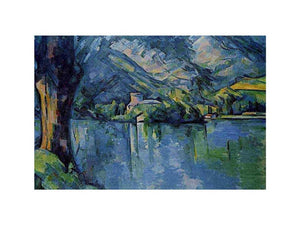
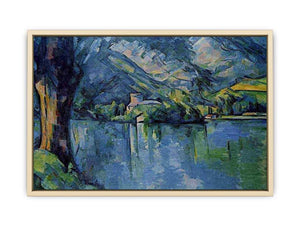
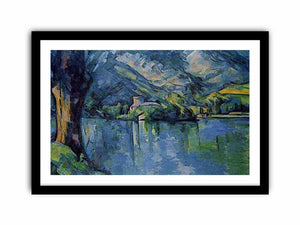
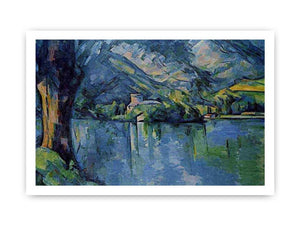
The Lac d’Annecy Painting by Paul Cézanne stands as one of the artist’s most lucid and quietly revolutionary landscapes, a work in which water, land, and atmosphere are reconfigured into a disciplined meditation on perception, structure, and permanence. Painted in the 1890s, during Cézanne’s mature period, the canvas does not present Lake Annecy as a picturesque destination or a lyrical retreat. Instead, it becomes a site of analytical vision, where nature is neither idealized nor fleeting, but carefully organized into a coherent and enduring pictorial reality.
The artist who redefined landscape through such works, Paul Cézanne, occupies a singular position in the history of modern art. Cézanne’s ambition was not to replicate what the eye sees momentarily, but to construct what the mind understands through sustained observation. Rejecting both academic illusionism and Impressionist transience, he sought a balance between sensation and structure. The Lac d’Annecy exemplifies this pursuit. The painting does not dramatize nature; it stabilizes it.
The subject is Lake Annecy in southeastern France, framed by hills, shoreline, and sky. Yet Cézanne resists the temptation to transform this setting into a scenic panorama. There is no emphasis on spectacle, tourism, or narrative incident. Instead, the lake functions as a compositional and perceptual field—a horizontal expanse that allows Cézanne to explore relationships between planes, color, and depth. The water does not reflect dramatically; it holds space, acting as a structural anchor within the composition.
Compositionally, the painting is governed by balance and restraint. Cézanne divides the canvas into broad horizontal zones—foreground land, middle ground water, distant hills, and sky—yet avoids rigid symmetry. Each zone presses gently against the next, creating a subtle tension that holds the composition together. The shoreline curves and recedes, guiding the eye without dictating movement. Nothing dominates; everything participates.
Perspective in The Lac d’Annecy is deliberately stabilized rather than dramatized. Depth is present, but it unfolds gradually, without theatrical recession. Cézanne allows spatial relationships to remain slightly compressed, keeping the viewer aware of the painting’s surface even as space is suggested. This refusal of deep illusion is essential to the work’s modernity. The landscape is not a window into another world; it is a constructed field of visual relationships.
Light is absorbed into color rather than treated as an external effect. Cézanne does not chase reflections or atmospheric sparkle across the water. Instead, illumination is embedded within tonal modulation. The lake’s surface is rendered through subtle shifts of blue and green, suggesting depth and stillness without optical drama. Light here serves permanence rather than moment, reinforcing the sense that the scene exists beyond a specific hour or season.
The color palette is restrained yet profoundly nuanced. Soft blues, muted greens, pale ochres, and gentle grays are laid down in carefully calibrated strokes. Color does not dissolve form, as in Impressionism; it constructs it. Each patch of color relates to those around it, building volume and stability through chromatic harmony. The lake’s cool tones are balanced by the warmer hues of land and hillside, creating equilibrium across the canvas.
Cézanne’s technique is deliberate and visible. Brushstrokes are firm, repetitive, and directional, reinforcing the underlying structure of the scene. There is no attempt to conceal the act of painting. On the contrary, the surface records Cézanne’s sustained engagement with the motif. This insistence on process is philosophical as well as technical. Cézanne believed that truth in painting emerged through methodical observation, not through illusionistic polish.
Symbolically, The Lac d’Annecy is understated but resonant. Water, often associated with reflection and change, is here rendered as solid and weighty. The lake does not shimmer or dissolve; it holds. This treatment suggests Cézanne’s broader aim: to grant stability to perception itself. The painting implies that nature, when truly seen, possesses an underlying order that transcends fleeting sensation. Meaning lies not in surface beauty, but in structural coherence.
Psychologically, the painting conveys calm, concentration, and intellectual poise. There is no human presence, no anecdotal detail to animate the scene. Yet the absence of figures does not create emptiness. Instead, it focuses attention on the act of seeing. Cézanne’s landscapes often feel contemplative rather than expressive, as though they are thinking rather than speaking. The Lac d’Annecy invites prolonged engagement rather than immediate response.
Within Cézanne’s broader oeuvre, this painting belongs to a group of late landscapes in which water and horizon become vehicles for spatial inquiry. Alongside his views of Mont Sainte-Victoire, these works would prove foundational for twentieth-century art. By flattening space while maintaining structure, Cézanne opened the path toward Cubism and abstraction. The lake in this painting is not only a subject; it is a testing ground for modern vision.
Culturally, The Lac d’Annecy reflects a shift in how nature was understood at the end of the nineteenth century. No longer a backdrop for myth or sentiment, landscape becomes a site of investigation. Cézanne’s approach mirrors a broader modern awareness that perception itself is constructed, provisional, and deeply human. The painting does not offer escape into nature; it offers engagement with how nature is known.
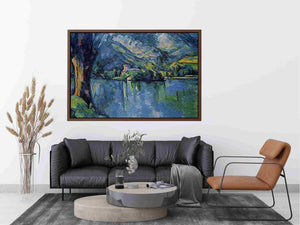
In contemporary interiors across the United States, the United Kingdom, Canada, Australia, and Europe, The Lac d’Annecy integrates with exceptional elegance and authority. In living rooms, it introduces calm expansiveness and visual balance. In studies and offices, it communicates discipline, clarity, and intellectual depth. In galleries and luxury residences, it anchors space with modernist gravity, harmonizing seamlessly with traditional, modern, minimalist, and eclectic décor through its restrained palette and structural clarity.
The painting remains meaningful today because it addresses a condition that has only intensified: the need to slow perception and recover coherence in a fragmented world. Cézanne’s lake does not demand attention through spectacle. It rewards attention through structure. The Lac d’Annecy teaches the viewer not what to see, but how to see.
The Lac d’Annecy Painting by Paul Cézanne endures as one of the most quietly authoritative landscapes in the history of modern art. Through disciplined composition, measured color, and philosophical restraint, Cézanne transformed a serene lake into a profound inquiry into perception and permanence. The water lies still, but the mind remains active.
Buy museum qulaity 400- 450 canvas prints, framed prints, and 100% oil paintings of The Lac d’Annecy by Paul Cézanne at Alpha Art Gallery, where world-famous masterpieces are recreated with museum-quality detail, refined craftsmanship, and premium materials.
FAQs
What does The Lac d’Annecy depict?
It depicts Lake Annecy in France, presented as a structured landscape rather than a scenic view.
Why does the painting feel calm and stable?
Cézanne uses balanced composition, restrained color, and controlled brushwork to emphasize permanence over momentary effect.
How does Cézanne treat water differently here?
The lake is rendered as solid and structural rather than reflective or decorative.
Is this painting connected to Impressionism?
It emerges from Impressionism but moves beyond it, prioritizing structure and coherence over fleeting light.
Why is there no human presence in the scene?
Cézanne removes figures to focus entirely on perception and the organization of nature.
What makes this painting important in art history?
It helped redefine landscape painting and influenced the development of Cubism and modern abstraction.
Why does the space feel both deep and flat?
Cézanne deliberately balances depth with surface awareness to highlight the act of seeing.
Where does this artwork work best in interiors?
It is ideal for living rooms, studies, offices, galleries, and spaces seeking calm, clarity, and modernist refinement.