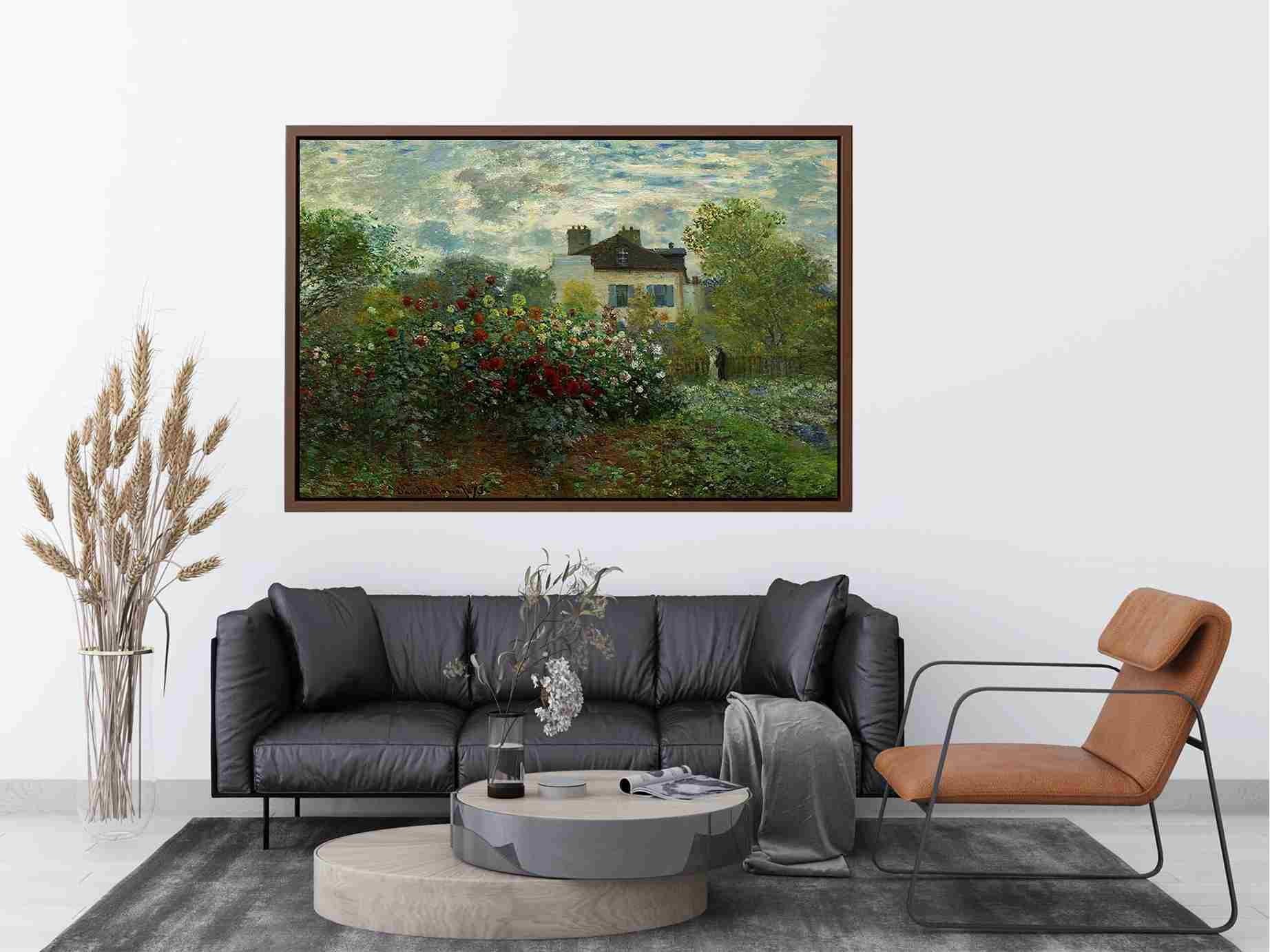
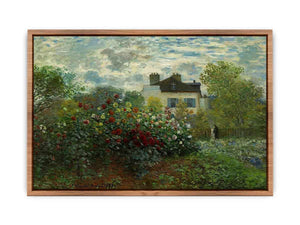
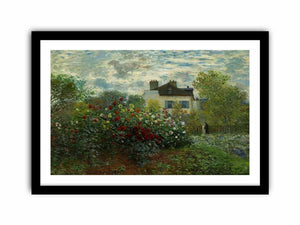
The Garden at Argenteuil Aka The Dahlias Painting by Claude Monet
The Garden at Argenteuil, also known as The Dahlias, stands as one of Claude Monet’s most quietly assured affirmations of modern life observed through colour, cultivation, and attentive perception. Painted in the early 1870s during Monet’s residence at Argenteuil, the work reflects a moment when the artist’s personal circumstances, artistic confidence, and environmental surroundings briefly aligned. In this painting, the garden is neither a decorative backdrop nor a symbolic retreat. It is a lived space—cultivated, inhabited, and observed with a clarity that transforms ordinary domestic life into a sustained visual experience.
Argenteuil occupied a pivotal place in Monet’s career. Located along the Seine, it offered proximity to Paris while retaining a suburban character shaped by gardens, leisure, and river activity. During these years, Monet was deeply engaged in redefining what constituted worthy subject matter for serious painting. Rejecting historical grandeur and academic hierarchy, he turned instead to scenes of contemporary existence: gardens, riverbanks, houses, and family life. The Garden at Argenteuil Aka The Dahlias emerges from this context as a painting that affirms the garden as a site of modern perception rather than inherited symbolism.
The composition is structured yet generous. A profusion of dahlias dominates the foreground, their rounded blooms forming dense clusters of colour that stretch across the canvas. Behind them, a garden path and fence establish spatial order without asserting dominance. Human presence is suggested through figures positioned quietly within the scene, integrated into the environment rather than set apart from it. Monet balances abundance with restraint, allowing the richness of the flowers to coexist with the calm geometry of cultivated space.
Perspective is carefully moderated. Monet does not employ dramatic recession or elevated vantage points. Instead, he situates the viewer at eye level within the garden, fostering a sense of participation rather than observation. Depth unfolds gradually through overlapping forms and tonal variation. The flowers advance toward the viewer while the background recedes gently, creating a sense of enclosure that remains open and breathable. The garden feels accessible, walked through rather than surveyed.
Light plays a central role in shaping the painting’s atmosphere. Sunlight falls evenly across the scene, clarifying colour without theatrical emphasis. There are no sharp shadows or dramatic contrasts. Instead, illumination is diffuse, allowing forms to remain distinct while preserving harmony. Light reveals rather than transforms, reinforcing the sense that this is a moment of ordinary brightness rather than extraordinary effect. Monet’s restraint here underscores his commitment to perception grounded in daily experience.
Colour is the painting’s most immediate and commanding presence. The dahlias provide a rich spectrum of reds, pinks, whites, and soft yellows, each hue modulated rather than applied in isolation. Monet resists decorative excess by allowing colours to relate to one another structurally. The surrounding greens—of leaves, grass, and hedges—anchor the composition, preventing chromatic saturation from becoming overwhelming. Colour operates relationally, establishing rhythm and balance across the surface.
Monet’s brushwork remains open and responsive. Individual strokes are visible, yet they cohere into unified forms rather than dissolving into abstraction. Flowers are suggested through clustered touches that convey volume without botanical precision. Leaves and stems are rendered with directional strokes that imply growth and density. The ground and path are described loosely, preserving texture without fixed outline. This handling maintains immediacy while sustaining compositional clarity.
Symbolically, The Garden at Argenteuil Aka The Dahlias resists allegorical reading. Its meaning arises from attention rather than metaphor. Yet the garden itself carries implicit significance as a space shaped by care, time, and repetition. Monet presents cultivated nature not as domination over the environment, but as collaboration with it. The dahlias are planted deliberately, yet their visual vitality exceeds control. Order and spontaneity coexist, reflecting Monet’s broader artistic pursuit of balance between structure and sensation.
Emotionally, the painting conveys calm abundance. There is no sense of urgency or spectacle. Instead, the scene unfolds with measured assurance, offering visual richness without agitation. Viewers often experience the work as welcoming and restorative, drawn into its colour and order without being overwhelmed. The presence of figures reinforces this tone, grounding the painting in lived domestic reality rather than idealised retreat.
Within Monet’s artistic evolution, this work represents a confident consolidation of Impressionist principles. Painted before his later turn toward serial studies and immersive surfaces, The Garden at Argenteuil Aka The Dahlias demonstrates how modern subject matter, visible brushwork, and colour-driven composition could coexist with recognisable space and human presence. It reflects an artist fully committed to painting contemporary life as it is perceived, without nostalgia or dramatization.
Culturally, the painting embodies a shift in how gardens were understood in nineteenth-century art. Rather than functioning as symbols of status or allegory, they became extensions of everyday life and sites of sensory engagement. Monet’s Argenteuil garden is not monumental; it is personal, temporal, and specific. In elevating such a space to serious artistic consideration, Monet contributed to a broader redefinition of artistic value in modern society.
In contemporary interiors, The Garden at Argenteuil Aka The Dahlias integrates with exceptional warmth and versatility. In living rooms, it introduces colour and vitality while maintaining compositional calm. In dining areas and shared spaces, it reinforces a sense of hospitality and openness. In studies and offices, it offers visual richness balanced by order, supporting focus rather than distraction. Across interiors in the United States, United Kingdom, Canada, Australia, and Europe, the painting complements traditional, modern, minimalist, and eclectic décor alike. Its floral abundance enlivens neutral spaces, while its structural clarity ensures long-term visual harmony.
The enduring relevance of The Garden at Argenteuil Aka The Dahlias lies in its affirmation of the everyday as a site of meaning. Monet demonstrates that attention, when sustained and disciplined, transforms ordinary environments into spaces of lasting resonance. The painting does not seek to astonish; it invites presence. By rendering a cultivated garden with honesty and sensitivity, Monet created an image that continues to resonate as a testament to modern life observed patiently, generously, and without pretension.
Buy museum qulaity 400- 450 canvas prints, framed prints, and 100% oil paintings of The Garden At Argenteuil Aka The Dahlias by Claude Monet at Alpha Art Gallery, where world-famous masterpieces are recreated with museum-quality detail, refined craftsmanship, and premium materials.
FAQS
What does The Garden at Argenteuil Aka The Dahlias by Claude Monet depict?
It depicts a flower-filled garden in Argenteuil, dominated by dahlias and structured paths, observed as a lived domestic space.
Why is Argenteuil important in Monet’s career?
It was where Monet developed key Impressionist ideas while engaging closely with modern suburban life.
What role do the dahlias play in the composition?
They provide chromatic richness and rhythmic structure, anchoring the foreground through colour rather than detail.
How does Monet use light in this painting?
Light is diffuse and even, clarifying colour and form without dramatic contrast.
Is this painting symbolic or observational?
It is primarily observational, with meaning arising from attentive depiction rather than allegory.
Does the painting include human presence?
Yes, figures are subtly integrated, reinforcing the garden as an inhabited, everyday environment.
Is The Garden at Argenteuil Aka The Dahlias suitable for contemporary interiors?
Yes, its balanced composition and floral vitality suit a wide range of modern and traditional spaces.
Why does The Garden at Argenteuil Aka The Dahlias remain relevant today?
Its celebration of everyday beauty, care, and perceptual attention continues to resonate in contemporary life.