The Card Players Painting by Paul Cézanne
The Card Players Painting by Paul Cézanne stands as one of the most quietly revolutionary works in the history of modern art, a painting in which simplicity of subject conceals a profound rethinking of form, perception, and human presence. Created during Cézanne’s mature period in the 1890s, this work reflects the culmination of decades of artistic inquiry into how reality might be structured on canvas without reliance on narrative drama or illusionistic flourish. In depicting a small group of Provençal peasants absorbed in a card game, Cézanne transforms an ordinary rural pastime into a timeless meditation on balance, concentration, and the architecture of human interaction.
Paul Cézanne lived and worked at a critical juncture in European art, bridging the gap between nineteenth-century realism and the radical innovations of the twentieth century. Though often associated with Impressionism due to his early friendships and shared interests, Cézanne ultimately pursued a different goal. He sought permanence rather than immediacy, structure rather than fleeting sensation. The Card Players emerges from this ambition. It is not concerned with anecdote or social commentary, but with the formal relationships that underpin visual experience itself.
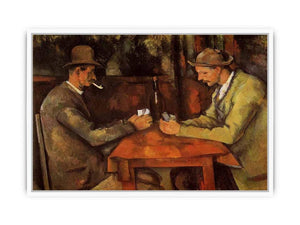
The scene is deceptively simple. Two men sit opposite one another at a small table, absorbed in a game of cards. Their bodies lean inward, their gazes fixed downward, their gestures restrained. There is no theatrical exchange, no overt emotion, no external distraction. Cézanne strips the moment to its essentials, allowing the painting to function as a study in equilibrium. Each figure occupies space with deliberate weight, creating a composition that feels stable, grounded, and self-contained.
Compositionally, the painting is a masterclass in balance. Cézanne organizes the scene through subtle geometric relationships rather than linear perspective. The table becomes a central axis, anchoring the composition, while the figures on either side counterbalance one another through mirrored posture and mass. Vertical elements, such as the men’s torsos and the background forms, reinforce stability, while horizontal planes create calm continuity. The result is a visual structure that feels inevitable, as though the figures belong exactly where they are.
Cézanne’s treatment of space is equally significant. Rather than constructing depth through traditional perspective, he builds it through overlapping planes of colour. Foreground and background are gently compressed, creating a shallow yet coherent spatial field. This flattening does not diminish realism; instead, it redefines it. Space becomes something felt rather than measured, experienced through the interaction of forms rather than optical illusion. In this way, The Card Players anticipates the formal concerns of Cubism while remaining firmly rooted in observation.
Colour plays a crucial role in shaping the painting’s mood and structure. Cézanne employs a restrained palette dominated by earthy browns, muted blues, soft ochres, and greys. These tones reflect the rural setting and the modest lives of the figures, yet they are chosen as much for their structural function as for descriptive accuracy. Cézanne uses colour to model form, allowing patches of pigment to define volume and solidity. Each colour note relates to the others, creating harmony without monotony.
Light in The Card Players is understated and even. There are no dramatic highlights or deep shadows. Instead, illumination seems to permeate the scene gently, reinforcing the painting’s sense of stillness and concentration. This refusal of theatrical lighting aligns with Cézanne’s broader rejection of spectacle. Light serves form, not emotion. It reveals the physical presence of the figures while preserving their inward focus.
Texture and brushwork further contribute to the painting’s distinctive character. Cézanne’s application of paint is deliberate and measured, with visible strokes that retain a tactile presence. These strokes do not dissolve into atmospheric softness, nor do they harden into rigid outlines. Instead, they build form gradually, stroke by stroke, reinforcing the idea that painting is a constructive act. The surface of the canvas remains active, reminding the viewer of the artist’s hand and the process of seeing.
Psychologically, the painting is remarkable for its restraint. The card players are not individualized through expressive faces or dramatic gestures. Their identities are secondary to their presence. Cézanne portrays them as absorbed, self-contained beings, united by a shared activity that requires concentration and patience. This inwardness lends the painting a meditative quality. The viewer becomes a silent witness to a moment of human focus unbroken by narrative intrusion.
Symbolically, The Card Players resists overt interpretation. Unlike earlier genre paintings, which often used card games as moral allegories, Cézanne avoids explicit symbolism. The game is neither vice nor virtue; it is simply an activity. Yet within this neutrality lies the painting’s philosophical depth. By removing moral judgment and anecdote, Cézanne allows the scene to function as a study of human presence in time and space. The act of playing cards becomes a metaphor for equilibrium, routine, and the quiet rituals that structure daily life.
Within Cézanne’s artistic evolution, The Card Players occupies a central position. It reflects his mature synthesis of observation and abstraction, where the visible world is reorganized according to underlying formal principles. This painting, along with others from the same series, exerted immense influence on later artists, particularly Pablo Picasso and Georges Braque, who recognized in Cézanne’s work a new way of seeing. Through its structural clarity and conceptual rigor, The Card Players helped lay the foundations of modern art.
Culturally, the painting represents a shift in how everyday subjects could be treated. Cézanne elevates ordinary rural figures without romanticizing or dramatizing them. Their dignity arises from presence rather than narrative importance. This approach resonates strongly in contemporary contexts, where authenticity and quiet depth are increasingly valued over spectacle.
In modern interiors across the United States, the United Kingdom, Canada, Australia, and Europe, The Card Players integrates seamlessly into a wide range of environments. In living rooms, it provides a grounding presence, introducing calm and intellectual weight. In studies or offices, it reinforces values of focus, patience, and thoughtful engagement. In galleries and curated spaces, it commands respect through its historical importance and formal mastery rather than visual excess.
The painting adapts naturally to traditional interiors, where its classical balance and subdued palette complement established design elements. At the same time, it works exceptionally well in modern and minimalist settings. Its clarity of form and absence of decorative distraction align with contemporary architectural sensibilities. In eclectic interiors, it functions as an anchor, providing visual stability amid diverse styles.
The long-term artistic importance of The Card Players lies in its quiet authority. It does not announce its significance through grandeur or drama. Instead, it reveals itself gradually, rewarding sustained attention. Cézanne’s achievement here is philosophical as much as visual: he demonstrates that painting can be an act of thought, a means of understanding reality through structure and relation.
Today, The Card Players remains profoundly relevant. In a world saturated with speed and distraction, its stillness offers a counterpoint. It invites viewers to slow down, to observe, and to consider the beauty of balance and restraint. Paul Cézanne’s vision endures not because it dazzles, but because it teaches us how to see.
Buy museum qulaity 400- 450 canvas prints, framed prints, and 100% oil paintings of The Card Players by Paul Cézanne at Alpha Art Gallery, where world-famous masterpieces are recreated with museum-quality detail, refined craftsmanship, and premium materials.
FAQS
What is the significance of The Card Players by Paul Cézanne?
The painting represents a pivotal moment in modern art, demonstrating Cézanne’s move toward structural clarity and away from narrative-driven realism.
Why did Cézanne choose such a simple subject?
He used ordinary subjects to explore deeper questions of form, balance, and perception, believing simplicity allowed greater artistic rigor.
Is The Card Players a social or moral commentary?
Unlike earlier genre scenes, Cézanne avoids moral judgment, presenting the card game as a neutral, contemplative human activity.
How does this painting influence modern art?
Its construction through planes of colour and form directly influenced Cubism and the development of twentieth-century abstraction.
Where does this painting work best in an interior setting?
It is especially suited to living rooms, studies, offices, and galleries where its calm authority and intellectual depth can be appreciated.
Does The Card Players hold long-term artistic value?
Yes, it is considered one of Cézanne’s most important works and a cornerstone of modern art history.
Why does the painting remain relevant today?
Its emphasis on stillness, focus, and balance resonates strongly in contemporary life, offering visual and intellectual refuge from excess.