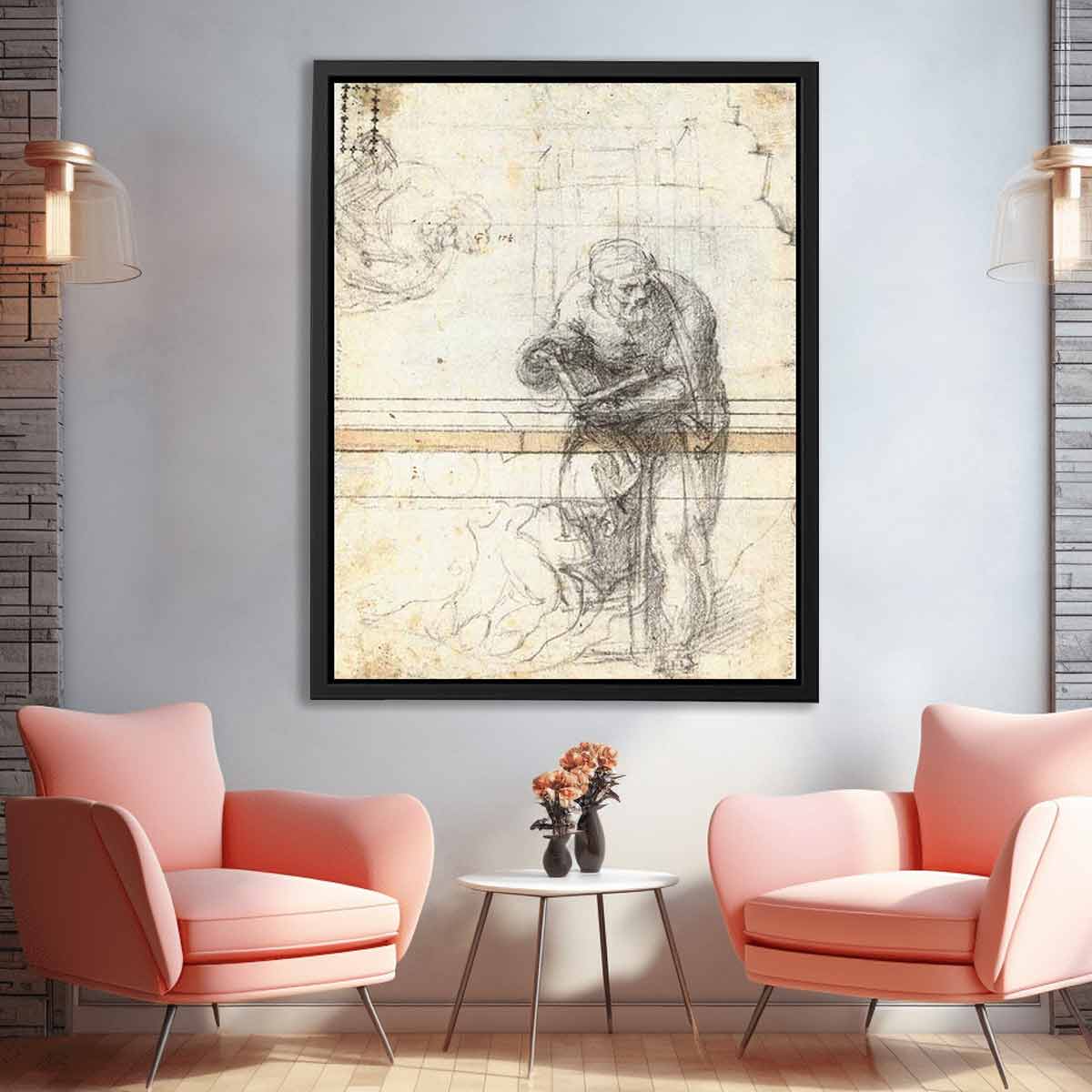
Study of a Prophet or Evangelist (verso), 1553–56 is a powerful Renaissance drawing by Michelangelo Buonarroti, created during the mature period of his career. The sheet presents a religious figure study connected with Michelangelo’s sustained interest in prophets, evangelists, sacred narratives, and the expressive possibilities of the human body.
About Study of a Prophet or Evangelist
Michelangelo’s drawings frequently served as laboratories for ideas about anatomy, gesture, movement, spiritual character, and composition. This verso study reflects that practice, concentrating attention on the figure rather than on a fully developed narrative setting.
The identification as a prophet or evangelist places the drawing within Michelangelo’s broader religious vocabulary. Such figures could embody revelation, faith, contemplation, and divine inspiration, allowing the artist to combine anatomical observation with spiritual expression.
Michelangelo’s Figure Studies
The human figure is central to Michelangelo’s artistic language. Through careful observation and repeated studies, he explored how posture, gesture, musculature, and movement could communicate personality and emotion.
In a study such as this, individual lines can reveal the stages of Michelangelo’s thinking. The drawing is valuable not only for its finished appearance but also for the evidence it provides of the artist’s working process.
Religious Meaning
Prophets and evangelists occupy an important place in Christian art because they are associated with divine revelation and the transmission of sacred truth. Michelangelo’s monumental religious figures often transform these subjects into psychologically compelling human presences.
The religious identity of the figure therefore works together with Michelangelo’s study of anatomy. Physical structure becomes a means of communicating spiritual authority, concentration, and inner life.
The Verso Study
The designation verso indicates that the image is drawn on the reverse side of a sheet. Renaissance artists frequently used both sides of paper, making individual sheets valuable records of multiple ideas and experiments.
This working practice is especially important for understanding Michelangelo. His surviving drawings reveal an artist constantly testing poses, proportions, gestures, and compositions before developing ideas further.
Renaissance and Mannerist Draftsmanship
The supplied artwork metadata identifies the work with both the High Renaissance and Mannerism. Michelangelo’s mature drawing style helped establish the expressive, complex, and highly sophisticated figure language associated with later sixteenth-century art.
The emphasis on the human body, expressive movement, and spiritual intensity makes this drawing a compelling example of Michelangelo’s continuing influence on Renaissance and Mannerist artists.
Wall Art and Reproduction
This Michelangelo drawing can be presented as sophisticated Renaissance wall art in a study, library, office, bedroom, gallery, or classical interior. Its monochromatic drawing character works especially well with neutral décor and collections focused on historic art.
Alpha Art Gallery offers reproduction formats including canvas prints, fine art prints, framed prints, and hand-painted oil reproductions. These reproductions are new artworks based on Michelangelo’s historic composition and are not the original museum artwork.
Frequently Asked Questions
Who created this drawing?
The work is attributed to Michelangelo Buonarroti.
What does the drawing depict?
It is identified as a Study of a Prophet or Evangelist, presenting a religious figure as a study of form, gesture, and expression.
What does verso mean?
Verso means the reverse side of a sheet of paper or drawing.
Where is the original?
The supplied metadata identifies the museum as Museum Not Identified, so no specific institutional location is claimed here.