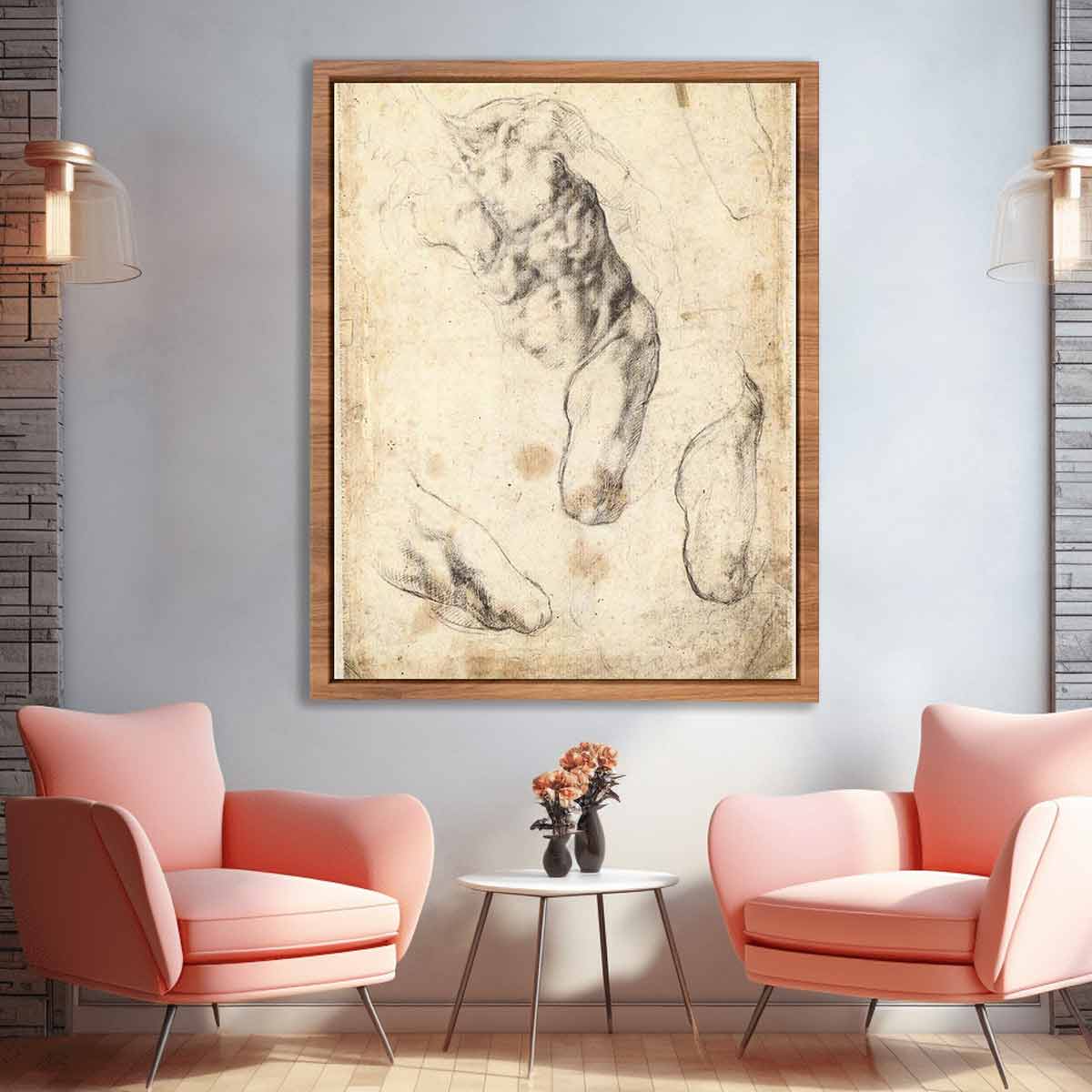
Studies of a Male Torso and Left Leg (verso), 1519–21 is an important anatomical study by Michelangelo Buonarroti. The sheet focuses on the male body, isolating the torso and left leg to investigate structure, proportion, musculature, balance, and movement.
About the Male Torso and Leg Studies
Michelangelo’s artistic practice depended heavily on drawing. Studies of individual body parts allowed him to understand how the human figure works as a three-dimensional structure.
The male torso is especially important in Michelangelo’s art because the chest, abdomen, shoulders, and hips provide the central framework for movement. The leg study extends this investigation into weight, balance, and muscular tension.
Michelangelo and Anatomy
Michelangelo’s reputation as a master of the human body is closely connected with his extraordinary anatomical knowledge. His drawings demonstrate a sustained interest in muscles, joints, proportions, and the mechanics of movement.
These studies were not simply scientific exercises. They were artistic investigations intended to help create more convincing and expressive figures in sculpture, painting, and drawing.
The Importance of the Torso
The torso is the core of the human figure. Its structure determines how the shoulders, arms, pelvis, and legs relate to one another. By studying it independently, Michelangelo could explore the complex relationship between stability and movement.
The study demonstrates the artist’s ability to make anatomical structure visually expressive. Muscles and contours become part of the composition rather than merely descriptive information.
The Left Leg
The leg study complements the torso by focusing on one of the principal mechanisms of human movement. The leg carries weight, establishes balance, and creates directional energy within a pose.
Michelangelo’s attention to the leg reflects his broader fascination with figures in complex positions. His later influence on Mannerist artists can be seen in the heightened importance of sophisticated body movement.
Verso Drawing
The designation verso means that the studies appear on the reverse side of a sheet. Renaissance artists often used paper efficiently, allowing multiple ideas and anatomical observations to coexist on a single sheet.
Such surviving drawings offer valuable evidence of Michelangelo’s creative process and demonstrate how extensively he explored the human figure before arriving at a final composition.
Wall Art and Reproduction
The anatomical character of this drawing makes it an excellent choice for studios, libraries, offices, architecture spaces, studies, and interiors inspired by Renaissance art.
Alpha Art Gallery offers canvas prints, fine art prints, framed prints, and hand-painted oil reproductions. Reproductions are new artworks based on the historic drawing and are not the original sheet.
Frequently Asked Questions
What does this drawing show?
It presents studies of a male torso and left leg.
When was it created?
The supplied title dates the work to approximately 1519–1521.
Why did Michelangelo study body parts separately?
Individual studies allowed him to investigate anatomy, proportion, movement, and the relationship of different parts within a complete figure.
Where is the original?
The supplied metadata identifies the museum as Museum Not Identified.