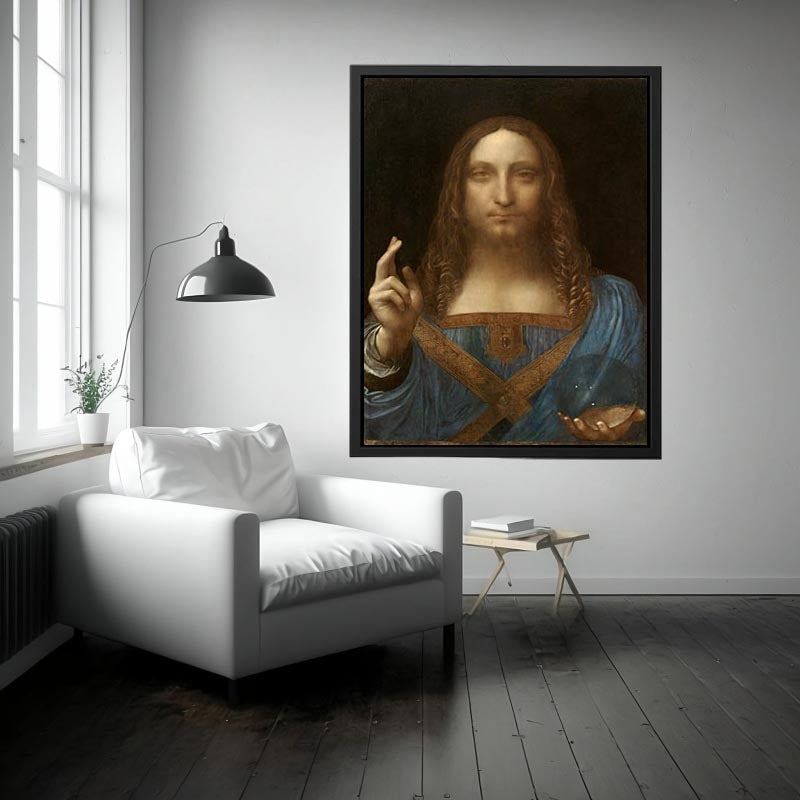
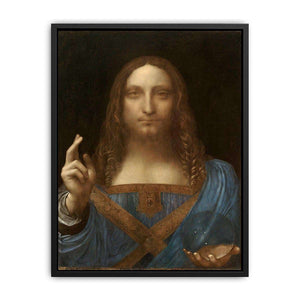
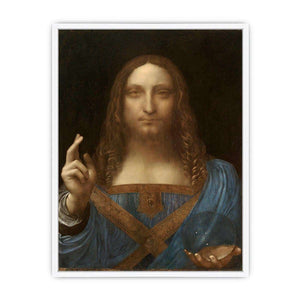
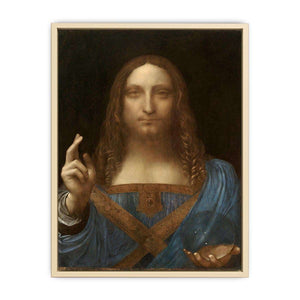
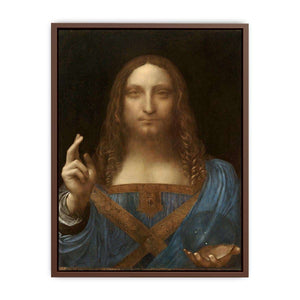
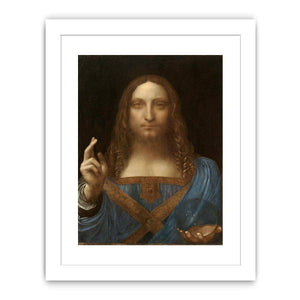
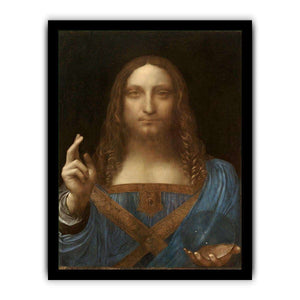
Salvator Mundi Painting by Leonardo da Vinci
Salvator Mundi by Leonardo da Vinci occupies one of the most extraordinary and contested positions in the history of Western art. Few paintings have provoked such sustained fascination, scholarly debate, and cultural reflection. At once serene and enigmatic, the image presents Christ as the saviour of the world, confronting the viewer with calm authority while embodying Leonardo’s lifelong pursuit of unity between science, spirituality, and human perception. The painting is not merely a devotional object; it is an intellectual construct in which theology, optics, anatomy, and psychology converge with unprecedented subtlety.
The historical background of Salvator Mundi is rooted in the late fifteenth and early sixteenth centuries, a period when Leonardo da Vinci stood at the height of his creative and intellectual powers. The image of Christ as Salvator Mundi had circulated widely in European art, particularly within Northern Renaissance traditions, where it often served as a symbol of divine kingship and universal order. Leonardo’s engagement with this subject transformed a familiar icon into something radically introspective. Rather than emphasising regalia or overt symbolism, he reduced the composition to essentials, allowing presence, gaze, and gesture to carry meaning.
Within Leonardo’s artistic life, Salvator Mundi reflects his mature philosophy of painting as a science of seeing. Leonardo believed that vision was humanity’s most noble sense, capable of revealing both physical reality and spiritual truth. This conviction is embedded throughout the painting. Christ’s frontal pose recalls Byzantine icons, yet the execution departs decisively from medieval rigidity. The figure breathes, thinks, and exists within a palpable atmospheric space. The painting thus becomes a bridge between the symbolic traditions of the past and the empirical humanism of the High Renaissance.
The artistic movement to which Salvator Mundi belongs cannot be reduced to a single category. It embodies the ideals of the High Renaissance—balance, harmony, and idealised form—while simultaneously anticipating later developments in psychological realism. Leonardo’s Christ is neither distant nor theatrical. He is composed, introspective, and profoundly human, inviting contemplation rather than awe. This balance between divinity and humanity lies at the heart of the painting’s enduring power.
Compositionally, the work is deceptively simple. Christ is presented frontally, occupying the central axis of the picture plane. This symmetry establishes authority and stability, reinforcing the concept of universal order. Yet subtle deviations prevent the composition from becoming static. The slight tilt of the head, the nuanced asymmetry of the features, and the gentle fall of curls introduce life and individuality. Leonardo’s mastery lies in these infinitesimal adjustments, through which stillness becomes presence rather than rigidity.
Perspective is handled with extraordinary restraint. There is no elaborate architectural setting or spatial recession. Instead, depth is created through atmospheric modulation and tonal gradation. The background dissolves into shadow, allowing the figure to emerge gradually rather than abruptly. This treatment aligns with Leonardo’s theory of sfumato, where forms are softened at their edges, mimicking the way the human eye perceives reality. The result is a figure that feels suspended between worlds, neither fully material nor purely symbolic.
Leonardo’s use of colour, light, and texture is central to the painting’s intellectual depth. The palette is restrained, dominated by deep blues, warm flesh tones, and subtle highlights. Light does not strike the figure dramatically; it caresses, revealing form through gradual transitions. The flesh appears translucent, animated by inner life rather than surface sheen. Texture is subdued, allowing the illusion of living matter to take precedence over painterly display. Every technical decision serves the painting’s contemplative purpose.
One of the most discussed elements of Salvator Mundi is the crystal orb held in Christ’s left hand. Traditionally symbolising dominion over the cosmos, the orb in Leonardo’s painting departs from convention. Rather than depicting the orb as a reflective or distorted object, Leonardo renders it with optical ambiguity. This choice has been interpreted as a deliberate engagement with contemporary theories of optics, suggesting that divine order transcends simple physical laws. The orb thus becomes a conceptual device, merging scientific inquiry with theological symbolism.
Symbolism throughout the painting is disciplined and restrained. Christ’s raised right hand offers a gesture of blessing, rendered with anatomical precision and expressive calm. The gesture is authoritative yet gentle, reinforcing Leonardo’s vision of power grounded in understanding rather than force. The direct gaze of Christ engages the viewer with quiet insistence, collapsing the distance between image and observer. This gaze is neither accusatory nor consoling; it is contemplative, inviting reflection rather than submission.
Emotionally, Salvator Mundi is characterised by profound stillness. There is no narrative drama, no visible suffering, no overt transcendence. Instead, the painting communicates serenity and introspection. This emotional restraint distinguishes it from more expressive religious imagery, aligning it with Leonardo’s belief that the highest form of art reveals truth through balance and clarity. The painting does not impose belief; it creates space for contemplation.
Culturally, Salvator Mundi has become one of the most discussed artworks in modern times, not only because of questions surrounding attribution and provenance, but because it encapsulates enduring questions about authorship, authenticity, and value. Beyond these debates, the painting’s deeper significance lies in its embodiment of Renaissance ideals: the reconciliation of faith and reason, observation and imagination, humanity and the divine.
The relevance of Salvator Mundi today extends far beyond religious context. In a contemporary world shaped by uncertainty and fragmentation, the painting’s emphasis on calm authority and inward reflection resonates powerfully. It offers an image of leadership defined not by dominance, but by comprehension. This philosophical dimension ensures that the painting remains meaningful across cultures and belief systems.
Within contemporary interiors across the United States, United Kingdom, Canada, Australia, and Europe, Salvator Mundi carries exceptional gravitas. In living rooms, it functions as a focal point of intellectual and spiritual reflection. In studies and offices, it reinforces an atmosphere of seriousness, contemplation, and cultivated taste. Galleries and luxury residences benefit from its iconic status and sustained visual engagement, as the painting reveals its complexity gradually over time.
Across interior styles, the artwork adapts with remarkable versatility. In minimalist spaces, its restrained palette and compositional clarity align naturally with simplicity and focus. Traditional interiors gain continuity through its Renaissance heritage and classical balance. Eclectic environments are anchored by its universal symbolism and intellectual depth. The painting does not dominate through scale or ornament; it commands through presence.
Ultimately, Salvator Mundi by Leonardo da Vinci stands as one of the most profound visual meditations on perception, authority, and transcendence ever created. Through unparalleled technical mastery and philosophical insight, Leonardo transformed a familiar religious image into a timeless exploration of seeing and being seen. Its enduring power lies not in spectacle, but in stillness—in the quiet conviction that truth, whether divine or human, is revealed through attentive observation and thoughtful restraint.
Buy museum qulaity 400- 450 canvas prints, framed prints, and 100% oil paintings of Salvator Mundi by Leonardo da Vinci at Alpha Art Gallery, where world-famous masterpieces are recreated with museum-quality detail, refined craftsmanship, and premium materials.
FAQS
What does Salvator Mundi mean?
The title means “Saviour of the World,” referring to Christ’s role as redeemer and spiritual authority.
Why is this painting considered so important?
It represents Leonardo da Vinci’s synthesis of art, science, and spirituality, making it one of the most intellectually significant works of the Renaissance.
What is the significance of the crystal orb?
The orb symbolises dominion over the cosmos and reflects Leonardo’s interest in optics and the nature of reality.
Is Salvator Mundi a traditional religious painting?
While rooted in Christian iconography, it is unusually introspective and humanised, focusing on perception and presence rather than narrative drama.
Does this artwork suit contemporary interiors?
Yes. Its calm composition and timeless symbolism integrate seamlessly into modern, traditional, and minimalist spaces.
Why does Christ gaze directly at the viewer?
The direct gaze establishes a contemplative relationship, inviting reflection rather than enforcing doctrine.
Is Salvator Mundi culturally relevant today?
Its themes of authority, perception, and inner calm resonate strongly in the modern world.
Where is the best place to display this artwork?
It is particularly effective in living rooms, studies, offices, galleries, and luxury residences where thoughtful engagement is valued.