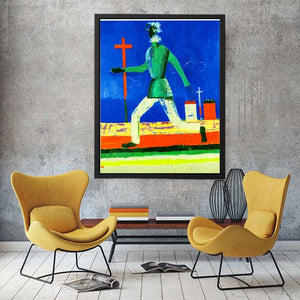
Running Man Painting by Kazimir Malevich
Running Man Painting by Kazimir Malevich is a concentrated exploration of motion, reduction, and the dissolution of the human figure within the language of modern abstraction. Created during the artist’s transition from representational forms toward radical non-objectivity, the work captures not a literal runner observed in space, but the idea of running itself—velocity, urgency, and directional force translated into shape and color. Malevich does not ask the viewer to recognize a body; he asks the viewer to experience movement as a conceptual and visual phenomenon.
Kazimir Malevich stands as one of the most influential figures of twentieth-century art, a painter-theorist who sought to free art from the burden of depiction. Running Man belongs to the crucial period when Malevich was dismantling the visible world in order to reconstruct it through pure form. While not yet fully detached from figuration, the painting reveals his determination to strip the human figure of anecdote, psychology, and individuality, leaving only structural energy behind.
The subject of Running Man is immediately legible yet deliberately unstable. Limbs are suggested rather than described, the body fractured into planes and directional elements that imply propulsion. The figure appears caught mid-stride, yet there is no ground, no horizon, no destination. Movement exists without context. Malevich transforms the act of running into an abstract condition, where forward momentum becomes the true subject and the human form merely its temporary vehicle.
Compositionally, the painting is governed by diagonals and intersecting planes. These lines generate tension and thrust, directing the viewer’s eye across the surface with urgency. Balance is not achieved through symmetry, but through counteracting forces. Each shape pushes against another, creating a visual rhythm that mirrors the physical mechanics of running. The composition feels compressed and dynamic, as if energy is being contained rather than released.
Perspective is intentionally disrupted. There is no consistent spatial logic, no stable vantage point. Malevich rejects traditional depth in favor of a flattened pictorial field where forms overlap without receding. This flattening does not diminish movement; it intensifies it. By collapsing space, Malevich forces all motion onto the surface itself, making the act of looking analogous to the act of running—continuous, directional, and unresolved.
Color is used as an active structural element rather than a descriptive one. Malevich employs bold, often contrasting hues to articulate force and separation between planes. Color does not model volume or suggest light; it defines energy. Each chromatic block functions as a unit of motion, contributing to the overall sense of acceleration. The palette is assertive yet disciplined, reinforcing the painting’s conceptual clarity.
Light, in the classical sense, is absent. There are no shadows, no highlights, no atmospheric effects. This absence is deliberate. Malevich removes light as a naturalizing device, refusing any illusion that the figure exists within a real environment. Instead, illumination is replaced by contrast. Visibility arises from juxtaposition rather than lighting, underscoring the painting’s intellectual rather than sensory orientation.
Malevich’s handling of form is precise and uncompromising. Shapes are sharply defined, edges firm, relationships exact. There is no decorative excess, no painterly indulgence. The surface is controlled, reflecting Malevich’s belief that art should be governed by reason as much as intuition. This discipline reinforces the painting’s sense of inevitability, as though the composition could exist in no other arrangement.
Emotionally, Running Man is not expressive in a personal or psychological sense. There is no visible strain, joy, or narrative urgency. Instead, the emotion arises from abstraction itself—from speed, imbalance, and forward thrust. The painting communicates intensity without sentiment, demonstrating Malevich’s conviction that feeling can emerge from form alone, independent of recognizable human expression.
Symbolically, the running figure can be read as an emblem of modernity—of progress, acceleration, and the dissolution of stable identity. Yet Malevich resists fixed allegory. The figure is neither hero nor worker, neither athlete nor allegorical messenger. It is simply motion embodied. This openness allows the painting to transcend its historical moment and remain relevant across shifting cultural contexts.
Within Malevich’s artistic evolution, Running Man occupies a critical threshold. It reveals the final stages of his engagement with the figure before the emergence of Suprematism, where all representational reference would be abandoned. In this sense, the painting documents a moment of conceptual courage: the willingness to let go of the human body as an anchor for meaning. Running Man is not an end point, but a necessary rupture.
Culturally, the painting reflects the radical ambitions of the early twentieth-century avant-garde. Artists across Europe were questioning how art could respond to speed, mechanization, and social transformation. Malevich’s response was not to depict machines or crowds, but to abstract the sensation of movement itself. Running Man participates in this broader redefinition of visual language, contributing to the foundations of modern abstraction.
In contemporary interiors across the United States, the United Kingdom, Canada, Australia, and Europe, Running Man integrates with striking authority. In living rooms, it introduces intellectual rigor and dynamic energy. In studies and offices, it reflects forward thinking, innovation, and conceptual clarity. In galleries and luxury residences, it signals engagement with the origins of abstract art and its philosophical ambitions.
The painting functions exceptionally well in modern and minimalist interiors, where its sharp geometry and assertive composition resonate with contemporary architectural lines. It also creates compelling contrast in traditional settings, asserting modern thought through disciplined form. In eclectic spaces, it acts as a kinetic focal point, anchoring diverse elements through shared intensity.
The long-term artistic importance of Running Man lies in its demonstration that movement itself can be a subject independent of narrative or environment. Malevich shows that art can abandon imitation without abandoning meaning. The painting endures because it captures a fundamental human experience—motion—while liberating it from literal depiction.
Today, Running Man remains powerfully relevant. In a world defined by speed, transition, and constant forward motion, its abstraction feels uncannily contemporary. Through rigorous composition, structural color, and conceptual clarity, Kazimir Malevich created a painting that continues to articulate the tension between body and idea, presence and direction, humanity and abstraction.
Buy museum qulaity 400- 450 canvas prints, framed prints, and 100% oil paintings of Running Man by Kazimir Malevich at Alpha Art Gallery, where world-famous masterpieces are recreated with museum-quality detail, refined craftsmanship, and premium materials.
FAQS
What does Running Man by Kazimir Malevich represent?
It represents motion and forward energy rather than a literal runner, translating movement into abstract form.
Is Running Man an abstract or figurative painting?
It exists between figuration and abstraction, marking Malevich’s transition toward non-objective art.
Why does the painting lack a background or setting?
Malevich removed environmental context to focus entirely on movement and structure.
How does color function in this work?
Color acts as a structural and energetic element rather than a descriptive one.
Where does this artwork work best in interior spaces?
It suits modern living rooms, studies, offices, galleries, and architecturally focused interiors.
Is Running Man suitable for minimalist décor?
Yes, its geometric clarity and conceptual strength integrate exceptionally well with minimalist spaces.
Does this painting have lasting artistic importance?
It is significant as a transitional work leading toward Suprematism and modern abstraction.