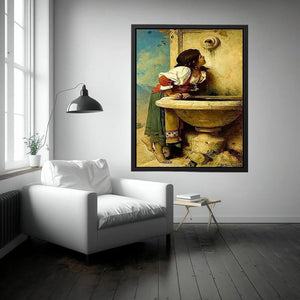
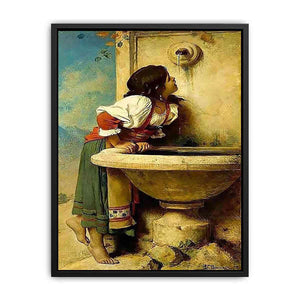
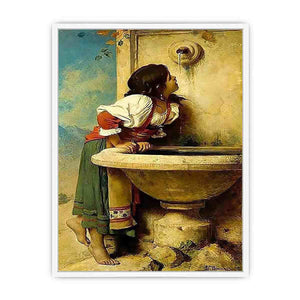
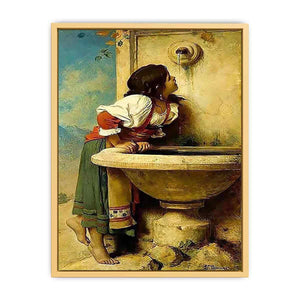
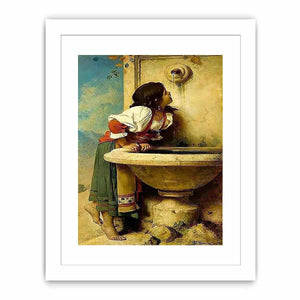
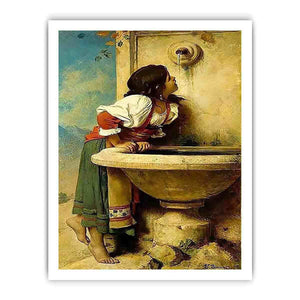
Roman Girl at a Fountain Painting by Léon-Bonnat
Roman Girl at a Fountain stands as one of Léon-Bonnat’s most quietly commanding genre paintings, a work in which realism, dignity, and psychological presence are fused with remarkable restraint. Rather than approaching Roman life through spectacle, idealisation, or archaeological fantasy, Bonnat focuses on an ordinary moment elevated by seriousness of observation. The painting is neither anecdotal nor sentimental. It presents a young woman engaged in a simple, timeless act, rendered with the same gravity and truth that Bonnat reserved for history, religion, and portraiture. In doing so, he affirms the human figure itself as worthy of sustained, respectful attention.
Léon-Bonnat was renowned for his uncompromising realism and intellectual discipline. Whether painting statesmen, biblical figures, or everyday subjects, he rejected decorative softness in favour of weight, structure, and psychological clarity. Roman Girl at a Fountain exemplifies this approach. The painting does not attempt to charm through prettiness or nostalgia. Instead, it confronts the viewer with presence—physical, moral, and emotional—rooted in lived experience rather than idealised femininity.
The subject is deceptively modest. A young Roman woman stands at a fountain, performing a task that has been repeated for centuries. Bonnat does not dramatise the act or imbue it with symbolic excess. Water, stone, and body exist in functional relationship. Yet within this simplicity, the painting achieves considerable depth. The fountain becomes a point of stillness, a place where labour pauses and awareness concentrates. Bonnat transforms routine into contemplation.
The composition is tightly organised and balanced. The figure occupies the pictorial space with grounded authority, neither pushed into the background nor isolated as a decorative motif. Bonnat positions her in close proximity to the viewer, establishing immediacy without intrusion. The verticality of the figure is echoed by the architectural solidity of the fountain, reinforcing stability and endurance. There is no unnecessary movement within the frame. Everything is held in equilibrium.
Perspective reinforces the painting’s realism and ethical tone. Bonnat places the viewer at eye level, eliminating hierarchy between observer and subject. This choice is crucial. The young woman is not elevated as an icon, nor diminished as a genre stereotype. She stands as an equal presence, absorbed in her task and unconcerned with being seen. The painting thus resists voyeurism, replacing it with recognition.
Light is employed with Bonnat’s characteristic discipline. Illumination is natural, even, and unsentimental. It clarifies form without theatrical contrast, revealing the density of the body, the texture of fabric, and the cool solidity of stone. Light does not romanticise the scene. It reveals, affirms, and stabilises. Through this restraint, Bonnat aligns visual truth with moral seriousness.
Colour is sober and controlled. Earth tones dominate the palette—muted browns, softened whites, restrained flesh tones—binding figure and environment into a single material reality. There is no chromatic indulgence. Colour functions structurally, guiding the eye and reinforcing weight rather than decoration. The harmony of tones contributes to the painting’s sense of permanence and quiet resolve.
Bonnat’s handling of anatomy is precise and unflinching. The body is rendered with realism rather than idealisation. Musculature, posture, and weight are observed with honesty, conveying strength born of routine rather than spectacle. This realism situates the subject firmly within the physical demands of daily life. The young woman is neither fragile nor ornamental. She is capable, present, and grounded.
Texture plays an important role in articulating material truth. Stone is heavy and worn, water implied through controlled highlights rather than animation, fabric treated with weight and familiarity. Bonnat’s brushwork remains disciplined and purposeful, avoiding flourish. Technique serves truth, ensuring that nothing distracts from the figure’s presence or the painting’s psychological gravity.
Emotionally, Roman Girl at a Fountain is restrained and dignified. The young woman’s expression is calm, serious, and inward. There is no overt narrative, no suggestion of joy or hardship exaggerated for effect. Instead, Bonnat captures a state of quiet self-possession. The painting conveys endurance without hardship, labour without complaint, presence without performance. This emotional sobriety is central to its power.
Symbolically, the painting resists overt interpretation. The fountain may suggest continuity, necessity, or sustenance, but Bonnat does not impose meaning. The work’s symbolism lies in its refusal to symbolise excessively. By presenting an ordinary act with extraordinary seriousness, Bonnat elevates daily life itself as a subject of moral and artistic value. The painting affirms that dignity does not require narrative significance.
Within Bonnat’s broader oeuvre, Roman Girl at a Fountain demonstrates his ability to apply the gravity of history painting to contemporary life. While he was celebrated for monumental and religious works, this painting reveals his conviction that truth and importance reside equally in the everyday. It confirms his belief that realism, when practiced with discipline, can carry profound ethical weight.
The painting’s relevance today remains strong across the United States, the United Kingdom, Canada, Australia, and Europe. Contemporary viewers respond to its seriousness, its refusal to sentimentalise labour or femininity, and its affirmation of quiet strength. In a modern world saturated with imagery designed to entertain or idealise, Bonnat’s painting offers a model of attention grounded in respect and restraint.
In interior settings, Roman Girl at a Fountain introduces calm authority and contemplative depth. In living rooms, it becomes a focal point of grounded presence. In studies and offices, it reinforces values of discipline, focus, and dignity. In galleries and luxury residences, it signals engagement with nineteenth-century realism at its most rigorous and humane.
The painting integrates seamlessly into traditional, modern, minimalist, and eclectic décor. Traditional interiors resonate with its classical seriousness and technical discipline. Modern spaces benefit from its compositional clarity and emotional restraint. Minimalist environments amplify its stillness and strength, while eclectic interiors draw cohesion from its sober palette and human focus.
The enduring importance of Roman Girl at a Fountain lies in its affirmation of ordinary life as worthy of reverence. Bonnat presents no heroism, no drama, no spectacle. Instead, he offers presence—quiet, enduring, and truthful. The painting endures because it recognises that the foundations of human dignity are laid not in extraordinary moments, but in the steady repetition of daily acts carried out with seriousness and resolve.
To live with Roman Girl at a Fountain is to engage daily with a work that rewards attentiveness. Through its disciplined realism, psychological depth, and moral restraint, the painting continues to affirm Léon-Bonnat’s position as one of the most intellectually rigorous painters of the nineteenth century. It stands as a testament to his belief that art, when grounded in truth and respect, can reveal the profound within the ordinary.
Buy museum qulaity 400- 450 canvas prints, framed prints, and 100% oil paintings of Roman Girl at a Fountain by Léon-Bonnat at Alpha Art Gallery, where world-famous masterpieces are recreated with museum-quality detail, refined craftsmanship, and premium materials.
FAQS
What is the subject of Roman Girl at a Fountain?
It depicts a young Roman woman engaged in the everyday act of drawing water, presented with seriousness and restraint.
Is this painting idealised or realistic?
It is firmly realistic, emphasising physical presence, weight, and psychological dignity over idealisation.
Why did Léon-Bonnat choose an ordinary subject?
He believed that truth, dignity, and moral weight reside as much in daily life as in grand historical narratives.
What emotional tone does the painting convey?
It conveys calm, seriousness, and quiet self-possession rather than sentiment or drama.
How does Bonnat use light in this work?
He uses controlled, natural light to clarify form and texture without theatrical contrast.
Is Roman Girl at a Fountain suitable for contemporary interiors?
Yes. Its sober palette and compositional clarity integrate seamlessly into modern and traditional spaces.
Does this artwork have lasting artistic importance?
As a strong example of nineteenth-century realist painting, it holds enduring cultural and aesthetic significance.
Where is the best place to display Roman Girl at a Fountain?
It is especially well suited to living rooms, studies, offices, galleries, and spaces that value calm, dignity, and reflection.