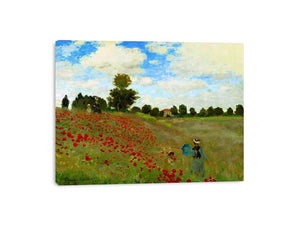
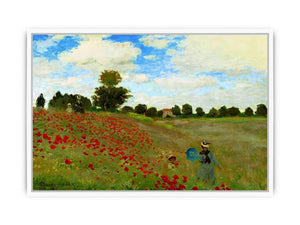
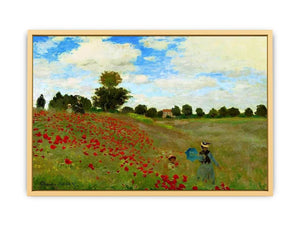
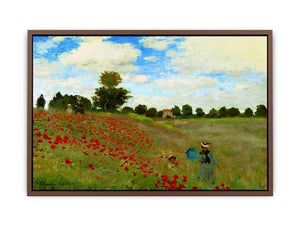
Poppies at Argenteuil Painting by Claude Monet
Poppies at Argenteuil stands as one of Claude Monet’s most lyrical and quietly radical affirmations of modern life, a painting in which landscape, leisure, and perception merge into a unified experience of light and colour. Painted in 1873, during Monet’s productive years in the suburban town of Argenteuil, the work embodies the central ambitions of Impressionism at a moment when the movement was still defining itself against academic convention. Rather than presenting a finished, idealised vision of nature, Monet offers an encounter—immediate, provisional, and grounded in lived experience.
Argenteuil was crucial to Monet’s artistic development. Situated along the Seine, it represented a new kind of environment: neither rural countryside nor dense city, but a modern suburb shaped by railways, leisure culture, and domestic life. Monet found in this setting a subject aligned with his belief that contemporary existence, in its ordinary moments, was worthy of serious artistic attention. Poppies at Argenteuil emerges from this conviction. The field of flowers is not a symbolic pastoral retreat; it is a familiar landscape encountered on a walk, animated by light, movement, and human presence.
The composition is structured yet open. A gently sloping field fills the canvas, punctuated by vibrant red poppies that scatter across the green ground like rhythmic accents. Two figures—widely understood to be Monet’s wife Camille and their son—appear twice within the scene, once in the foreground and again further up the hill. This repetition does not suggest narrative progression so much as visual continuity. The figures become part of the landscape’s rhythm, their movement echoing the undulating terrain and guiding the viewer’s eye diagonally across the painting.
Perspective is informal and experiential. Monet avoids rigid linear construction, allowing depth to unfold naturally through scale, placement, and colour intensity. The foreground poppies appear larger and more saturated, while those further away diminish subtly in size and contrast. The horizon remains high, compressing the space and reinforcing the sense of immersion. The viewer does not stand outside the scene; they inhabit it, sharing the same visual field as the figures within it.
Light plays a defining role in shaping the painting’s atmosphere. Sunlight spreads evenly across the field, illuminating flowers, grass, and figures without dramatic emphasis. There are no theatrical shadows or strong contrasts. Instead, light operates as a unifying condition, binding colour and form into a single perceptual experience. Monet captures the sensation of a bright day not through intensity, but through clarity and openness. Everything appears visible, yet nothing is fixed.
Colour is the painting’s most immediately striking feature. The red poppies assert themselves boldly against the surrounding greens, yet they are never decorative for their own sake. Monet modulates these reds carefully, allowing them to vary in tone and intensity according to light and distance. The greens themselves are richly varied, ranging from cool bluish notes to warmer yellow-inflected hues. The sky, pale and expansive, provides chromatic relief, balancing the density of the field below. Colour here functions relationally, establishing rhythm and harmony rather than hierarchy.
Monet’s brushwork is loose, confident, and visibly present. Individual strokes remain legible, particularly in the rendering of grass and flowers, where short, broken touches suggest movement and growth rather than precise form. Figures are painted with economy, their presence indicated through colour and gesture rather than detail. This openness preserves the immediacy of perception, aligning the surface of the painting with the act of seeing itself. The work feels alive because it resists closure.
Symbolically, Poppies at Argenteuil resists traditional pastoral allegory. While fields of flowers had long appeared in European art as symbols of fertility or transience, Monet does not emphasise such meanings. Instead, the poppies function as visual events—bursts of colour that animate the field and structure perception. The painting’s significance lies not in what the flowers represent, but in how they are seen within a specific moment and place.
Emotionally, the painting conveys lightness without sentimentality. There is a sense of ease and movement, yet also attentiveness. The figures do not pose; they walk. The landscape does not overwhelm; it unfolds. Viewers often experience the work as quietly uplifting, not because it depicts happiness explicitly, but because it captures harmony between human presence and natural environment. The scene feels balanced, unforced, and open to continuation beyond the frame.
Within Monet’s career, Poppies at Argenteuil represents a confident articulation of Impressionist principles at an early stage. It demonstrates his commitment to painting outdoors, to visible brushwork, and to modern subject matter rooted in everyday life. The painting shows Monet moving decisively away from academic finish toward a language capable of conveying sensation directly. It is exploratory without being tentative, assured without being rigid.
Culturally, the work holds a significant place in the history of modern art. It exemplifies Impressionism’s challenge to established hierarchies of subject matter and technique. By treating a suburban field and a family walk as worthy of serious attention, Monet expanded the scope of painting to include contemporary leisure and ordinary environments. The painting helped redefine how modern life could be represented—not through grand narratives, but through perceptual truth.
In contemporary interiors, Poppies at Argenteuil integrates with exceptional warmth and versatility. In living rooms, it introduces colour and movement while maintaining visual balance. In bedrooms and private spaces, it reinforces lightness and calm without becoming decorative excess. In studies and offices, it offers visual refreshment and clarity, encouraging openness rather than distraction. Across interiors in the United States, United Kingdom, Canada, Australia, and Europe, the painting complements traditional, modern, minimalist, and eclectic décor alike. Its vibrant reds enliven neutral spaces, while its compositional harmony ensures enduring appeal.
The enduring relevance of Poppies at Argenteuil lies in its affirmation of the present moment. Monet demonstrates that meaning does not depend on rarity or monumentality, but on attention. By observing a field of flowers and a simple walk with patience and sensitivity, he transformed an ordinary scene into a lasting meditation on perception, movement, and modern life. The painting endures because it continues to recreate the sensation of being there—of seeing colour vibrate in sunlight, of moving gently through space, and of recognising beauty as something encountered rather than staged.
Buy museum qulaity 400- 450 canvas prints, framed prints, and 100% oil paintings of Poppies at Argenteuil by Claude Monet at Alpha Art Gallery, where world-famous masterpieces are recreated with museum-quality detail, refined craftsmanship, and premium materials.
FAQS
What does Poppies at Argenteuil by Claude Monet depict?
It depicts a poppy-filled field near Argenteuil with figures walking through it, focusing on colour, light, and movement.
Why is Argenteuil important in Monet’s work?
Argenteuil was where Monet developed many core Impressionist ideas while engaging closely with modern suburban life.
What role do the red poppies play in the composition?
They provide rhythmic colour accents that structure the painting and intensify surrounding greens.
Are the figures in the painting significant?
Yes, they introduce human scale and movement, integrating everyday life into the landscape.
How does Monet use light in this painting?
Light spreads evenly across the scene, unifying colour and form without dramatic contrast.
Is Poppies at Argenteuil representative of Impressionism?
Yes, it exemplifies Impressionist principles of visible brushwork, outdoor painting, and modern subject matter.
Is this artwork suitable for contemporary interiors?
Yes, its vibrant yet balanced palette works well in both modern and traditional spaces.
Why does Poppies at Argenteuil remain relevant today?
Its celebration of everyday beauty, movement, and perceptual immediacy continues to resonate with modern viewers.