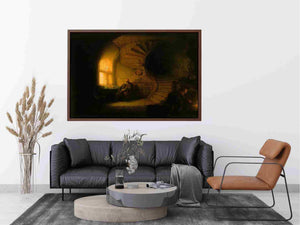
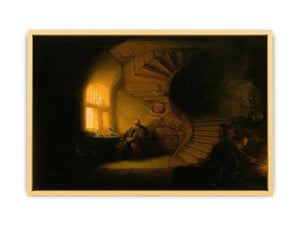
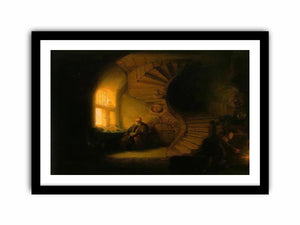
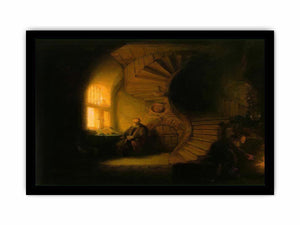
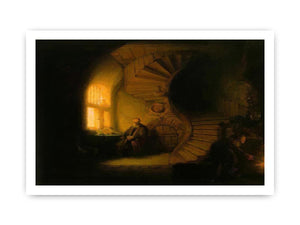
Philosopher in Meditation 1632 Painting by Rembrandt Van Rijn
Philosopher in Meditation stands as one of the most quietly profound and intellectually resonant works of Rembrandt Van Rijn’s early maturity, revealing an artist already deeply attuned to the inner life of the human mind. Painted in 1632, the same year as The Anatomy Lesson of Dr Tulp, the work occupies a markedly different emotional and philosophical register. Where the anatomy scene asserts collective inquiry and public knowledge, Philosopher in Meditation turns inward, presenting thought itself as a solitary, patient, and deeply human act. It is not a portrait of action, authority, or event, but a meditation on contemplation, time, and the relationship between light and consciousness.
Created shortly after Rembrandt’s move to Amsterdam, the painting reflects a young artist rapidly expanding his expressive range. At this early stage in his career, Rembrandt had already mastered the technical languages of chiaroscuro and psychological realism, yet Philosopher in Meditation demonstrates something rarer: an ability to render silence, slowness, and mental depth as compelling pictorial subjects. The painting does not instruct or declare; it invites. It asks the viewer to enter a space shaped by reflection rather than motion.
The composition is built around stillness and asymmetry. The philosopher sits near a window, partially turned away from the viewer, his posture relaxed yet attentive. He is absorbed in thought, his body at rest while his mind appears active. The room is modest, sparsely furnished, and enclosed, reinforcing a sense of withdrawal from the external world. A spiral staircase recedes into shadow, its curved form suggesting continuity, ascent, and the passage of time without defining a clear destination. This architectural element does not serve a practical narrative function; it operates symbolically, reinforcing the painting’s philosophical undertones.
Light is the primary expressive force within the composition. Rembrandt allows it to enter gently through the window, illuminating the philosopher and the surrounding space with a soft, golden glow. This light is neither dramatic nor theatrical. It does not overwhelm darkness; it coexists with it. Shadow occupies much of the painting, but it feels contemplative rather than ominous. The balance between light and dark mirrors the balance between knowledge and mystery, clarity and uncertainty.
The philosopher himself is not idealised. He is presented as aged, modest, and physically unremarkable. There is no emphasis on status, wealth, or intellectual display. Instead, Rembrandt focuses on presence. The philosopher’s inward gaze, his still posture, and his proximity to the light suggest a life oriented toward understanding rather than assertion. Thought here is slow, cumulative, and deeply personal.
Colour is restrained and harmonious. Warm browns, soft golds, muted creams, and deep shadows dominate the palette. These tones create an atmosphere of warmth and quiet gravity, encouraging prolonged engagement. There are no sharp contrasts or decorative flourishes. Everything in the painting serves the mood of contemplation. The colour relationships bind figure, architecture, and light into a unified whole.
Rembrandt’s brushwork is subtle and controlled. Forms emerge gradually from shadow, edges softened rather than sharply defined. The texture of stone, wood, and fabric is suggested with sensitivity rather than precision. This approach reinforces the painting’s thematic focus. Just as thought unfolds slowly, so too does the image reveal itself over time. The viewer is not confronted; they are drawn in.
Symbolically, Philosopher in Meditation resists definitive interpretation, and this openness is central to its power. The philosopher may represent wisdom, reflection, or the pursuit of truth, yet Rembrandt avoids specific philosophical or theological markers. There are no books prominently displayed, no gestures of instruction, no signs of doctrinal allegiance. Thought is presented as an interior condition rather than an intellectual system. The spiral staircase has often been interpreted as a symbol of ascent or spiritual journey, but Rembrandt leaves its meaning deliberately unresolved.
Emotionally, the painting conveys calm, patience, and quiet seriousness. There is no tension, no narrative conflict, no sense of urgency. Yet the work is far from empty or inert. It pulses with interior life. The viewer senses time passing slowly, marked not by action but by attention. This emotional restraint is one of Rembrandt’s great achievements. He demonstrates that depth does not require drama, and that meaning can reside in stillness.
Within Rembrandt Van Rijn’s broader career, Philosopher in Meditation anticipates many qualities that would define his later masterpieces. His fascination with inner life, his ability to convey moral and psychological complexity through light and gesture, and his refusal to idealise his subjects are all present here in early form. The painting reveals an artist already committed to exploring what it means to think, to age, and to exist within time.
The work’s relevance has only grown with centuries. In a modern world often dominated by speed, noise, and constant assertion, Philosopher in Meditation offers an alternative vision grounded in slowness and inward attention. Viewers across the United States, the United Kingdom, Canada, Australia, and Europe continue to respond to its quiet authority. It speaks across cultures because contemplation itself is a universal human experience.
In interior spaces, Philosopher in Meditation introduces depth without heaviness. In living rooms, it creates an atmosphere of calm reflection and intellectual warmth. In studies and offices, it reinforces values of patience, focus, and thoughtful inquiry. In galleries and luxury residences, it communicates refined engagement with art that prioritises meaning over display.
The painting integrates naturally into both traditional and modern interiors. In classical settings, its chiaroscuro and architectural gravity resonate with historical continuity. In minimalist or contemporary spaces, its subdued palette and luminous focal point create a powerful counterbalance to architectural restraint. Its presence encourages stillness rather than distraction.
The enduring importance of Philosopher in Meditation lies in its refusal to explain itself. It does not instruct the viewer on what to think, only how to look. It affirms that contemplation is itself a form of action, and that understanding emerges not through force, but through patience and attention.
To live with Philosopher in Meditation is to engage daily with one of Rembrandt Van Rijn’s most humane and quietly radical visions. It is a painting that rewards time, revealing its depth gradually, just as thought itself unfolds. Through its luminous restraint, psychological insight, and moral calm, the work endures as a timeless meditation on what it means to think, to wait, and to be present.
Buy museum qulaity 400- 450 canvas prints, framed prints, and 100% oil paintings of Philosopher in Meditation 1632 by Rembrandt Van Rijn at Alpha Art Gallery, where world-famous masterpieces are recreated with museum-quality detail, refined craftsmanship, and premium materials.
FAQS
What is the central meaning of Philosopher in Meditation?
The painting explores contemplation, inner life, and the quiet pursuit of understanding through light and stillness.
Is the philosopher a specific historical figure?
No. The figure is generally understood as symbolic, representing reflective thought rather than a named individual.
What role does light play in the painting?
Light functions as a metaphor for awareness and understanding, gently illuminating thought without dispelling mystery.
What does the spiral staircase symbolise?
It is often interpreted as a sign of time, continuity, or spiritual ascent, though Rembrandt leaves its meaning intentionally open.
Is Philosopher in Meditation suitable for modern interiors?
Yes. Its restrained palette and contemplative mood integrate seamlessly into both modern and traditional spaces.
What emotional atmosphere does the painting create?
It encourages calm, patience, and reflective seriousness rather than dramatic engagement.
Does this artwork have lasting cultural value?
As one of Rembrandt’s most philosophically rich early works, it holds enduring artistic and cultural significance.
Where is the best place to display this painting?
It is particularly well suited to studies, offices, living rooms, and gallery environments where contemplation is valued.