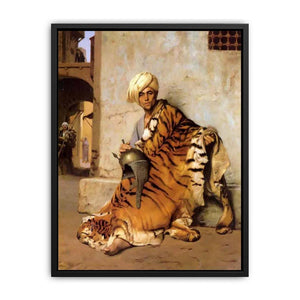
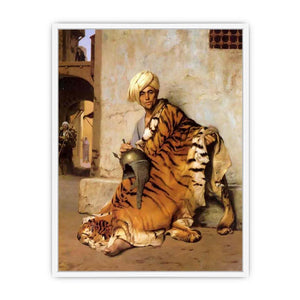
Pelt Merchant Of Cairo Painting by Jean Léon Gérôme
Pelt Merchant Of Cairo Painting by Jean Léon Gérôme is a masterful example of nineteenth-century academic realism, in which ethnographic observation, compositional discipline, and technical precision converge to create an image of commerce rendered with almost archaeological authority. Gérôme does not dramatize the scene nor sentimentalize its subjects. Instead, he presents a moment of trade as a structured social ritual, revealing how exchange, material value, and cultural order intersect within a specific historical and geographic context. The painting stands as both a visual document and an intellectual construction, shaped by Gérôme’s unwavering commitment to clarity and control.
By the time this work was produced, Jean-Léon Gérôme had secured his reputation as one of the most exacting artists of his era. Trained in the rigorous traditions of the French Academy and deeply invested in the study of antiquity and non-European cultures, Gérôme approached painting with the precision of a historian. His extensive travels through Egypt and the Near East informed a body of work characterized by meticulous detail, compositional balance, and emotional restraint. Pelt Merchant Of Cairo exemplifies this approach, revealing how Gérôme translated direct observation into structured visual knowledge.
The subject is drawn from everyday commercial life in Cairo, a city that fascinated nineteenth-century European artists for its layered history and active markets. Gérôme depicts a merchant engaged in the display and negotiation of animal pelts, materials valued for both practical and economic reasons. The scene is not animated by bargaining gestures or expressive faces. Instead, it unfolds quietly, emphasizing order and procedure over drama. Trade is shown not as spectacle, but as routine.
Compositionally, the painting is carefully organized around vertical and horizontal planes that stabilize the scene. The pelts themselves dominate the visual field, their textures and forms providing both structure and rhythm. Gérôme arranges them with deliberate clarity, allowing each surface to be examined individually while contributing to the overall harmony of the composition. The human figures are positioned in relation to these materials, reinforcing the idea that commerce governs posture, attention, and interaction.
Perspective places the viewer at a measured distance, close enough to inspect details yet removed from participation. This vantage point is characteristic of Gérôme’s work. He positions the viewer as an observer rather than a participant, reinforcing the analytical tone of the painting. The act of looking becomes central. One examines the pelts much as the buyers do, evaluating quality, texture, and worth. The painting thus mirrors its own subject: assessment.
Light is even and controlled, illuminating surfaces without theatrical emphasis. Gérôme uses light to reveal material truth rather than emotional atmosphere. The pelts’ textures—thick, coarse, varied—are rendered with astonishing clarity, while architectural elements and human figures are lit with equal impartiality. Nothing is hidden. Nothing is exaggerated. Light functions as an instrument of knowledge.
The color palette is restrained and earthy. Browns, tans, muted whites, and stone greys dominate the composition, creating a sense of material continuity between objects, figures, and environment. There is no chromatic indulgence. Color serves realism and balance rather than emotional effect. The subdued palette reinforces the painting’s seriousness and observational rigor.
Gérôme’s technique is characteristically exact. Brushwork is smooth to the point of invisibility, suppressing any trace of the artist’s hand. Surfaces appear solid, tactile, and permanent. The rendering of fur is particularly remarkable, conveying density and weight without exaggeration. This technical mastery is not merely decorative. It asserts authority. Gérôme’s control over surface becomes a claim to truth.
Symbolically, Pelt Merchant Of Cairo engages with themes of exchange and valuation. Animal skins, removed from their original context, are transformed into commodities. Gérôme presents this transformation without commentary, allowing the viewer to consider the implications. The scene reflects a broader nineteenth-century fascination with global trade and material culture, in which distant markets supplied goods that circulated through imperial economies. The painting thus participates in a larger conversation about commerce, consumption, and representation.
Psychologically, the painting is restrained and deliberate. The figures do not emote broadly. Their focus is directed toward the transaction itself. Gérôme avoids narrative embellishment, allowing the quiet seriousness of trade to define the scene. This emotional economy reinforces the painting’s analytical tone. It invites sustained looking rather than immediate reaction.
Within Gérôme’s broader oeuvre, this work aligns closely with other market and merchant scenes, such as The Carpet Merchant, where material culture becomes a primary subject. In these paintings, Gérôme demonstrates his belief that everyday activity, when rendered with precision, carries historical and cultural significance. He elevates commerce to the level of serious art without romanticizing it.
Culturally, the painting reflects nineteenth-century European engagement with Cairo as both a real city and an imagined site of authenticity. Gérôme’s Cairo is orderly, legible, and timeless, abstracted from political change or social conflict. This presentation reveals both the strengths and limitations of academic Orientalism. The painting offers extraordinary visual knowledge while simultaneously framing its subject through Western systems of order and control.
In contemporary interiors across the United States, the United Kingdom, Canada, Australia, and Europe, Pelt Merchant Of Cairo integrates with exceptional sophistication. In living rooms, it introduces warmth, texture, and historical depth. In studies and offices, it conveys intellectual seriousness and global awareness. In galleries and luxury residences, it anchors space with visual richness and disciplined composition, harmonizing seamlessly with traditional, eclectic, and modern minimalist décor.
The painting remains meaningful today because it foregrounds the act of evaluation—how objects, materials, and cultures are assessed and assigned value. In a global economy still shaped by trade and representation, Pelt Merchant Of Cairo invites reflection on the systems that connect observation, commerce, and power. Gérôme does not instruct the viewer how to judge. He presents the scene with clarity and allows judgment to emerge through attention.
Pelt Merchant Of Cairo Painting by Jean Léon Gérôme endures as a testament to academic precision and the visual study of commerce. Through compositional balance, technical mastery, and emotional restraint, Gérôme transformed an everyday transaction into a timeless examination of material culture and exchange. The painting does not dramatize trade. It renders it visible.
Buy museum qulaity 400- 450 canvas prints, framed prints, and 100% oil paintings of Pelt Merchant Of Cairo by Jean Léon Gérôme at Alpha Art Gallery, where world-famous masterpieces are recreated with museum-quality detail, refined craftsmanship, and premium materials.
FAQs
What does Pelt Merchant Of Cairo depict?
It depicts a Cairo merchant engaged in the display and sale of animal pelts within a market setting.
Why is this painting considered Orientalist?
It represents Middle Eastern commercial life through a Western academic lens focused on observation and order.
What role do the pelts play in the composition?
They dominate the visual field, emphasizing material texture and the economics of trade.
How does Gérôme’s technique shape the painting’s meaning?
His invisible brushwork and precision reinforce authority, realism, and analytical distance.
Is the scene narrative or observational?
It is observational, focusing on process rather than dramatic interaction.
Why does the painting feel emotionally restrained?
Gérôme avoids dramatization to maintain clarity and intellectual seriousness.
Why does Pelt Merchant Of Cairo remain relevant today?
It invites reflection on commerce, valuation, and cultural representation.
Where does this artwork work best in interiors?
It is ideal for living rooms, studies, offices, galleries, and refined private spaces.