Paradise Ascent of the Blessed Painting by Hieronymus Bosch
Paradise Ascent of the Blessed Painting by Hieronymus Bosch occupies a singular position within the history of Western art, standing at the intersection of medieval theology, visionary imagination, and psychological profundity. Created in the late fifteenth or early sixteenth century, this extraordinary work forms part of Bosch’s contemplations on the fate of the human soul, a subject that preoccupied Europe during a period marked by religious devotion, eschatological anxiety, and moral introspection. Unlike conventional depictions of heaven rooted in architectural splendour or static harmony, Bosch presents Paradise as a dynamic, almost otherworldly journey, one that unfolds through movement, light, and metaphysical transformation.
Hieronymus Bosch lived and worked in the Duchy of Brabant at a time when Christian doctrine shaped every aspect of cultural life. The belief in heaven, hell, and purgatory was not abstract theology but an immediate moral reality. Paradise Ascent of the Blessed reflects this worldview, offering not merely an image of salvation but a visual meditation on transition itself: the passage from earthly existence into divine eternity. The painting does not depict paradise as a destination fully revealed, but as an approach, an ascent that emphasizes spiritual progression rather than arrival.
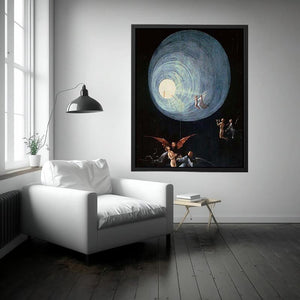
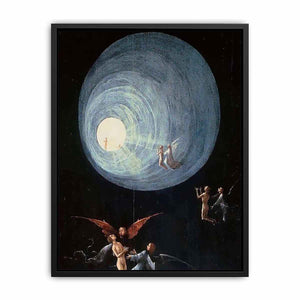
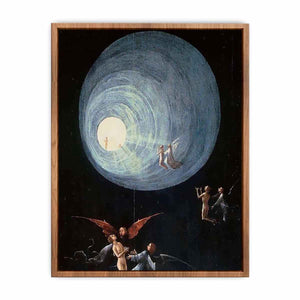
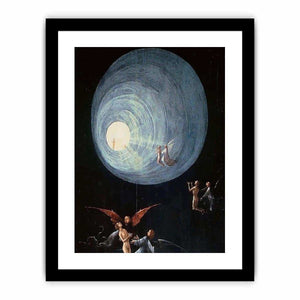
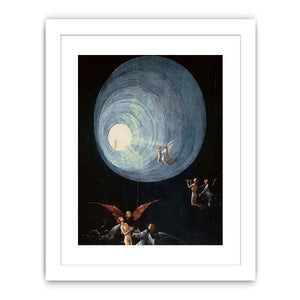
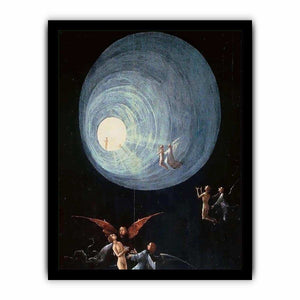
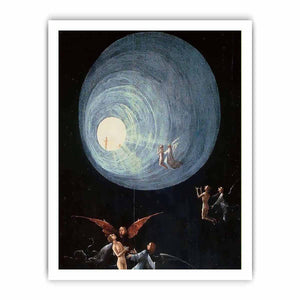
The composition is vertically oriented, guiding the viewer’s gaze upward in a deliberate and symbolic motion. At the lower portion, the blessed souls emerge from darkness, still marked by their earthly condition. They are rendered nude, stripped of worldly identifiers, emphasizing the universality of the human soul before divine judgment. As they rise, the darkness recedes, replaced by an increasingly luminous environment that culminates in a radiant tunnel of light. This upward movement is not merely spatial but metaphysical, representing purification, transcendence, and divine acceptance.
Bosch’s handling of light is central to the painting’s emotional and theological resonance. The luminous vortex at the top of the composition functions as both visual climax and spiritual symbol. Unlike naturalistic light sources, this radiance appears unbound by physical laws, suggesting the presence of the divine rather than the sun or flame. The gradual intensification of brightness reinforces the notion of salvation as a process, one in which the soul moves progressively closer to divine truth. This use of light anticipates later artistic explorations of transcendence, yet remains firmly grounded in Bosch’s distinctive symbolic language.
The figures themselves are rendered with restrained realism, their gestures subtle and reverent. Angels guide the ascending souls with calm assurance rather than dramatic intervention. There is no struggle, no resistance; the ascent unfolds with quiet inevitability. Bosch’s decision to portray salvation without theatrical excess distinguishes this work from many contemporaneous religious paintings. Instead of overwhelming the viewer with grandeur, he invites contemplation, encouraging a personal engagement with the mystery of the afterlife.
Colour plays a supporting but essential role in shaping the painting’s atmosphere. Bosch employs cool blues, muted greys, and soft whites to create a sense of immaterial space. These tones dissolve the boundaries between figure and environment, reinforcing the idea that the souls are leaving the material world behind. The absence of rich earthly colours further emphasizes detachment from corporeal existence, aligning the visual language with the theological message of spiritual liberation.
Symbolism permeates every aspect of Paradise Ascent of the Blessed. The tunnel-like structure leading into light has been interpreted as a metaphor for divine passage, spiritual rebirth, or the soul’s entry into God’s presence. Bosch’s genius lies in his refusal to fix meaning rigidly. Instead, he allows symbolism to remain suggestive, open to interpretation, and deeply personal. This ambiguity contributes to the painting’s enduring fascination, as each generation brings its own philosophical and spiritual concerns to the image.
Within Bosch’s artistic development, this painting reflects his unparalleled ability to visualize the invisible. While he is often celebrated for his fantastical depictions of sin and damnation, Paradise Ascent of the Blessed demonstrates his equal sensitivity to themes of hope and redemption. Here, Bosch tempers his imaginative intensity with serenity, presenting salvation not as spectacle but as quiet fulfilment. This balance underscores his range as an artist capable of articulating the full moral spectrum of human existence.
Culturally, the painting resonates beyond its original religious context. Its imagery of ascent, light, and transformation speaks to universal human questions about mortality, meaning, and transcendence. In a contemporary world increasingly defined by secular perspectives, Paradise Ascent of the Blessed continues to engage viewers through its psychological depth and symbolic richness. It offers not doctrinal instruction but an invitation to reflect on the nature of fulfilment and the possibility of transcendence beyond material life.
In modern interiors across the United States, the United Kingdom, Canada, Australia, and Europe, this painting functions as a powerful focal point. In living rooms, it introduces a contemplative presence that encourages reflection rather than distraction. In studies or private libraries, it aligns naturally with spaces dedicated to thought, philosophy, and introspection. Within professional offices or galleries, it conveys intellectual gravitas and cultural depth, signalling a collector’s engagement with complex ideas rather than decorative trends.
The painting integrates seamlessly into both traditional and contemporary settings. In minimalist interiors, its ethereal composition and restrained palette provide visual calm while introducing conceptual richness. In more classical or eclectic environments, it complements existing artworks by adding a layer of symbolic and historical resonance. Its vertical emphasis makes it particularly suited to spaces with height, where the sense of ascent can be experienced physically as well as visually.
The long-term artistic importance of Paradise Ascent of the Blessed lies in its ability to transcend stylistic and temporal boundaries. Bosch’s vision does not belong exclusively to the medieval world; it anticipates modern explorations of consciousness, psychology, and the unknown. The painting remains a testament to art’s capacity to address humanity’s most profound questions through imagery that is at once specific and universal.
As centuries pass, the relevance of this work only deepens. In an age marked by uncertainty, transition, and existential inquiry, Bosch’s meditation on ascent and illumination offers a visual language for hope without simplification. Paradise Ascent of the Blessed endures not because it provides answers, but because it dignifies the act of seeking, rendering the journey itself as meaningful as its imagined end.
Buy museum qulaity 400- 450 canvas prints, framed prints, and 100% oil paintings of Paradise Ascent of the Blessed by Hieronymus Bosch at Alpha Art Gallery, where world-famous masterpieces are recreated with museum-quality detail, refined craftsmanship, and premium materials.
FAQS
What is the primary meaning of Paradise Ascent of the Blessed by Hieronymus Bosch?
The painting represents the soul’s journey from earthly existence toward divine illumination, emphasizing spiritual transformation rather than a literal depiction of heaven.
How does this work differ from traditional depictions of paradise?
Instead of architectural splendour or static harmony, Bosch portrays paradise as a dynamic ascent, focusing on movement, light, and metaphysical transition.
Why is this painting important within Bosch’s oeuvre?
It demonstrates Bosch’s ability to depict hope and salvation with the same imaginative depth for which his darker works are famous, revealing the full scope of his artistic vision.
Is the symbolism in the painting fixed or open to interpretation?
Bosch’s symbolism is intentionally suggestive, allowing viewers to engage with the imagery through personal, philosophical, or spiritual perspectives.
Where does this artwork work best in an interior setting?
It is particularly effective in studies, living rooms, galleries, and contemplative spaces where its vertical composition and thematic depth can be fully appreciated.
Does this painting hold long-term cultural value?
Yes, its exploration of transcendence, mortality, and hope ensures enduring relevance across historical periods and cultural contexts.
Why does the painting remain compelling to modern viewers?
Its psychological depth and symbolic ambiguity resonate with contemporary questions about meaning, transformation, and the unknown beyond material life.