On the Wallaby Track Painting by Frederick McCubbin
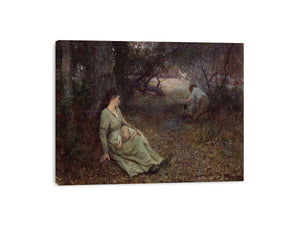
Painted in 1896, On the Wallaby Track by Frederick McCubbin stands as one of the most quietly powerful images in Australian art, a work in which landscape, labour, and human endurance are fused into a single, resonant vision. Rather than dramatise hardship, McCubbin presents it with restraint and dignity, allowing the viewer to encounter the realities of itinerant life not as spectacle, but as lived experience. The painting captures a defining aspect of late nineteenth-century Australia: the transient existence of working families moving through the bush in search of survival, stability, and hope.
The historical background of On the Wallaby Track is inseparable from the economic depression of the 1890s, a period that reshaped Australian society. Widespread unemployment forced many families onto the road, travelling from place to place in search of seasonal work. These travellers, known colloquially as being “on the wallaby track,” became emblematic of resilience under pressure. McCubbin, deeply attuned to the social realities of his time, chose not to romanticise this condition. Instead, he recorded it with empathy and sober clarity, embedding human struggle within the vastness of the Australian bush.
Within McCubbin’s artistic life, this painting represents a mature synthesis of his concerns as both a storyteller and a landscape painter. Earlier works often engaged with pioneer myth and national legend, but On the Wallaby Track shifts toward social realism without abandoning poetic restraint. The figures are not heroic pioneers nor anonymous types; they are recognisably human, grounded in the specifics of their circumstance. McCubbin’s achievement lies in presenting their story without sentimentality, allowing quiet observation to carry emotional weight.
The painting belongs to the Heidelberg School, Australia’s first significant art movement, which sought to develop a distinctly local visual language. While many Heidelberg artists focused on light, atmosphere, and pastoral tranquillity, McCubbin extended the movement’s ambitions to include social experience. In this work, the bush is not merely a setting; it is an active participant in the narrative. The land offers neither comfort nor hostility, only indifference, reinforcing the precariousness of human existence within it.
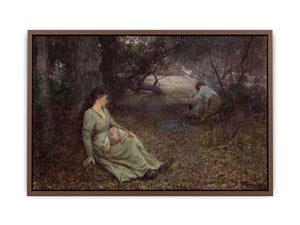
Compositionally, On the Wallaby Track is defined by balance and stillness. The figures are arranged with deliberate economy, occupying the foreground without dominating it. The family’s camp is modest and temporary, emphasising impermanence. The horizontal spread of the landscape reinforces a sense of pause rather than progress, suggesting a moment of rest within an ongoing journey. McCubbin resists dramatic gesture, allowing posture and proximity to convey fatigue, care, and quiet solidarity.
Perspective plays a subtle psychological role. The viewer stands at a respectful distance, close enough to observe but not intrude. This distance preserves the dignity of the subjects, preventing voyeurism. The space around the figures is open yet enclosing, reflecting both the physical expanse of the bush and the emotional isolation of itinerant life. McCubbin’s spatial design ensures that environment and humanity remain inseparable.
Colour and light are handled with remarkable restraint. The palette is dominated by earthy browns, muted greens, and subdued golds, reflecting the dry Australian terrain. Light filters softly through the scene rather than illuminating it theatrically. This diffused illumination avoids idealisation, reinforcing the painting’s tone of realism. Flesh tones are natural and unembellished, integrating the figures seamlessly into their surroundings. Texture is suggested rather than asserted, allowing atmosphere to take precedence over surface detail.
Symbolically, On the Wallaby Track operates as a meditation on endurance rather than struggle alone. The presence of children introduces themes of responsibility and continuity, reminding the viewer that hardship is borne not in isolation but across generations. The woman’s central placement suggests emotional anchoring, while the man’s posture reflects the burden of providing in uncertain circumstances. These roles are not exaggerated; they are observed, allowing symbolism to emerge organically from reality.
Emotionally, the painting is profoundly restrained. There is no despair, no overt hope, only persistence. McCubbin captures a moment of stillness where exhaustion and resolve coexist. This emotional equilibrium is what gives the work its lasting power. By refusing melodrama, the painting invites empathy rather than pity. The viewer is asked to recognise the humanity of the subjects, not to judge or sentimentalise them.
Culturally, On the Wallaby Track holds a central place in Australia’s artistic and social history. It challenged prevailing ideals by acknowledging the hardships underlying national development. Rather than reinforcing myths of effortless progress, McCubbin presented a more honest vision of settlement shaped by uncertainty and resilience. The painting contributed to a broader understanding of Australian identity, grounded not in triumph alone, but in perseverance.
The relevance of this work today remains striking. In a global context marked by displacement, economic instability, and migration, the themes of On the Wallaby Track resonate far beyond its original setting. The painting speaks to the universal experience of people navigating uncertainty with dignity. Its refusal to sensationalise hardship ensures that it remains timeless rather than bound to a single historical moment.
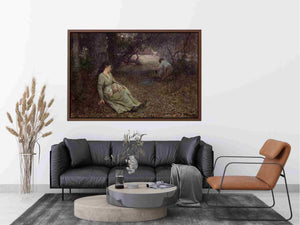
Within contemporary interiors across the United States, United Kingdom, Canada, Australia, and Europe, the painting integrates with quiet authority. In living rooms, it introduces depth and narrative seriousness without visual aggression. In studies and offices, it reinforces values of resilience, reflection, and social awareness. Galleries and luxury residences benefit from its cultural weight and emotional subtlety, as the work sustains engagement through meaning rather than scale.
Across interior styles, On the Wallaby Track adapts with distinction. In minimalist spaces, its restrained palette and grounded composition provide warmth without clutter. Traditional interiors gain historical depth through its national significance and painterly discipline. Eclectic settings find balance in its human-centred narrative and tonal harmony. The painting does not impose itself; it endures.
Ultimately, On the Wallaby Track by Frederick McCubbin stands as one of the most humane and quietly truthful works of nineteenth-century art. Through compositional restraint, social insight, and emotional intelligence, McCubbin transformed an ordinary moment into a lasting reflection on endurance and dignity. The painting remains powerful because it neither consoles nor condemns; it observes, and in doing so, affirms the quiet strength of those who continue onward despite uncertainty.
Buy museum qulaity 400- 450 canvas prints, framed prints, and 100% oil paintings of On the Wallaby Track by Frederick McCubbin at Alpha Art Gallery, where world-famous masterpieces are recreated with museum-quality detail, refined craftsmanship, and premium materials.
FAQS
What does “on the wallaby track” mean?
It refers to itinerant workers and families travelling the Australian bush in search of employment during economic hardship.
What is the main theme of the painting?
The painting explores endurance, family responsibility, and human dignity amid uncertainty.
Is this painting autobiographical or symbolic?
While not autobiographical, it is socially observant and symbolically representative of a broader historical experience.
Why is the painting emotionally restrained?
McCubbin avoids melodrama to preserve dignity and encourage empathy rather than sentimentality.
What artistic movement does this work belong to?
It is associated with the Heidelberg School, Australia’s foundational national art movement.
Does this artwork suit contemporary interiors?
Yes. Its balanced composition and subdued palette integrate well into modern, traditional, and minimalist spaces.
Why is On the Wallaby Track culturally important?
It offers an honest portrayal of hardship during a formative period in Australian history.
Where is the best place to display this artwork?
It is especially effective in living rooms, studies, offices, galleries, and refined residential settings where reflective art is valued.