Napoleon at the St. Bernard Pass 1801 Painting by Jacques-Louis David
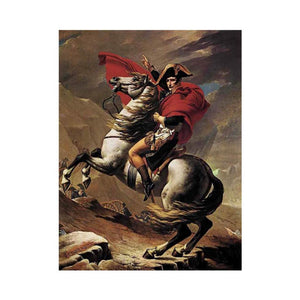
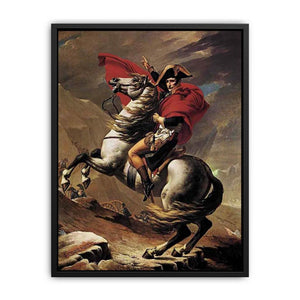
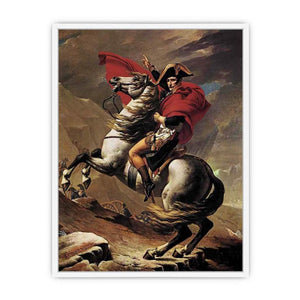
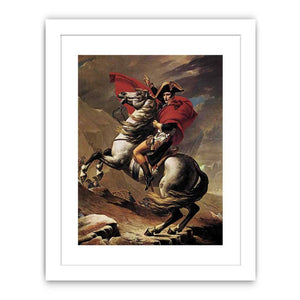
Napoleon at the St. Bernard Pass 1801 Painting by Jacques-Louis David is a consummate expression of Neoclassical authority and one of the most intellectually disciplined constructions of political power in Western art. Painted in 1801 as part of David’s celebrated Alpine series, the work does not aspire to eyewitness truth. Instead, it articulates a philosophy of leadership—one in which composure, resolve, and moral clarity prevail over physical hardship and historical contingency. David’s Napoleon is not a traveler battling nature; he is a sovereign intelligence advancing history by will.
The architect of this vision, Jacques-Louis David, understood with exceptional acuity that modern authority required modern images. Having shaped the visual language of Revolutionary France through works of civic virtue and stoic resolve, David now applied the same rigor to the representation of empire. Napoleon at the St. Bernard Pass refines that project with particular precision, emphasizing serenity over spectacle and command over exertion.
The historical crossing of the Great St. Bernard Pass occurred in 1800 during the Italian campaign, a formidable logistical feat undertaken under severe conditions. David consciously rejects the documentary realities of cold, fatigue, and uncertainty. Napoleon is shown mounted on a rearing horse rather than riding a mule, dressed in immaculate uniform rather than travel-worn attire. These choices are not errors; they are declarations. The painting asserts a symbolic truth: leadership transcends circumstance. What matters is not how the pass was crossed, but what the crossing signified.
Compositionally, the painting is a study in controlled dynamism. The horse surges upward against the incline, its energy captured in taut musculature and sweeping movement. In deliberate counterpoint, Napoleon remains upright, composed, and assured. The diagonal thrust of the terrain and the horse’s motion propel the eye forward, while Napoleon’s calm posture stabilizes the entire composition. David engineers tension only to resolve it in the figure of command.
Perspective reinforces this resolution. The viewer looks slightly upward, granting Napoleon visual authority without distortion. He is elevated by compositional logic rather than exaggerated scale. The surrounding mountains loom, jagged and resistant, yet they function as a stage for authority rather than an obstacle to it. Nature is present, formidable, and ultimately subordinate.
Light is deployed with restraint and clarity. Napoleon’s figure is illuminated decisively, separating him from the darker, turbulent background. There is no supernatural radiance, no theatrical chiaroscuro. Instead, light serves legibility and emphasis, aligning visual clarity with rational control. David’s illumination affirms that authority is intelligible and orderly, not mysterious.
The color palette is both symbolic and disciplined. Napoleon’s cloak—rendered in commanding reds or warm imperial tones—cuts sharply against the cool greys and blues of rock and sky. This chromatic separation isolates the leader from his environment, visually articulating the idea of exceptionality. Color here is declarative rather than decorative, reinforcing hierarchy and purpose.
David’s technique exemplifies Neoclassical precision. Forms are crisply defined, anatomy idealized, and surfaces polished to sculptural firmness. There is no visible improvisation. Each line and contour contributes to a coherent statement of order. The disciplined execution mirrors the painting’s ideological claim: power, when legitimate, is rational and controlled.
Symbolism is embedded subtly within the landscape. Inscribed into the rock face are the names of earlier conquerors—Hannibal and Charlemagne—who, like Napoleon, crossed the Alps to alter the course of European history. By invoking these precedents, David situates Napoleon within a lineage of epoch-making leaders, collapsing temporal distance and elevating contemporary politics to the realm of epic history. The gesture is concise yet decisive.
Psychologically, the painting is remarkable for its emotional economy. Napoleon’s expression is calm, unwavering, and inscrutable. There is no visible strain or exhilaration. This restraint is central to the image’s authority. David presents leadership as certainty rather than effort, as composure rather than display. Power here is not reactive; it is declarative.
Within David’s oeuvre, Napoleon at the St. Bernard Pass marks a culmination of his transition from revolutionary moralism to imperial representation. Earlier works foregrounded collective virtue and sacrifice. Here, those values are concentrated into the figure of a single leader. The Neoclassical language remains—clarity, order, idealization—but its purpose has shifted toward legitimizing centralized authority.
Culturally, the painting stands as a masterclass in visual persuasion. It demonstrates how images can overwrite experience, replacing contingency with inevitability. For generations, this vision has shaped the popular memory of Napoleon more powerfully than any archival account. The work endures not because it records fact, but because it defines belief.
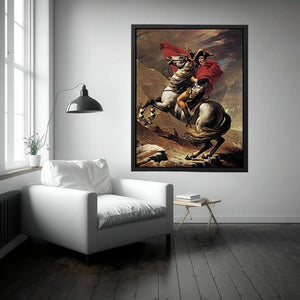
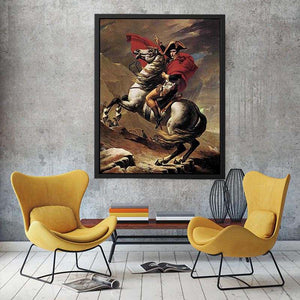
In contemporary interiors across the United States, the United Kingdom, Canada, Australia, and Europe, Napoleon at the St. Bernard Pass commands immediate gravitas. In studies, libraries, and offices, it communicates decisiveness, ambition, and historical consciousness. In galleries and luxury residences, it anchors space with heroic clarity, integrating seamlessly into traditional, neoclassical, and eclectic décor while offering a striking counterpoint within modern minimalist settings through its disciplined structure and dynamic force.
The painting remains meaningful today because it reveals the mechanics of leadership imagery. In a world still shaped by visual narratives of power, David’s masterpiece offers insight into how authority is framed, stabilized, and remembered. It reminds us that history is not only made on mountain passes; it is made in the images that endure.
Napoleon at the St. Bernard Pass 1801 Painting by Jacques-Louis David endures as a definitive articulation of authority through restraint. Through compositional balance, symbolic intelligence, and Neoclassical discipline, David transformed a perilous journey into a timeless meditation on command and destiny. The painting does not recount a crossing. It establishes a myth.
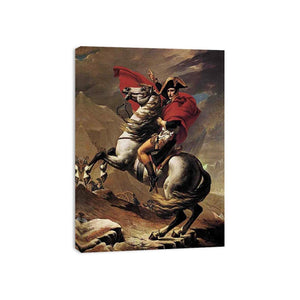
Buy museum qulaity 400- 450 canvas prints, framed prints, and 100% oil paintings of Napoleon at the St. Bernard Pass by Jacques Louis David at Alpha Art Gallery, where world-famous masterpieces are recreated with museum-quality detail, refined craftsmanship, and premium materials.
FAQs
What historical moment does Napoleon at the St. Bernard Pass depict?
It represents Napoleon’s Alpine crossing during the Italian campaign, rendered symbolically rather than literally.
Why is Napoleon shown calm amid turbulent movement?
The contrast signifies leadership through composure and control rather than physical struggle.
Is the painting historically accurate?
It is allegorical, prioritizing mythic authority and legitimacy over documentary detail.
What do the carved names in the rocks signify?
They reference Hannibal and Charlemagne, aligning Napoleon with historic conquerors.
How does this painting reflect Neoclassical principles?
Through clarity of form, disciplined composition, idealized anatomy, and moral seriousness.
Why is this work considered political image-making?
It constructs an idealized vision designed to legitimize power and shape public memory.
Why does the painting remain relevant today?
It demonstrates how visual narratives define leadership and historical perception.
Where does this artwork work best in interiors?
It is ideal for offices, studies, libraries, galleries, and spaces emphasizing authority and history.