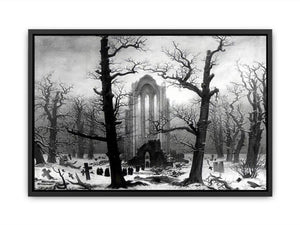
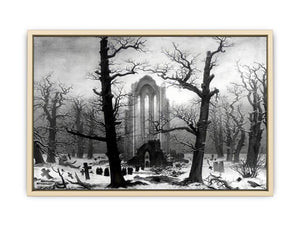
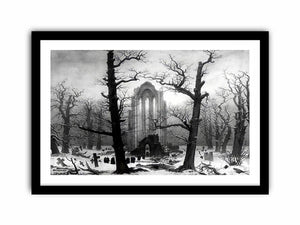
Monastery Graveyard in the Snow Painting by Caspar David Friedrich
Monastery Graveyard in the Snow stands as one of Caspar David Friedrich’s most austere and spiritually resonant meditations on mortality, time, and transcendence. Painted in the early nineteenth century, during the height of German Romanticism, the work embodies Friedrich’s conviction that landscape painting could serve as a vessel for philosophical and theological reflection. Here, nature, architecture, and human absence converge into a silent vision of endings and continuities, where faith is not asserted through narrative or doctrine, but contemplated through atmosphere, decay, and stillness.
Caspar David Friedrich worked at a moment when traditional religious structures were being questioned and reinterpreted in post-Enlightenment Europe. Rather than rejecting faith, Friedrich internalised it, transforming Christian belief into an inward, experiential encounter with the natural world. Monastery Graveyard in the Snow reflects this shift with exceptional clarity. The painting does not depict religious ritual or human devotion. Instead, it presents the remnants of spiritual life—ruined Gothic walls, a snow-covered burial ground, and bare trees—as symbols of time’s passage and the persistence of belief beyond institutional form.
The composition is deliberately severe. A ruined monastery dominates the scene, its skeletal arches and walls rising against a cold, winter sky. The structure is incomplete and broken, yet it retains a solemn dignity. In the foreground, gravestones protrude from the snow, their forms partially obscured, suggesting both presence and erasure. The absence of living figures is striking. Human life is implied only through what remains—architecture, graves, and memory. Friedrich constructs the scene so that the viewer confronts not action, but consequence.
Perspective is frontal and restrained. Friedrich places the viewer at a respectful distance, neither elevated nor immersed, as though standing before the site in quiet contemplation. Depth is created through overlapping planes—the snow-covered ground, the grave markers, the ruined monastery, and the distant sky—yet spatial recession is subdued. The landscape feels enclosed rather than expansive, reinforcing the sense of solemn containment. The viewer is not invited to wander visually, but to pause.
Light plays a crucial symbolic role. Illumination is muted and diffuse, filtering weakly through a winter atmosphere. There is no dramatic contrast between light and shadow, no divine radiance piercing the clouds. Instead, light exists as a fragile presence, barely sufficient to reveal form. This restraint aligns with Friedrich’s spiritual vision. Faith here is not triumphant or declarative; it is quiet, enduring, and tested by time. Light suggests persistence rather than revelation.
Colour is reduced to a narrow, disciplined range. Whites and greys dominate the snow and sky, while muted browns and dark greens define trees, ruins, and gravestones. This limited palette reinforces the painting’s emotional gravity. There is no warmth, no chromatic relief. The cold tones do not shock; they settle, creating a mood of resignation tempered by calm. Friedrich’s use of colour avoids sentimentality, allowing meaning to emerge through austerity.
Friedrich’s brushwork is controlled and precise, yet never decorative. Architectural forms are rendered with clarity, emphasising their fragility and incompleteness. The snow is painted with subtle variation, conveying texture without drawing attention to technique. Trees are skeletal, their bare branches echoing the ruined arches of the monastery. This visual rhyme binds nature and architecture into a single symbolic language, reinforcing the idea that human structures and natural cycles are subject to the same passage of time.
Symbolically, Monastery Graveyard in the Snow operates as a meditation on death without despair. The graveyard signifies mortality, yet it is not portrayed as terrifying or grotesque. The ruined monastery suggests the decline of earthly institutions, but not the extinction of spiritual meaning. Friedrich does not frame decay as negation. Instead, he presents it as transition. Snow, often associated with silence and erasure, also implies purification and rest. The painting holds these meanings in balance, refusing simple conclusion.
Emotionally, the work conveys profound stillness. There is no fear, no overt mourning. The mood is contemplative, solemn, and inward. Viewers often experience the painting as heavy yet calming, its silence offering space for reflection rather than distress. Friedrich achieves this effect through restraint, trusting the viewer to engage with absence as actively as with presence. The painting does not comfort through reassurance; it steadies through acceptance.
Within Friedrich’s artistic development, Monastery Graveyard in the Snow represents a culmination of his preoccupation with ruins, winter landscapes, and spiritual solitude. It belongs to a group of works in which he explored death not as narrative event, but as condition. Unlike earlier religious art that depicted salvation through figures and stories, Friedrich locates transcendence within the landscape itself. This approach would profoundly influence later Symbolist and modern artists who sought meaning beyond literal representation.
Culturally, the painting holds lasting significance as one of Romanticism’s most uncompromising expressions of spiritual introspection. It rejects Enlightenment optimism and theatrical religiosity alike, proposing instead a faith grounded in humility and reflection. Monastery Graveyard in the Snow helped redefine landscape painting as a medium capable of addressing ultimate questions—mortality, belief, and time—without recourse to allegory or spectacle.
In contemporary interiors, Monastery Graveyard in the Snow integrates with exceptional gravity and refinement. In studies, libraries, and offices, it fosters contemplation and intellectual depth. In living rooms and private collections, it functions as a powerful focal work that invites silence rather than decoration. In galleries and luxury residences across the United States, United Kingdom, Canada, Australia, and Europe, the painting complements minimalist, classical, and modern interiors alike. Its restrained palette and architectural clarity allow it to command presence without visual excess, making it particularly suited to spaces that value reflection and cultural seriousness.
The enduring relevance of Monastery Graveyard in the Snow lies in its honesty. Friedrich does not offer consolation through illusion or certainty. He presents mortality as inevitable, faith as quiet, and meaning as something encountered through stillness rather than proclamation. The painting endures because it speaks to a universal human experience: standing before the remnants of belief, aware of loss, yet sensing continuity beyond what can be seen. In this work, Caspar David Friedrich offers not a doctrine, but a space for reflection—one that remains as profound today as it was two centuries ago.
Buy museum qulaity 400- 450 canvas prints, framed prints, and 100% oil paintings of Monastery Graveyard in the Snow by Caspar David Friedrich at Alpha Art Gallery, where world-famous masterpieces are recreated with museum-quality detail, refined craftsmanship, and premium materials.
FAQS
What does Monastery Graveyard in the Snow by Caspar David Friedrich depict?
It depicts a ruined monastery and a snow-covered graveyard, presenting a silent meditation on death, time, and faith.
Why are there no living figures in the painting?
Friedrich removes human presence to focus on absence, memory, and spiritual reflection rather than narrative action.
What is the significance of the ruined monastery?
It symbolises the decline of earthly institutions while suggesting the persistence of spiritual meaning beyond them.
How does winter contribute to the painting’s meaning?
Winter represents silence, mortality, and rest, reinforcing themes of death and contemplation without despair.
Is this painting religious in nature?
Yes, but its spirituality is inward and contemplative rather than doctrinal or narrative.
What emotional tone defines the artwork?
The tone is solemn, quiet, and reflective, marked by acceptance rather than fear.
Is Monastery Graveyard in the Snow suitable for contemporary interiors?
Yes, its restrained palette and philosophical depth suit modern, minimalist, and classical spaces.
Why does Monastery Graveyard in the Snow remain relevant today?
Its exploration of mortality, impermanence, and quiet faith continues to resonate across cultures and eras.