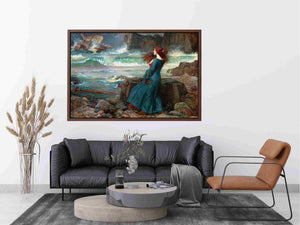
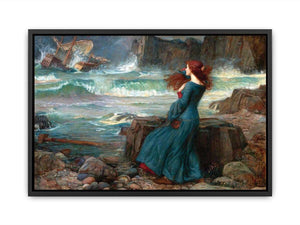
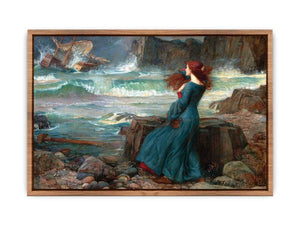
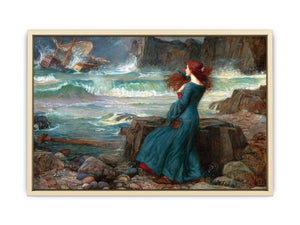
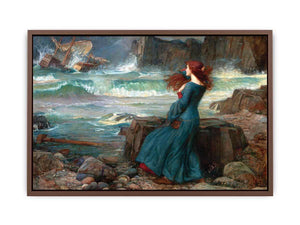
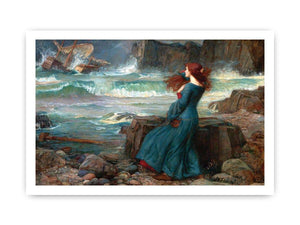
Miranda (The Tempest) Painting by John William Waterhouse
Miranda (The Tempest) Painting by John William Waterhouse is among the most humane and introspective interpretations of Shakespearean literature in nineteenth-century British painting. Created in 1916, near the end of Waterhouse’s life, the work distills decades of artistic exploration into a single moment of moral awakening. Rather than depicting action, romance, or spectacle, the painting captures a state of consciousness: the instant when sheltered innocence encounters suffering and responds with compassion rather than fear. It is a painting defined not by drama, but by ethical clarity.
At this late stage in his career, John William Waterhouse had moved decisively toward restraint and inwardness. While earlier works often balanced lush naturalism with literary narrative, his final paintings are marked by emotional economy and psychological precision. Miranda (The Tempest) belongs fully to this mature phase. The artist abandons visual excess in favor of concentration, allowing gesture, posture, and atmosphere to carry meaning. What remains is a distilled vision of humanity at its most attentive.
The subject is drawn from William Shakespeare’s The Tempest. Miranda, raised in isolation on an island by her father Prospero, has known only a sheltered world until the arrival of a violent storm brings shipwrecked strangers into her life. In the play, Miranda’s defining response is empathy; she pleads for mercy, believing the ship’s passengers to be suffering. Waterhouse chooses this precise psychological moment—not the romance that follows, not the revelation of identity, but the first encounter with pain beyond her experience. The painting centers not on the event, but on response.
Compositionally, the painting is austere and deliberate. Miranda stands alone upon a rocky outcrop, her figure upright and still against an expansive, unseen seascape. The absence of other figures intensifies the scene’s ethical focus. There is no distraction, no competing narrative. The human figure confronts the immensity of the world directly. The vertical stability of Miranda’s posture contrasts with the implied turbulence beyond the frame, reinforcing the tension between inner calm and external catastrophe.
Perspective places the viewer slightly behind and to the side of Miranda, sharing her vantage without supplanting it. This positioning is crucial. The viewer does not look at Miranda as an object, but stands with her as witness. The shipwreck itself remains outside the frame, existing only through implication. By withholding spectacle, Waterhouse forces attention onto the act of seeing and responding. The painting becomes participatory, ethical rather than narrative.
Light in Miranda (The Tempest) is cool, restrained, and evenly distributed. There is no theatrical illumination, no storm-lit drama. Instead, light clarifies Miranda’s form with quiet neutrality. This calm illumination stands in deliberate contrast to the implied violence of the storm. Waterhouse suggests that compassion does not arise from emotional frenzy, but from steady awareness. Light here is moral rather than expressive.
The color palette reinforces this restraint. Muted blues and greys dominate the environment, evoking distance, uncertainty, and vastness. Miranda’s pale garments and flesh tones emerge gently from this subdued field, marking her as human without isolating her from nature. There is no chromatic excess. Color serves balance and atmosphere, shaping emotional tone without dictating it.
Waterhouse’s technique is fluid yet controlled. Brushwork remains visible enough to suggest movement in air and fabric, yet soft enough to preserve unity. Edges are subtly blended, creating a sense of suspension, as though the moment exists between breaths. The artist’s hand recedes, allowing psychological presence to take precedence over surface detail.
Miranda’s expression is the painting’s emotional core. She does not display terror or confusion. Her gaze is intent, concerned, and quietly focused. Her body does not recoil. Instead, it leans into awareness. This portrayal aligns closely with Shakespeare’s conception of Miranda as a figure of innate empathy—someone whose innocence is not ignorance, but uncorrupted moral perception. Waterhouse resists romanticization. Miranda is neither decorative nor passive. She is attentive.
Symbolically, the painting operates as an image of first ethical encounter. The sea represents the broader human world, with its suffering, violence, and unpredictability. Miranda stands at the threshold between isolation and engagement, childhood and moral adulthood. Unlike many literary heroines defined by desire or fate, Miranda is defined by response. Waterhouse honors this by stripping the scene of ornament and allowing meaning to emerge through stillness.
Within Waterhouse’s broader body of work, Miranda (The Tempest) occupies a distinctive position. Unlike mythological paintings driven by temptation or doom, this work is grounded in moral recognition. It reflects the artist’s late-career shift away from tragedy toward contemplative seriousness. The painting suggests that the most consequential moments in human life are often silent—moments when awareness precedes action.
Culturally, the painting resonates strongly with early twentieth-century sensibilities. Created during a period of global upheaval, it reads as a quiet assertion of empathy amid destruction. Without explicit political reference, the image affirms compassion as a timeless human response. Its relevance has only deepened in a world where suffering is often witnessed from a distance, mediated but real.
In contemporary interiors across the United States, the United Kingdom, Canada, Australia, and Europe, Miranda (The Tempest) integrates with exceptional grace and authority. In living rooms, it introduces calm moral presence. In studies and offices, it conveys introspection, empathy, and intellectual depth. In galleries and refined private residences, it anchors interiors with literary seriousness and emotional clarity, harmonizing effortlessly with traditional, modern, minimalist, and eclectic décor.
The painting remains meaningful today because it poses a simple but enduring question: how does one respond when confronted with suffering beyond one’s own experience? Waterhouse’s answer, embodied in Miranda, is attentiveness without panic, compassion without spectacle. The painting does not instruct. It exemplifies.
Miranda (The Tempest) Painting by John William Waterhouse endures as one of the artist’s most humane and philosophically resonant works. Through compositional restraint, tonal subtlety, and profound emotional intelligence, Waterhouse transformed a Shakespearean moment into a timeless meditation on moral awakening. The painting does not dramatize empathy. It allows it to be seen.
Buy museum qulaity 400- 450 canvas prints, framed prints, and 100% oil paintings of Miranda (The Tempest) by John William Waterhouse at Alpha Art Gallery, where world-famous masterpieces are recreated with museum-quality detail, refined craftsmanship, and premium materials.
FAQs
What moment from Shakespeare’s The Tempest does this painting depict?
It depicts Miranda witnessing the shipwreck and responding with compassion rather than fear.
Why is the shipwreck not shown directly?
Waterhouse focuses on Miranda’s moral and emotional response instead of the spectacle of disaster.
How does this painting reflect Waterhouse’s late style?
It shows his shift toward restraint, introspection, and ethical seriousness over narrative drama.
What does the sea symbolize in the painting?
The sea represents the unknown world and the arrival of suffering into Miranda’s sheltered life.
Why is Miranda shown alone?
Her solitude emphasizes the personal and internal nature of moral awakening.
Is this portrayal faithful to Shakespeare’s character?
Yes, it reflects Miranda’s innate empathy and moral clarity as written by Shakespeare.
Why does this artwork remain relevant today?
Its focus on compassionate witnessing resonates strongly in the modern world.
Where does this artwork work best in interiors?
It is ideal for living rooms, studies, offices, galleries, and contemplative private spaces.