Madonna and Child Painting by Giovanni Battista
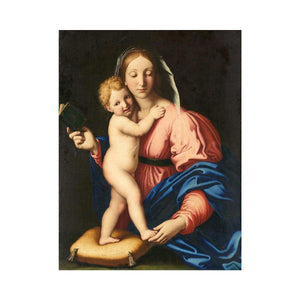
Madonna and Child Painting by Giovanni Battista is a work of devotional clarity and serene authority, embodying the enduring spiritual ideals of the Italian Renaissance while offering a timeless vision of tenderness, balance, and sacred intimacy. Attributed to Giovanni Battista Salvi, known as Sassoferrato, the painting reflects a deliberate return to purity of form and emotional restraint, qualities that defined his approach to religious art. Rather than dramatic narrative or complex symbolism, the work presents faith as stillness, contemplation, and enduring grace.
Giovanni Battista Salvi built his reputation on devotional images that consciously revived the clarity and spiritual calm of High Renaissance masters such as Raphael and Perugino. Working in the seventeenth century, at a time when Baroque drama dominated much of European art, Giovanni Battista chose an alternative path. His Madonna and Child paintings reject theatrical excess in favor of harmony, idealized beauty, and inward devotion. This choice was not conservative imitation, but a philosophical commitment to timeless spiritual ideals.
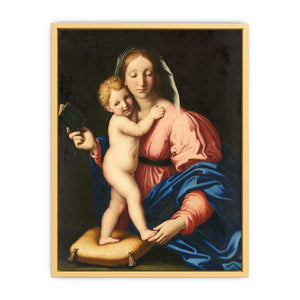
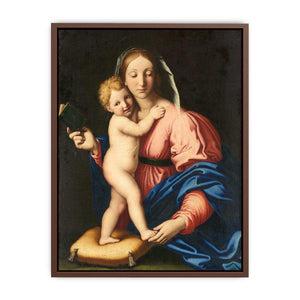
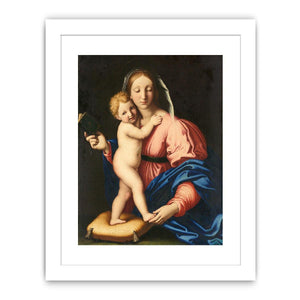
The subject of the Madonna and Child is presented with composed simplicity. The Virgin Mary holds the Christ Child with quiet assurance, her posture stable, her expression calm and introspective. There is no overt drama, no moment of action. Instead, the painting offers an image of eternal presence. Mother and child exist in a state of sacred pause, inviting contemplation rather than emotional reaction. This stillness is central to the painting’s devotional power.
Compositionally, the work is governed by balance and symmetry. The figures are arranged to create a stable triangular structure, a classical compositional device long associated with harmony and divine order. This structure reinforces the spiritual message of the painting: faith as equilibrium, belief as constancy. The Virgin’s figure anchors the composition, while the child’s form introduces gentle movement without disturbing overall calm.
Perspective is deliberately shallow, minimizing spatial depth in favor of clarity and focus. The background is often restrained, neutral, or softly idealized, ensuring that attention remains fixed on the figures themselves. Space here is not meant to situate the figures in a specific environment, but to isolate them from distraction. The result is an image that feels timeless, existing outside historical moment or physical location.
Light plays a crucial role in shaping the painting’s devotional atmosphere. Illumination is soft and even, caressing the figures without casting dramatic shadows. This gentle light reinforces the sense of spiritual purity and calm authority. Light does not dramatize; it reveals. It serves as a visual metaphor for divine presence—constant, unobtrusive, and sustaining.
Color is restrained and harmoniously balanced. Giovanni Battista employs a palette of gentle blues, warm flesh tones, and soft earth colors, each carefully modulated to maintain unity. The Virgin’s garments often carry symbolic resonance through traditional hues, yet these associations are never forced. Color functions primarily to support serenity and visual coherence, allowing the painting to communicate through harmony rather than contrast.
The handling of form reflects refined idealization. Faces are smooth, features balanced, expressions composed. This idealization is not meant to distance the figures from humanity, but to elevate them into a spiritual register. The Madonna is not depicted as an individual woman marked by personality or circumstance; she is presented as an embodiment of maternal devotion and spiritual acceptance. The child, likewise, is rendered with gentle dignity rather than playful realism.
Emotionally, Madonna and Child Painting by Giovanni Battista conveys peace rather than passion. The bond between mother and child is expressed through proximity and gesture, not through overt display. This restraint allows viewers to project their own contemplation into the image. The painting does not instruct emotion; it creates space for it.
Symbolically, the work participates in a long Christian tradition in which the Madonna represents intercession, compassion, and spiritual refuge. The Christ Child embodies promise, redemption, and divine incarnation. Giovanni Battista does not overload these symbols with narrative detail. Instead, he allows their meaning to reside in presence itself. The painting becomes an image for meditation, not interpretation.
Within Giovanni Battista Salvi’s broader body of work, Madonna and Child represents the core of his artistic mission. While many contemporaries pursued movement and spectacle, he pursued clarity and stillness. His work appealed particularly to private devotion, monasteries, and collectors seeking images that supported prayer and reflection rather than dramatic engagement. This focus ensured the enduring relevance of his paintings across centuries.
Culturally, the painting reflects a countercurrent within seventeenth-century Italian art—a reaffirmation of Renaissance ideals in an age of Baroque intensity. By returning to balanced composition and emotional restraint, Giovanni Battista asserted that spiritual authority could be expressed through calm rather than excess. This position has ensured his lasting place within the history of religious art.
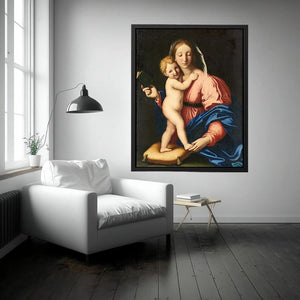
In contemporary interiors across the United States, the United Kingdom, Canada, Australia, and Europe, Madonna and Child Painting by Giovanni Battista integrates with exceptional dignity. In living rooms, it introduces serenity and contemplative depth. In studies and private spaces, it supports reflection and quiet focus. In galleries and luxury residences, it signals appreciation for classical devotional art grounded in balance and refinement.
The painting works seamlessly in traditional interiors, where its classical composition and spiritual subject resonate naturally. It also integrates effectively into modern and minimalist spaces, where its clarity, symmetry, and calm presence provide visual and emotional grounding. In eclectic environments, it functions as a stabilizing element, offering continuity amid varied styles.
The long-term artistic importance of Madonna and Child Painting by Giovanni Battista lies in its affirmation of stillness as power. The painting demonstrates that devotion does not require spectacle, and that spiritual meaning can be conveyed through restraint and harmony. Its endurance rests on this quiet authority, which remains accessible across cultures and eras.
Today, Madonna and Child Painting by Giovanni Battista continues to resonate in a world often defined by speed and distraction. Its invitation to pause, reflect, and contemplate remains profoundly relevant. Through balanced composition, gentle light, and idealized form, Giovanni Battista created an image that transcends time—one that continues to offer solace, clarity, and spiritual presence.
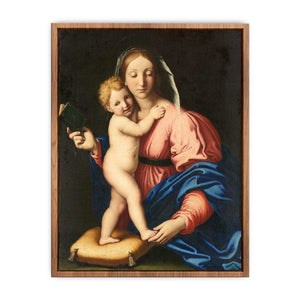
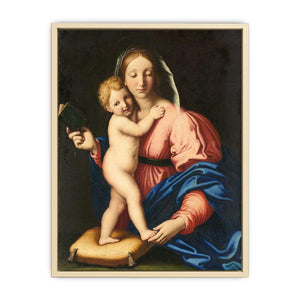
Buy museum qulaity 400- 450 canvas prints, framed prints, and 100% oil paintings of Madonna and Child by Giovanni Battista at Alpha Art Gallery, where world-famous masterpieces are recreated with museum-quality detail, refined craftsmanship, and premium materials.
FAQS
Which Giovanni Battista is associated with this Madonna and Child painting?
The work is attributed to Giovanni Battista Salvi, known as Sassoferrato, renowned for serene devotional imagery.
What artistic style does this painting represent?
It reflects a Renaissance-inspired devotional style marked by balance, idealization, and emotional restraint.
Why is the painting so calm and still?
Giovanni Battista emphasized contemplation and spiritual clarity over dramatic narrative.
What is the spiritual significance of the Madonna and Child theme?
It represents maternal compassion, divine incarnation, and spiritual refuge within Christian tradition.
Where does this artwork work best in interior spaces?
It is well suited to living rooms, studies, private devotional spaces, galleries, and refined residences.
Is Madonna and Child suitable for modern décor?
Yes, its symmetry, clarity, and serene palette integrate beautifully into modern and minimalist interiors.
Does this painting have lasting artistic value?
It is valued for its timeless devotional presence, classical harmony, and enduring spiritual relevance.