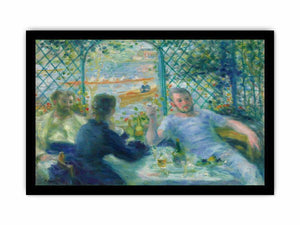
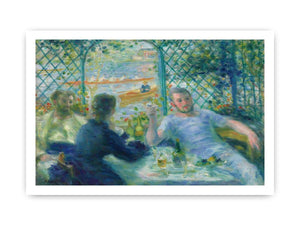
Lunch at the Restaurant Fournaise Painting by Pierre-Auguste Renoir
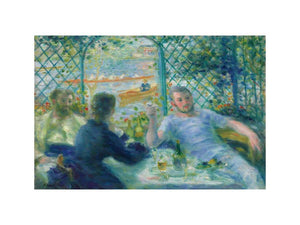
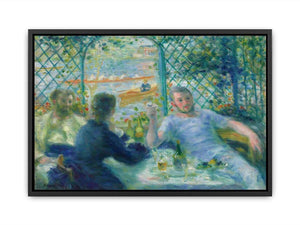
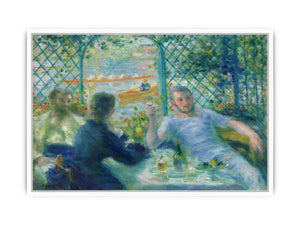
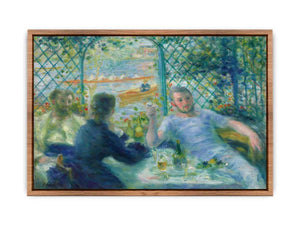
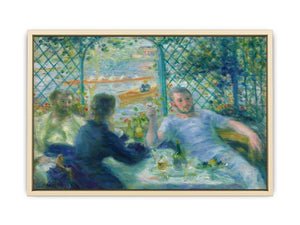
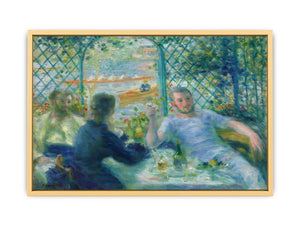
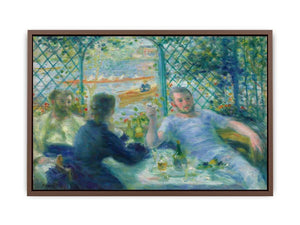
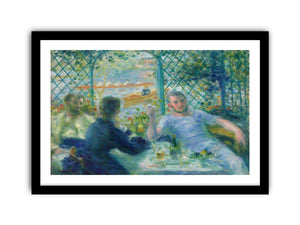
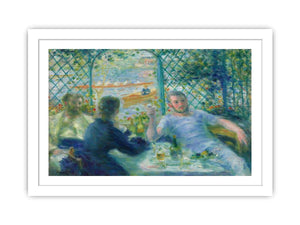
Lunch at the Restaurant Fournaise Painting by Pierre-Auguste Renoir is a radiant affirmation of sociability, leisure, and human warmth, capturing a fleeting yet deeply resonant moment of modern life at the height of Impressionism. Painted in the early 1870s, the work belongs to a formative phase in Renoir’s career, when he was refining his vision of contemporary experience through light, color, and intimate observation. The painting does not merely depict a meal shared by friends; it articulates a philosophy of presence, where pleasure, companionship, and perception are woven into a unified visual harmony.
Pierre‑Auguste Renoir approached painting with a conviction that art should affirm life rather than dissect it. While many of his contemporaries explored the city’s anonymity or the countryside’s solitude, Renoir gravitated toward moments of shared enjoyment—conversations, glances, gestures, and the subtle choreography of social interaction. Lunch at the Restaurant Fournaise exemplifies this orientation. It is neither a staged tableau nor a casual sketch, but a carefully balanced composition that preserves the spontaneity of lived experience.
The subject is a group gathered around a table at the Restaurant Fournaise, a riverside establishment along the Seine frequented by artists and friends. Renoir does not impose hierarchy among the figures. No single person dominates the scene. Instead, the painting unfolds as a network of relationships—people leaning toward one another, pausing mid-gesture, absorbed in conversation or quiet reflection. The scene is animated yet unforced, conveying the rhythm of social life without theatrical emphasis.
Compositionally, the painting is orchestrated to encourage circulation of the eye. Figures are arranged in a loose but deliberate pattern that guides attention across the canvas rather than toward a central focal point. Renoir uses overlapping forms, angled bodies, and variations in posture to create visual continuity. The table anchors the scene, yet it does not confine it. Space opens outward through the background, suggesting air, light, and the river beyond, even when not explicitly rendered.
Perspective places the viewer at the table’s edge, close enough to feel included but not intrusive. This proximity is essential to the painting’s emotional tone. Renoir does not position the viewer as an observer from a distance; he invites participation. The scene feels lived-in, as though it continues beyond the frame. This sense of immediacy distinguishes the work from more formal depictions of dining and social ritual.
Light is central to the painting’s vitality. Natural daylight filters gently across faces, clothing, and tableware, dissolving hard edges and unifying the scene. Renoir does not dramatize light through contrast. Instead, illumination is diffuse and enveloping, reinforcing the painting’s atmosphere of ease. Light here is not directional; it is social, shared among figures and objects alike.
Color is employed with warmth and sensitivity. Renoir’s palette favors soft whites, gentle blues, warm flesh tones, and subtle accents that enliven the scene without overpowering it. Colors interact through proximity rather than isolation, creating a sense of chromatic conversation that mirrors the human exchanges depicted. There is no rigid separation between figure and environment; color binds them together.
Renoir’s brushwork is fluid and responsive. Strokes remain visible, yet they are never aggressive. The surface vibrates with life, suggesting movement and breath rather than solidity. Forms are defined through color and light rather than line, reinforcing the painting’s emphasis on sensation over structure. This handling allows the scene to feel immediate, as though captured in the midst of unfolding time.
Emotionally, Lunch at the Restaurant Fournaise conveys contentment without complacency. The figures are relaxed, yet attentive; at ease, yet engaged. There is no overt narrative, no dramatic exchange. Instead, the painting honors the quiet richness of ordinary pleasure—the satisfaction of company, the warmth of shared space, the subtle intimacy of conversation. Renoir affirms these moments as worthy of sustained attention.
Psychologically, the painting reflects a modern understanding of identity as relational. Individuals are defined not in isolation but through interaction. Glances, proximity, and posture communicate as much as facial expression. Renoir avoids caricature or social commentary. His interest lies in presence rather than judgment. The figures are neither idealized nor scrutinized; they are accepted as they are.
Symbolically, the painting has often been read as an emblem of Impressionist values: modern life, leisure, and immediacy. Yet its significance extends beyond stylistic association. Lunch at the Restaurant Fournaise represents a broader cultural shift, in which everyday experiences became legitimate subjects of serious art. Renoir asserts that meaning resides not only in history or mythology, but in lived moments shared among people.
Within Renoir’s artistic development, the work marks a confident assertion of his mature approach. While earlier paintings experimented with light and outdoor scenes, this work demonstrates his ability to integrate figure, environment, and emotion into a cohesive whole. It anticipates later masterpieces that would further explore social interaction, yet it retains a freshness rooted in direct observation.
Culturally, the painting reflects the transformation of Parisian life in the late nineteenth century, when cafés, restaurants, and leisure spaces became centers of social exchange. Renoir does not depict these spaces as symbols of excess or modern anxiety. Instead, he presents them as environments where human connection flourishes. This perspective distinguishes his work from more critical or detached views of modernity.
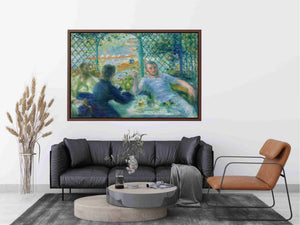
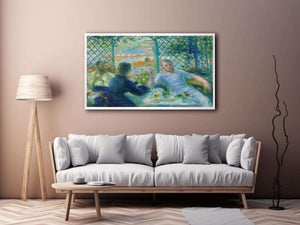
In contemporary interiors across the United States, the United Kingdom, Canada, Australia, and Europe, Lunch at the Restaurant Fournaise offers enduring appeal. In living rooms, it introduces warmth, conviviality, and visual lightness. In dining areas, it resonates naturally with themes of gathering and shared experience. In studies and offices, it provides balance, reminding viewers of life beyond work and abstraction. In galleries and luxury residences, it signals appreciation for Impressionism’s humanistic core.
The painting integrates seamlessly into traditional interiors through its classical balance and refined palette. It also enhances modern and minimalist spaces, where its softness and social energy counteract austerity. In eclectic environments, it functions as a unifying presence, harmonizing diverse elements through shared warmth.
The long-term artistic importance of Lunch at the Restaurant Fournaise lies in its affirmation of everyday joy as a subject of lasting value. Renoir demonstrates that art need not dramatize or moralize to endure. By attending closely to light, color, and human presence, he created a painting that remains emotionally accessible and intellectually sound.
Today, the work continues to resonate with audiences seeking connection and calm in a fragmented world. Its vision of shared time, unhurried conversation, and gentle pleasure feels both historical and immediate. Through luminous color, fluid form, and profound attentiveness to human interaction, Pierre-Auguste Renoir created a painting that endures as a celebration of life lived together.
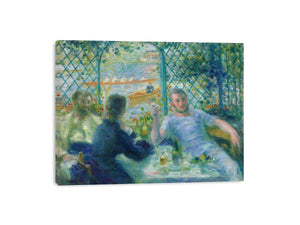
Buy museum qulaity 400- 450 canvas prints, framed prints, and 100% oil paintings of Lunch at the Restaurant Fournaise by Pierre-Auguste Renoir at Alpha Art Gallery, where world-famous masterpieces are recreated with museum-quality detail, refined craftsmanship, and premium materials.
FAQS
What does Lunch at the Restaurant Fournaise depict?
It depicts a group of people sharing a meal and conversation at a riverside restaurant, emphasizing social interaction and leisure.
Why is this painting important in Renoir’s career?
It reflects his mature Impressionist style and his focus on human warmth, light, and shared experience.
Is the scene based on real life?
Yes, it is inspired by Renoir’s circle and a real restaurant frequented by artists and friends.
What mood does the painting convey?
It conveys ease, contentment, and quiet social harmony rather than drama or narrative tension.
Where does this artwork work best in interior spaces?
It is well suited to living rooms, dining areas, studies, offices, galleries, and refined residential interiors.
Is Lunch at the Restaurant Fournaise suitable for modern décor?
Yes, its light palette and fluid composition integrate beautifully into modern and minimalist spaces.
Does the painting have lasting artistic significance?
It is valued as a refined example of Impressionism’s humanistic vision and its celebration of everyday life.