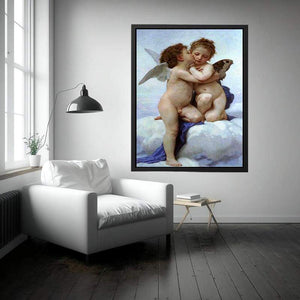
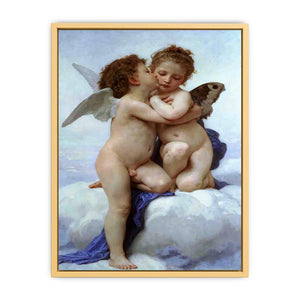
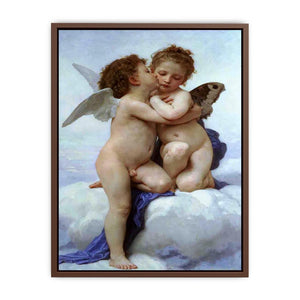
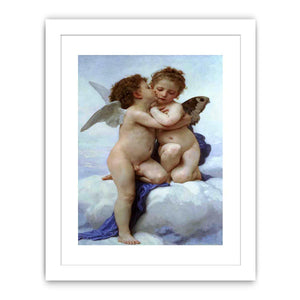
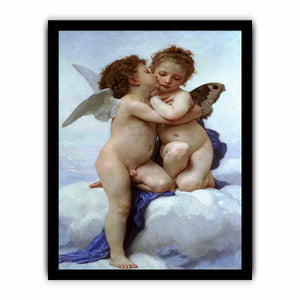
L'Amour et Psyche, enfants (Cupid and Psyche as Children) Painting by William Adolphe Bouguereau
L'Amour et Psyche, enfants (Cupid and Psyche as Children) stands as one of the most tender and conceptually refined works by William Adolphe Bouguereau, a painting in which classical mythology is transformed into an image of innocence, trust, and nascent emotion. Painted in 1890, the work reflects Bouguereau’s mature mastery of academic technique and his deeply human approach to mythological subject matter. Rather than dramatizing passion or heroic conflict, he turns to childhood as a symbolic state, presenting love not as desire or tragedy, but as purity, vulnerability, and mutual discovery.
By the late nineteenth century, Bouguereau had become one of the most technically accomplished painters of his era, renowned for his command of anatomy, surface, and compositional balance. Yet beneath this technical precision lay a consistent philosophical orientation. Bouguereau believed that art should aspire toward beauty, clarity, and moral resonance. In L'Amour et Psyche, enfants, he achieves this synthesis with exceptional restraint. The myth of Cupid and Psyche—traditionally associated with trials, longing, and transcendence—is reimagined here at its point of origin, before suffering, separation, or desire intrude. What remains is the essence of connection.
The composition is intimate and closely framed. Two children sit together, their bodies inclined toward one another in a gesture of quiet closeness. Cupid, identifiable by his small wings, leans gently toward Psyche, whose posture conveys trust and attentiveness. Their proximity suggests affection without self-consciousness, a bond formed instinctively rather than declared. Bouguereau eliminates extraneous setting and narrative detail, allowing the relationship itself to occupy the centre of meaning. The scene unfolds not as an episode, but as a state of being.
The balance of the composition is meticulously controlled. The figures form a unified, interlocking arrangement, their gestures and gazes creating a closed circuit of attention. There is no outward address to the viewer; the children are absorbed in one another. This inward focus reinforces the painting’s emotional integrity, preserving the sense that the moment exists independently of observation. Bouguereau’s compositional restraint ensures that nothing distracts from the psychological and symbolic core of the work.
Light plays a crucial role in shaping the painting’s tone. It falls softly across the children’s skin, illuminating their forms with even clarity. There are no dramatic shadows, no theatrical contrasts. Instead, light functions as a unifying presence, revealing texture and volume without intrusion. This gentle illumination enhances the sense of timelessness, situating the scene outside specific hour or place. Light here affirms innocence rather than drama.
Colour is employed with subtle refinement. Bouguereau’s palette is warm and harmonious, dominated by natural flesh tones, muted earth hues, and delicate accents that support unity rather than contrast. The colours do not compete for attention; they collaborate. This chromatic restraint reinforces the painting’s emotional calm, allowing the figures’ expressions and gestures to carry meaning. Colour becomes an atmosphere rather than a statement.
Bouguereau’s technique is, as always, exacting. The modelling of flesh is smooth and precise, achieving softness without sentimentality. Skin appears luminous yet substantial, conveying youth without fragility. The transition between light and shadow is seamless, demonstrating Bouguereau’s unrivalled control of form. This technical perfection is not decorative excess; it serves the painting’s conceptual clarity. The absence of visible brushwork removes any sense of artifice, allowing the scene to appear inevitable rather than constructed.
Symbolically, the decision to depict Cupid and Psyche as children is central to the painting’s meaning. Childhood represents potential rather than fulfillment, feeling before desire, attachment before trial. Bouguereau strips the myth of its later complexity to reveal its foundation: love as recognition and closeness rather than conquest or endurance. The children’s interaction suggests that love, at its most essential, is gentle and reciprocal. Psyche, whose name signifies the soul, is shown here not as tested or wounded, but as open and unguarded. Cupid, the embodiment of love, appears not as a mischievous force, but as a companion.
Emotionally, the painting conveys serenity and tenderness without sentimentality. There is no exaggerated sweetness, no theatrical expression. The children’s calm engagement invites quiet empathy rather than overt emotion. Viewers often experience a sense of stillness when encountering the work, as though witnessing a moment that should not be disturbed. This emotional restraint is central to Bouguereau’s vision. He trusts the viewer to feel without being instructed how.
Within Bouguereau’s body of work, L'Amour et Psyche, enfants represents a culmination of his mythological approach. It exemplifies his ability to reconcile classical subject matter with human immediacy, avoiding both academic stiffness and romantic excess. The painting reflects his conviction that myth remains relevant not through spectacle, but through psychological truth and emotional clarity.
Culturally, the painting occupies a distinctive position at the close of the nineteenth century, a period increasingly drawn toward realism, symbolism, and modern fragmentation. Bouguereau’s work stands apart, not in opposition to modernity, but in quiet continuity with enduring ideals of beauty and coherence. L'Amour et Psyche, enfants asserts that innocence and harmony remain worthy subjects of serious art, even in an age of change.
In contemporary interiors, the painting offers exceptional adaptability and emotional presence. In living rooms, it introduces calm refinement and cultural depth without visual dominance. In bedrooms and private spaces, it reinforces intimacy and quiet reflection. In studies, libraries, and galleries, it communicates intellectual seriousness softened by human warmth. Within luxury residences across the United States, United Kingdom, Canada, Australia, and Europe, the work integrates seamlessly with classical, transitional, and minimalist décor. Its balanced composition and gentle palette allow it to anchor a space with understated authority.
The enduring relevance of L'Amour et Psyche, enfants lies in its affirmation of love as origin rather than outcome. Bouguereau reminds viewers that before passion, before suffering, and before transcendence, love begins as closeness, trust, and shared attention. By returning to this beginning, he offers a vision of human connection that remains profoundly resonant. The painting endures not because it dazzles, but because it reassures, presenting love not as conflict, but as quiet recognition between two souls at rest.
Buy museum qulaity 400- 450 canvas prints, framed prints, and 100% oil paintings of L'Amour et Psyche, enfants (Cupid and Psyche as Children) by William Adolphe Bouguereau at Alpha Art Gallery, where world-famous masterpieces are recreated with museum-quality detail, refined craftsmanship, and premium materials.
FAQS
What does L'Amour et Psyche, enfants by William Adolphe Bouguereau represent?
It represents love and the soul in their purest state, depicted as childhood innocence, trust, and emotional closeness.
Why are Cupid and Psyche shown as children in this painting?
Bouguereau chose childhood to symbolise love before desire or suffering, focusing on origin rather than mythic trials.
How does this painting differ from other depictions of Cupid and Psyche?
Unlike dramatic or romantic interpretations, it emphasises tenderness, calm, and psychological intimacy.
What role does light play in the composition?
Soft, even light reinforces timelessness and innocence without theatrical contrast.
Is the painting meant to be symbolic or narrative?
It is symbolic rather than narrative, presenting a state of being rather than a specific mythological event.
How does Bouguereau’s technique contribute to the painting’s effect?
His precise modelling and smooth surface enhance realism and emotional clarity without distraction.
Is L'Amour et Psyche, enfants suitable for contemporary interiors?
Yes, its gentle palette and balanced composition suit both classical and modern spaces.
Why does this painting remain relevant today?
Its portrayal of love as gentle recognition and trust continues to resonate across cultures and generations.