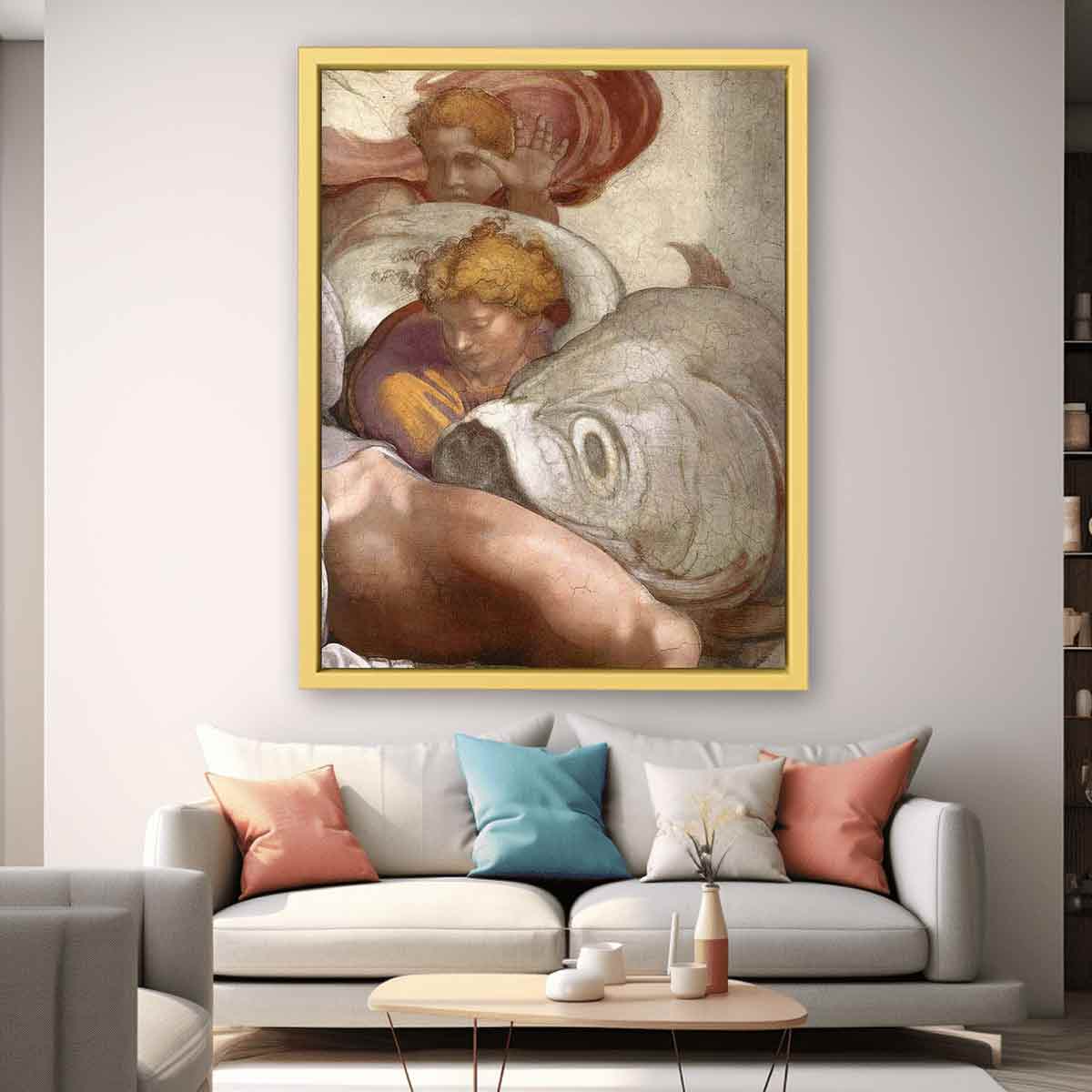
Jonah is one of the monumental prophets painted by Michelangelo Buonarroti on the ceiling of the Sistine Chapel in Vatican City. This detailed view focuses on the powerful figure of the biblical prophet Jonah, whose dramatic reclining pose, monumental anatomy, and expressive movement make him one of the most visually striking figures in Michelangelo's celebrated ceiling frescoes.
Jonah occupies the position above the altar and forms an important part of the theological and visual programme surrounding the central Genesis scenes. Michelangelo presents the prophet with an extraordinary sense of movement, using a complex reclining pose and upward turn of the head to create drama across the curved architectural surface.
Who Was the Prophet Jonah?
Jonah is a biblical prophet whose story appears in the Book of Jonah in the Old Testament. He is particularly famous for the episode in which he is swallowed by a great fish after attempting to flee from God's command to preach to the people of Nineveh.
Jonah's emergence from the fish became an important Christian symbol and was traditionally interpreted as a prefiguration of Christ's death and resurrection.
Michelangelo's Dramatic Human Figure
Jonah is an extraordinary demonstration of Michelangelo's fascination with the human body. The torso twists dramatically while the limbs extend in different directions, allowing the artist to demonstrate anatomy and complex foreshortening.
Although the figure is painted in fresco, it possesses the physical authority of sculpture. Michelangelo's understanding of volume is clearly visible in the modelling of the body.
Jonah on the Sistine Chapel Ceiling
Michelangelo painted the Sistine Chapel ceiling between 1508 and 1512. The completed ceiling contains nine central scenes from Genesis surrounded by prophets, sibyls, ancestors of Christ, ignudi, and elaborate architectural elements.
Jonah is positioned at the altar end and acts as a monumental transition between the central Genesis narrative and the sanctuary area of the chapel.
High Renaissance and Mannerist Influence
The Jonah fresco belongs to Michelangelo's High Renaissance period while anticipating qualities associated with Mannerism. Its extreme pose, powerful anatomy, and expressive distortion became influential among later sixteenth-century artists.
Wall Art and Reproduction Formats
The dramatic pose and monumental anatomy of Jonah make this artwork particularly effective as wall art. It can become a striking focal point in a study, library, office, gallery, or classical interior.
Canvas Print
A canvas print is particularly appropriate for this monumental fresco and provides strong wall presence.
Fine Art Print
A fine art print offers a refined presentation for collectors of Renaissance, religious, and historical art.
Framed Print
A framed print provides a finished formal presentation suitable for traditional interiors.
Hand-Painted Oil Reproduction
A 100% hand-painted oil painting reproduction provides a tactile interpretation with genuine brushwork and painted texture.
Frequently Asked Questions
Who painted Jonah?
Jonah was painted by Michelangelo Buonarroti as part of the Sistine Chapel ceiling.
What does the fresco depict?
It depicts the biblical prophet Jonah in a dramatic reclining and twisting pose.
Where is the original?
The original fresco remains on the ceiling of the Sistine Chapel in Vatican City.
Can I buy a Jonah canvas print?
Yes. Available formats include canvas, fine art, framed, and hand-painted oil reproductions.
Bring Michelangelo's Jonah Into Your Space
Jonah combines biblical symbolism with extraordinary anatomical knowledge, monumental scale, and complex movement, making it one of the most dramatic prophetic figures of Renaissance art.