Joan Of Arc Painting by Jules Bastien Lepage
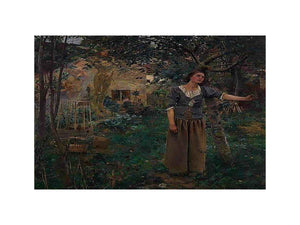
Joan of Arc stands as one of Jules Bastien-Lepage’s most psychologically intense and intellectually modern works, a painting in which history, vision, and inner consciousness are fused with extraordinary subtlety. Completed in 1879, the work departs decisively from traditional heroic or theatrical representations of the French saint. Instead of depicting Joan in armour on the battlefield or in the blaze of martyrdom, Bastien-Lepage situates her at the threshold of revelation—alone, rooted in the rural world, and suspended between ordinary life and extraordinary destiny. The painting becomes not an illustration of legend, but an exploration of belief as an internal, lived experience.
Jules Bastien-Lepage emerged as one of the most significant figures in late nineteenth-century French painting, bridging Realism and Naturalism while profoundly influencing Symbolism. Deeply committed to truth of observation, he believed that modern history painting must begin with psychological credibility rather than grand gesture. In Joan of Arc, this philosophy finds its fullest expression. Bastien-Lepage strips the subject of pageantry and places her within the familiar landscape of Domrémy, grounding the miraculous in the tangible realities of rural France.
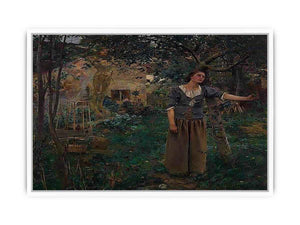
The composition is striking in its restraint. Joan stands motionless in the foreground, her body rigid, her hands clenched, her gaze unfocused yet inwardly fixed. She is neither triumphant nor ecstatic. Instead, she appears arrested—caught at the exact moment when the boundary between the visible and invisible dissolves. Behind her, spectral figures emerge subtly from the foliage, not as dominating apparitions, but as faint, almost hesitant presences. Bastien-Lepage refuses spectacle, allowing the supernatural to appear as psychological intrusion rather than visual command.
Perspective reinforces this interior tension. Joan is rendered at nearly life scale, occupying the viewer’s space with uncompromising immediacy. There is no distancing framework, no elevated viewpoint. The viewer confronts her as one might confront a living person undergoing an experience that cannot be shared. The background recedes into layered depth, but Joan remains anchored in the present, her physicality inescapable.
Light plays a crucial and unconventional role. Bastien-Lepage employs a cool, even illumination that denies dramatic contrast. There is no divine glow separating Joan from her surroundings. Instead, light treats the mundane and the visionary with equal neutrality. This decision is radical. It suggests that revelation does not rupture reality, but occurs within it. The supernatural does not override the world; it inhabits it quietly, insistently.
Colour is subdued and resolutely naturalistic. Earthy browns, muted greens, and softened flesh tones dominate the palette, binding Joan inseparably to her environment. The spectral figures behind her are rendered in pale, desaturated hues, almost dissolving into air and foliage. Colour thus becomes a psychological instrument, differentiating states of being without breaking visual coherence. The world of labour and the world of vision coexist uneasily within the same chromatic field.
Bastien-Lepage’s handling of texture reveals his allegiance to Naturalism. Joan’s clothing is coarse, practical, and worn—rendered with tactile honesty. The earth beneath her feet, the tree bark, and the surrounding vegetation are observed with uncompromising precision. Against this material certainty, the ethereal figures appear deliberately unresolved, their forms softer, less anchored. The contrast reinforces the painting’s central tension between the physical and the immaterial.
Emotionally, Joan of Arc is defined by containment rather than release. Joan does not react outwardly to her visions. Her expression conveys strain, concentration, and isolation. Bastien-Lepage presents belief not as comfort, but as burden. The calling is intrusive, demanding, and irrevocable. This psychological realism transforms Joan from saintly icon into human subject, making her experience intelligible without diminishing its gravity.
Symbolically, the painting redefines sanctity. Joan’s holiness is not expressed through miracles or triumphs, but through inward submission to an unseen command. The absence of overt religious symbolism is deliberate. Bastien-Lepage allows the viewer to encounter faith as an internal conflict rather than a public declaration. Joan’s solitude underscores the loneliness of conviction, especially when it precedes understanding or validation.
Within Bastien-Lepage’s oeuvre, Joan of Arc represents a pivotal achievement. While he was celebrated for his rural genre scenes, this painting demonstrates his capacity to expand Naturalism into the realm of psychological symbolism. It anticipates later Symbolist explorations of inner vision while remaining grounded in observational truth. The work redefines what historical painting could be in the modern age: not reenactment, but interpretation of consciousness.
The painting’s relevance today remains profound across the United States, the United Kingdom, Canada, Australia, and Europe. Contemporary audiences continue to recognise in Joan’s expression the universal experience of inner calling, moral tension, and isolation. In a modern world often sceptical of absolutes, Bastien-Lepage’s Joan resonates as a figure of conviction shaped not by certainty, but by inner necessity.
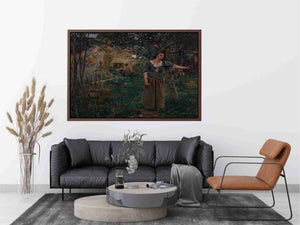
In interior settings, Joan of Arc introduces intellectual gravity and emotional depth. In living rooms, it functions as a contemplative focal point that invites sustained engagement. In studies and offices, it reinforces themes of responsibility, courage, and inward resolve. In galleries and luxury residences, it signals refined appreciation for psychologically sophisticated nineteenth-century painting.
The painting integrates seamlessly into traditional, modern, minimalist, and eclectic décor. Traditional interiors resonate with its historical subject and classical seriousness. Modern spaces benefit from its psychological intensity and compositional restraint. Minimalist environments amplify its stillness and tension, while eclectic interiors draw cohesion from its subdued palette and symbolic depth.
The enduring importance of Joan of Arc lies in its refusal to simplify belief or heroism. Bastien-Lepage presents faith as an interior struggle rather than a public spectacle. The painting endures because it recognises that history’s most transformative figures are often shaped not by outward triumph, but by solitary moments of inward decision.
To live with Joan of Arc is to engage daily with a work that honours complexity, doubt, and resolve. Through its disciplined realism, symbolic subtlety, and psychological acuity, the painting continues to affirm Jules Bastien-Lepage’s position as one of the most forward-looking painters of the nineteenth century. It stands as a testament to his belief that modern art must reveal not only what happened, but what it felt like to become history.
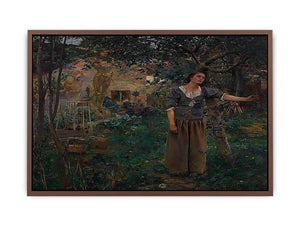
Buy museum qulaity 400- 450 canvas prints, framed prints, and 100% oil paintings of Joan Of Arc by Jules Bastien Lepage at Alpha Art Gallery, where world-famous masterpieces are recreated with museum-quality detail, refined craftsmanship, and premium materials.
FAQS
What moment does Joan of Arc by Jules Bastien-Lepage depict?
It depicts Joan at the moment of receiving her visions, focusing on inner experience rather than public action.
Why is this painting considered psychologically modern?
It presents belief as an internal, conflicted state rather than heroic spectacle or religious triumph.
How does Bastien-Lepage differ from traditional depictions of Joan of Arc?
He removes armour, battle, and pageantry, grounding Joan in rural reality and inward tension.
What role do the background figures play in the painting?
They represent Joan’s visions, rendered subtly to suggest psychological presence rather than physical domination.
Is Joan of Arc suitable for contemporary interiors?
Yes. Its restrained palette and psychological depth integrate powerfully into modern and traditional spaces.
What emotional tone does the painting convey?
It conveys tension, solitude, and inward resolve rather than triumph or ecstasy.
Does this artwork have lasting cultural significance?
As one of the most influential modern interpretations of Joan of Arc, it holds enduring artistic and intellectual importance.
Where is the best place to display Joan of Arc?
It is especially well suited to studies, offices, galleries, and living spaces that value reflection, history, and moral depth.