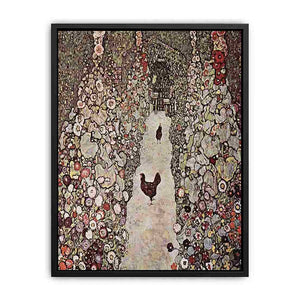
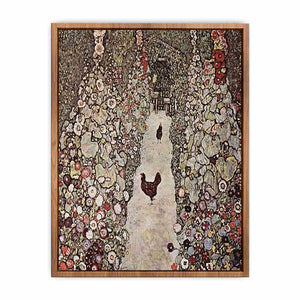
Garden with Roosters Painting by Gustav Klimt
Garden with Roosters Painting by Gustav Klimt occupies a distinctive and intellectually rich position within the artist’s late landscape and garden works, revealing a quieter yet no less radical dimension of his artistic vision. Unlike the gilded portraits and symbol-laden allegories for which Klimt is most widely known, this painting directs attention toward nature observed through a decorative, rhythmic, and deeply personal lens. It demonstrates how Klimt’s revolutionary approach to surface, pattern, and perception extended beyond the human figure into the natural world, where animals, vegetation, and space are bound together in a unified visual language.
Gustav Klimt created Garden with Roosters during a period when he increasingly withdrew from public commissions and concentrated on landscapes painted during his summer retreats. These works allowed him to explore color, texture, and structure free from the constraints of portraiture or allegorical narrative. In this context, Garden with Roosters emerges not as a pastoral anecdote, but as an experiment in perception—an attempt to reconcile observation with decoration, and nature with abstraction.
The subject is deceptively simple: a cultivated garden animated by the presence of roosters. Yet Klimt transforms this everyday rural motif into a complex orchestration of pattern and movement. The roosters do not function as narrative actors; they are visual catalysts. Their angular bodies, upright stances, and rhythmic repetition punctuate the dense field of foliage, introducing dynamic accents within an otherwise immersive tapestry of color and form. The animals exist not apart from the garden, but within it, integrated into its visual and structural logic.
Compositionally, the painting rejects conventional depth. Klimt compresses space, stacking planes of vegetation and form until foreground and background dissolve into a continuous surface. This flattening is deliberate. Rather than guiding the eye into illusionistic distance, Klimt holds it on the picture plane, encouraging slow, meditative engagement with the surface itself. The roosters emerge from this field not through perspective, but through contrast and placement, asserting presence through pattern rather than scale.
Perspective in Garden with Roosters is therefore conceptual rather than optical. Klimt invites the viewer to experience the garden as an all-over environment, akin to a textile or mosaic, where every section carries equal visual weight. This approach aligns with his broader interest in decorative unity, influenced by Byzantine mosaics, Japanese prints, and the applied arts. The painting becomes less a window onto a garden than an autonomous visual field governed by rhythm and repetition.
Color is central to the painting’s effect. Klimt employs a vibrant yet controlled palette dominated by greens, punctuated by brighter accents from flowers and the roosters themselves. These colors are not blended to create atmospheric recession; instead, they are laid down in discrete areas, creating a shimmering surface of juxtaposed hues. Color functions structurally, organizing the composition into interlocking zones rather than descriptive planes.
Light, in the traditional sense, is largely absent. There is no identifiable source of illumination casting shadows or modeling form. Instead, Klimt replaces naturalistic light with chromatic intensity. The garden appears evenly lit, almost timeless, as though existing outside specific conditions of weather or hour. This choice reinforces the painting’s symbolic autonomy, freeing it from transient effects and situating it within a realm of sustained visual presence.
Klimt’s handling of texture further emphasizes this effect. Vegetation is rendered through repeated marks and patterns rather than individualized leaves or blades of grass. This repetition generates a sense of organic abundance without descriptive overload. The roosters, though more clearly articulated, are similarly stylized, their forms simplified to essential contours and color relationships. The result is a harmonious balance between recognition and abstraction.
Emotionally, Garden with Roosters conveys vitality without agitation. The roosters suggest alertness and life, yet the overall mood remains calm and contemplative. There is no implied action or narrative tension. The painting does not depict a moment unfolding in time, but a state of being—nature observed as continuous, rhythmic, and self-sustaining. This emotional equilibrium is characteristic of Klimt’s landscapes, which often evoke immersion rather than drama.
Symbolically, the presence of roosters carries layered associations. Traditionally linked to vigilance, cycles of time, and rural life, they introduce a subtle note of order and repetition into the composition. Yet Klimt does not insist on explicit symbolism. The roosters are allowed to remain what they are—living forms integrated into a decorative system. Any symbolic reading arises organically from the viewer’s engagement rather than from imposed allegory.
Within Klimt’s broader body of work, Garden with Roosters exemplifies his late commitment to dissolving boundaries between fine art and decoration. While his earlier Symbolist paintings often confront themes of desire, mortality, and myth, his landscapes shift toward sensory immersion and formal exploration. This painting demonstrates that Klimt’s radicalism was not confined to subject matter, but extended to how seeing itself could be structured.
Culturally, the painting reflects early twentieth-century Vienna’s engagement with modernism, where artists sought alternatives to academic realism and narrative painting. Klimt’s garden works, including Garden with Roosters, align with this search by proposing a vision of art rooted in pattern, surface, and sensory unity. They anticipate later developments in abstraction while remaining grounded in the natural world.
In contemporary interiors across the United States, the United Kingdom, Canada, Australia, and Europe, Garden with Roosters integrates with remarkable versatility. In living rooms, it introduces color, rhythm, and organic energy. In studies and private offices, it encourages contemplation and sustained visual engagement. In galleries and luxury residences, it signals an appreciation for Klimt’s lesser-known but profoundly influential landscape practice.
The painting works exceptionally well in modern and minimalist interiors, where its dense surface and vibrant palette provide visual richness without narrative clutter. It also complements eclectic spaces, where its decorative intensity harmonizes with layered textures and patterns. Even in traditional interiors, the work functions as a striking counterpoint, introducing modernist sensibility through controlled beauty.
The long-term artistic importance of Garden with Roosters lies in its demonstration that landscape can be both decorative and intellectually rigorous. Klimt shows that nature need not be depicted as distant scenery or dramatic event, but can be reimagined as an immersive field of pattern and presence. This approach continues to influence how viewers and artists understand the relationship between observation and abstraction.
Today, Garden with Roosters remains deeply relevant because it invites a different way of seeing—one that privileges attention, rhythm, and surface over narrative and illusion. Through chromatic richness, compositional unity, and restrained symbolism, Gustav Klimt created a painting that stands as a testament to his ability to transform even the most familiar subjects into enduring visual experiences.
Buy museum qulaity 400- 450 canvas prints, framed prints, and 100% oil paintings of Garden with Roosters by Gustav Klimt at Alpha Art Gallery, where world-famous masterpieces are recreated with museum-quality detail, refined craftsmanship, and premium materials.
FAQS
What is depicted in Garden with Roosters by Gustav Klimt?
It depicts a lush garden scene animated by roosters, rendered through dense pattern and vibrant color rather than traditional perspective.
Is this painting part of Klimt’s Symbolist phase?
It belongs to his later landscape period, where symbolism gives way to decorative unity and sensory immersion.
Why does the painting appear flat rather than deep?
Klimt intentionally compresses space to emphasize surface, pattern, and rhythmic composition.
Do the roosters have symbolic meaning?
They can suggest vigilance and cycles of life, but Klimt allows symbolism to remain subtle and open-ended.
Where does this artwork work best in interior spaces?
It is well suited to living rooms, studies, offices, galleries, and refined residential interiors.
Is Garden with Roosters suitable for modern décor?
Yes, its pattern-driven composition and vibrant palette integrate beautifully into modern and minimalist settings.
Does the painting have lasting artistic value?
Its innovative approach to landscape, decoration, and perception ensures enduring significance.