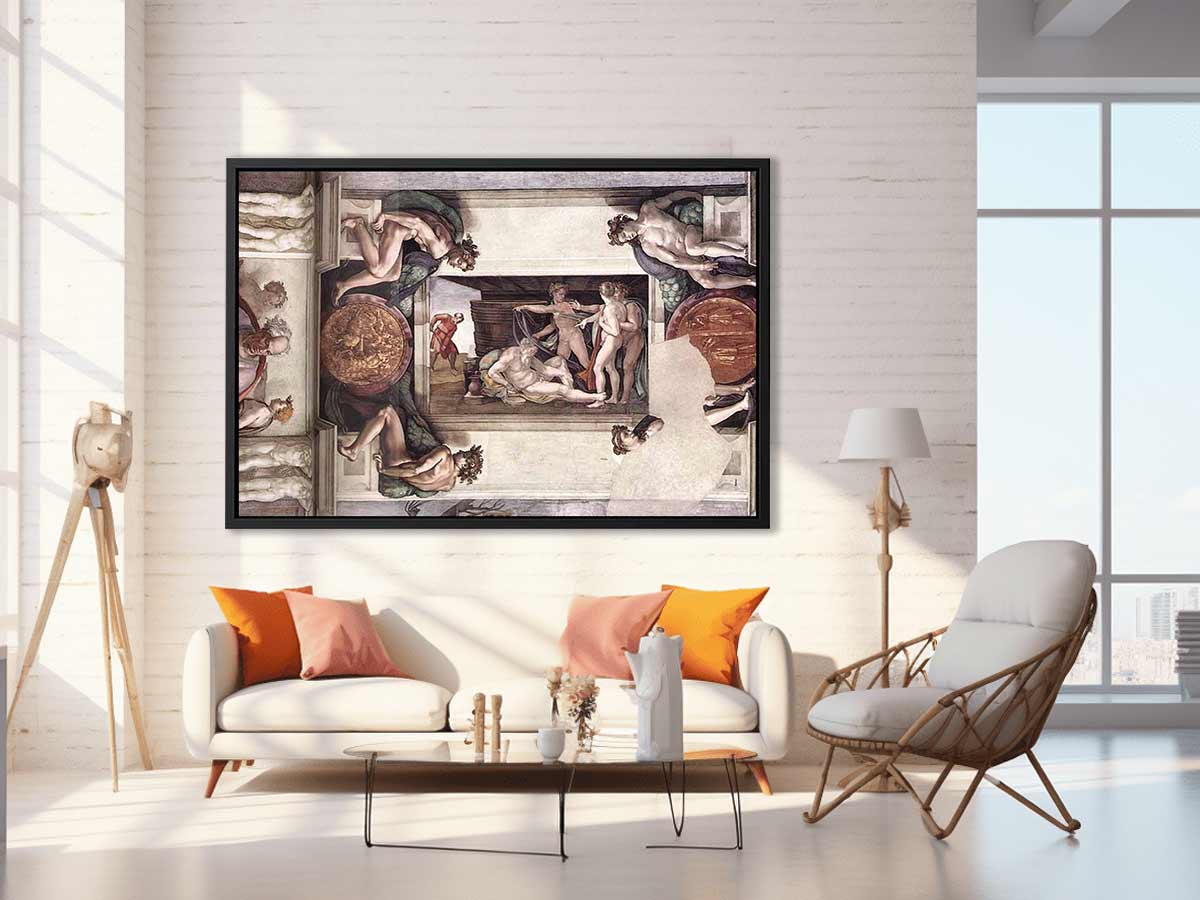
Sistine Chapel Ceiling: Bay 1 is the first bay of Michelangelo Buonarroti's monumental fresco programme on the Sistine Chapel ceiling, painted between 1508 and 1512. Its central Genesis scene is Separation of Light from Darkness, the opening episode in the nine Genesis narratives running along the vault. The bay introduces the powerful figure of God as Creator and establishes the theological and visual foundation of Michelangelo's Genesis cycle. Alpha Art Gallery offers contemporary reproductions as canvas prints, fine art prints, framed prints, and 100% hand-painted oil painting reproductions.
The First Bay of the Sistine Chapel
The term bay refers to one of the major sections of the vault organized through Michelangelo's painted architectural framework. Bay 1 contains the opening Genesis episode and its surrounding architectural and decorative elements. The central Genesis scenes are arranged along the axis of the ceiling, creating a visual narrative that begins with Creation and progresses toward the creation of humanity, the Fall, the Flood, and Noah.
At the center of Bay 1 is Separation of Light from Darkness, representing the biblical moment in Genesis when God separates light from darkness. Michelangelo presents the Creator as a monumental, twisting figure whose physical movement turns an abstract theological event into a dramatic visual experience.
Michelangelo's Ceiling Project
Michelangelo began work on the Sistine Chapel ceiling in 1508 after Pope Julius II commissioned the project. The final programme became far more ambitious than a simple decorative commission. It incorporated nine central Genesis scenes, Prophets and Sibyls, ancestors of Christ, ignudi, and an elaborate painted architectural framework. The complete ceiling was finished in 1512.
The first bay therefore serves as both an individual composition and the opening of a much larger integrated environment. Michelangelo designed the scenes, figures, and painted architecture to function together rather than as unrelated pictures.
Separation of Light from Darkness
The opening scene is based on Genesis 1:1–5 and describes the establishment of the distinction between light and darkness. Michelangelo concentrates attention on the Creator instead of filling the scene with numerous narrative figures. The powerful twisting body dominates the composition and gives the image an extraordinary sense of energy.
The figure demonstrates Michelangelo's exceptional understanding of anatomy. The torso, arms, legs, and drapery create a complex three-dimensional impression within the painted surface. His sculptural background is evident in the way the body seems to possess weight, volume, and movement.
Painted Architecture and the Larger Programme
The central Genesis scene is surrounded by an elaborate system of painted architecture and figures. Michelangelo transformed the curved vault into a coherent visual structure, using simulated architectural elements to frame the narrative scenes and connect the surrounding Prophets, Sibyls, ancestors, and ignudi.
This context is important because Bay 1 is not simply an isolated picture. Its meaning and visual power come partly from its position at the beginning of the entire ceiling programme.
High Renaissance Style
The Sistine Chapel ceiling is one of the defining achievements of the High Renaissance. Michelangelo combines monumental figure design, idealized anatomy, classical influence, expressive movement, and religious narrative. The first bay demonstrates this approach through the monumental Creator, whose human physicality becomes a vehicle for expressing divine power.
Where Is the Original?
The original Bay 1 fresco remains on the ceiling of the Sistine Chapel in Vatican City and is preserved as part of the Vatican Museums. It is an integral part of the building rather than a movable framed painting. Alpha Art Gallery's product is a contemporary reproduction based on Michelangelo's historic ceiling imagery.
Choosing a Reproduction
Museum-Quality Canvas Print
A canvas print provides strong wall presence and is particularly effective when the monumental Creator is intended to become a focal point. It can suit living rooms, studies, libraries, offices, and reception spaces.
Museum-Quality Fine Art Print
A fine art print provides a refined traditional presentation and works well in curated collections, studies, libraries, hallways, and bedrooms.
Museum-Quality Framed Print
A framed print offers a finished and formal presentation that can complement traditional interiors as well as contemporary rooms featuring Renaissance artwork.
100% Hand-Painted Oil Painting Reproduction
Alpha Art Gallery offers 100% hand-painted oil painting reproductions on canvas, individually painted by professional artists. This format provides genuine brushwork, painted texture, and visual depth.
Bay 1 as Wall Art
The strong central figure makes Bay 1 especially suitable as statement wall art. It can anchor a living-room wall, complement a study or library, or create a commanding cultural focal point in an office or reception area. The historical subject also works effectively in contemporary interiors where classical art is intentionally contrasted with modern furnishings.
Frequently Asked Questions
What is Sistine Chapel Ceiling Bay 1?
It is the first major bay of Michelangelo's Genesis programme, centered on Separation of Light from Darkness.
Who painted the Sistine Chapel ceiling?
Michelangelo Buonarroti painted the monumental ceiling frescoes between 1508 and 1512.
What scene is in Bay 1?
The central Genesis scene is Separation of Light from Darkness.
Where is the original?
The original remains on the Sistine Chapel ceiling in Vatican City.
Can I buy Bay 1 as a canvas print?
Yes. Alpha Art Gallery offers a museum-quality canvas reproduction, along with fine art, framed, and hand-painted formats.
Can I buy a hand-painted oil reproduction?
Yes. A 100% hand-painted oil painting reproduction on canvas is available.
Bring Michelangelo's Sistine Chapel Vision Into Your Space
Sistine Chapel Ceiling: Bay 1 represents the beginning of one of the greatest artistic programmes of the Renaissance. Choose a canvas print, fine art print, framed presentation, or hand-painted oil reproduction to experience Michelangelo's extraordinary Creation imagery as contemporary wall art.