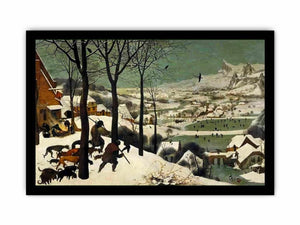
The Hunters in the Snow (Winter) 1565
-23%
The Hunters in the Snow (Winter) 1565

The Hunters in the Snow (Winter) 1565

Regular price $129.00 Sale price $99.00

Go kalles this summer with this vintage navy and white striped v-neck t-shirt from the Nike. Perfect for pairing with denim and white kicks for a stylish kalles vibe.

1. Select Type: Canvas Print
2. Select Finish Option: Rolled Canvas
3. Select Size: 60cm X 90cm [24" x 36"]
Add to Wishlist
Add to Compare
Artist: Pieter the Elder Bruegel
SKU: FA-PTE-2-S1
The Hunters in the Snow (Winter) 1565

The Hunters in the Snow (Winter) 1565

Print & Painting Options

One Famous Painting. Four Beautiful Ways to Own It.

Choose the finish that best matches the way you want to experience this masterpiece. Alpha Art Gallery offers Museum-Quality Canvas Prints, Fine Art Paper Prints, Satin Photo Paper Prints and 100% Hand-Painted Oil Paintings—each with its own surface, character and visual effect.

Premium Fine-Art Materials
Professional Pigment Printing
Ready-to-Hang Options
Real Hand-Painted Oils

Which option should you choose? Museum Canvas is ideal when you want texture and wall presence. Fine Art Paper gives a refined matte museum-print look. Satin Photo Paper offers richer colour with a subtle semi-gloss sheen. If you want a genuine painting rather than a print, choose our 100% Hand-Painted Oil Painting.

Most Popular

Museum-Quality Canvas Print

A premium textured reproduction that gives famous paintings the depth, scale and presence traditionally associated with canvas.

  • Premium approximately 400–450 GSM polycotton artist canvas*
  • Professional pigment printing for rich colour and fine detail
  • Natural canvas texture adds visual depth
  • Low-glare surface ideal for artwork display
  • Excellent choice for classical and famous painting reproductions
  • Available rolled, stretched or floating framed
Best for: art lovers who want a substantial, textured fine-art reproduction with strong gallery-style wall presence.
Rolled Canvas Same premium canvas, ready for your own local framer.
Stretched Canvas Professionally stretched and supplied ready to hang.
Floating Frame A premium contemporary presentation with an elegant shadow gap.
Why choose Museum Canvas? +

Famous paintings often contain subtle colour relationships, visible texture and compositional depth. A quality canvas reproduction provides a substantial surface that helps the image feel more like a piece of wall art than a conventional paper print. Stretched canvases use timber stretcher bars, while floating framed canvases place the stretched artwork inside an outer frame with an approximately 5 mm visual gap.

Refined Matte Finish

Fine Art Paper Print

A sophisticated fine-art reproduction with an elegant velvet-matte appearance and excellent detail.

  • Premium archival-grade fine-art paper*
  • Professional pigment printing
  • Soft velvet-matte appearance
  • Excellent tonal transitions and fine-detail reproduction
  • Low reflection compared with glossy surfaces
  • Especially beautiful when professionally framed
Best for: classical masterpieces, drawings, detailed paintings and customers who prefer an elegant museum-print presentation.
Why choose Fine Art Paper? +

Fine Art Paper is designed for viewers who value subtle detail and a restrained surface. The matte presentation helps minimize distracting reflections while preserving delicate lines, tonal shifts and colour relationships. It is an excellent choice for framed reproductions of well-known paintings and works on paper.

About framed Fine Art Prints +

Framed paper prints are presented in sleek wood frames with a contemporary slim profile and protective shatter-resistant plexiglass. Available frame choices vary by product and size. Framed options are supplied ready to hang.

Vibrant Semi-Gloss

Satin Photo Paper Print

A smooth, vivid reproduction with crisp detail and a subtle semi-gloss surface that gives colour and contrast extra impact.

  • Premium photographic print surface*
  • Elegant satin / semi-gloss appearance
  • Sharp image reproduction
  • Rich colour and strong contrast
  • More luminous than matte Fine Art Paper
  • Less reflective than traditional high-gloss photo paper
Best for: colourful masterpieces, modern art and customers who enjoy stronger colour with a subtle polished sheen.
Fine Art Paper or Satin Photo Paper? +

Choose Fine Art Paper for a soft matte museum-print appearance with minimal reflection. Choose Satin Photo Paper when you prefer stronger colour, crisp contrast and a gentle semi-gloss finish. Neither is universally better—the right choice depends on the artwork and your preferred visual style.

Collector's Choice

100% Hand-Painted Oil Painting

For customers who want a real painting rather than a print, this masterpiece is individually recreated by a skilled artist using real oil paint on canvas.

  • 100% hand-painted by a skilled artist
  • Real oil paint applied directly to canvas
  • Genuine brushstrokes and physical paint texture
  • Individually recreated rather than mechanically printed
  • No artificial printed brushstroke effect
  • Custom sizes and commissioned paintings available
Best for: collectors and art lovers who want the closest experience to owning a traditionally painted version of the masterpiece.
A Painting, Not a Print. Every hand-painted oil reproduction is created with real paint and genuine artist-applied brushwork. Subtle differences in brushwork and paint application are part of the character of an individually made painting.
Canvas Print vs Hand-Painted Oil Painting +

A canvas print reproduces the artwork using professional printing technology on textured canvas. A hand-painted oil painting is physically recreated by an artist using real oil paint, resulting in genuine brushstrokes, paint texture and handmade variation.

Compare the Four Artwork Formats

The main difference is the surface and how the artwork is created. The first three options are professionally printed reproductions. The oil painting option is individually painted by hand.

Artwork Type Surface Appearance Best Feature Best For
Museum Canvas Textured artist canvas Rich & gallery-style Texture & wall presence Classic famous painting reproductions
Fine Art Paper Velvet-matte fine-art paper Elegant & refined Fine detail Traditional framed presentation
Satin Photo Paper Smooth semi-gloss paper Vibrant & luminous Colour impact Colour-rich and modern artworks
Hand-Painted Oil Real oil paint on canvas Textured & painterly Genuine brushwork Collectors wanting a real painting

Still Not Sure Which One to Choose?

Most Popular Museum Canvas
Most Refined Fine Art Paper
Most Vibrant Satin Photo Paper
Most Authentic Hand-Painted Oil

Prefer Your Artwork Ready to Hang?

Choose a Stretched Canvas, Floating Framed Canvas or Framed Paper Print for a professionally finished presentation designed to go straight onto your wall.

Prefer to use your own framer? Choose Rolled Canvas.

Quick Buying Questions

Which format looks most like a traditional painting?

A 100% Hand-Painted Oil Painting provides the closest experience to a traditionally painted artwork because real oil paint is applied by hand. Among printed options, Museum Canvas provides the most painterly surface because of its visible canvas texture.

What is the difference between Canvas and Fine Art Paper?

Canvas has a textured woven surface and can be stretched or floating framed, giving the artwork more physical depth. Fine Art Paper has a smoother matte surface that emphasizes delicate detail and traditional framed presentation.

Which option is best for famous painting reproductions?

Museum Canvas is an excellent all-round option for famous paintings because it combines texture, visual presence and flexible framing choices. Fine Art Paper is ideal when subtle detail and a matte museum-print appearance are more important.

Which option has the strongest colour?

Satin Photo Paper generally provides the most vivid, polished colour appearance because its semi-gloss surface enhances contrast and luminosity.

*Exact paper, canvas, framing materials and specifications may vary by product, size or production location. Where a specific product page lists a different specification, that product-specific information takes precedence.

The Hunters in the Snow (Winter) 1565 Painting by Pieter Bruegel the Elder

The Hunters in the Snow (Winter) 1565 Painting by Pieter Bruegel the Elder is one of the most enduring and intellectually profound landscapes of the Northern Renaissance, a work that transforms seasonal hardship into a meditation on human endurance, communal rhythm, and the quiet authority of nature. Painted in 1565 as part of Bruegel’s celebrated cycle of the months, the scene resists anecdote and spectacle, offering instead a panoramic vision in which labor, leisure, and survival are bound together by winter’s uncompromising presence. The painting is neither nostalgic nor dramatic. It is observational, ethical, and astonishingly modern in its balance of empathy and distance.

The artist who conceived this vision, Pieter Bruegel the Elder, stands apart in sixteenth-century art for his insistence that meaning arises from collective life rather than heroic exception. Bruegel’s landscapes are not stages upon which stories are enacted; they are systems within which human activity unfolds. In The Hunters in the Snow, he situates humanity within a vast, cold environment that neither favors nor opposes it, but simply endures. The painting’s authority lies in its refusal to console. Winter is not romanticized; it is acknowledged.

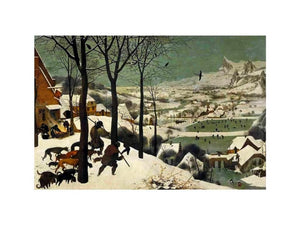
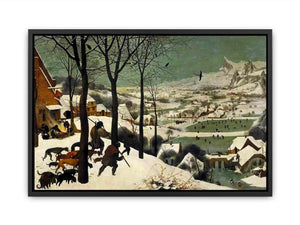
The scene opens with three hunters returning from an unsuccessful hunt, their bodies bent forward by fatigue, their spears bearing little reward. A pack of dogs follows, heads lowered, mirroring their masters’ exhaustion. This procession descends from the left foreground into a wide, frozen valley where village life continues despite scarcity. Below, people skate, play games, carry firewood, tend fires, and gather around inns. The hunters’ quiet struggle contrasts with the dispersed vitality of the village, yet neither is privileged as narrative center. Bruegel presents a world of parallel realities coexisting within the same season.

Compositionally, the painting is masterful in its orchestration of depth and movement. Bruegel employs a high vantage point that allows the eye to travel from the dark, compressed foreground into an expansive middle ground and finally toward distant, icy mountains. This recession is gradual and coherent, guiding the viewer across multiple zones of activity without hierarchy. The diagonal descent of the hunters establishes momentum, while the broad valley opens outward, inviting contemplation rather than focus on a single event.

Perspective functions as a philosophical tool. By placing the viewer slightly above the scene, Bruegel encourages observation rather than immersion. We are made aware of scale—of how small human figures appear against the breadth of land and sky. Yet this distance does not diminish human significance. Instead, it situates it properly, as part of a larger order. Individual effort matters, but it unfolds within forces that exceed it. The painting’s calm authority emerges from this equilibrium.

Light in The Hunters in the Snow is pale, cold, and even. Bruegel avoids dramatic contrasts, bathing the scene in a winter luminosity that clarifies rather than dramatizes. Snow and ice reflect light softly, flattening extremes and reinforcing stillness. This illumination does not celebrate winter’s beauty nor emphasize its cruelty. It records condition. The day is bright but cold, active but restrained—a visual analogue for endurance.

The color palette is restrained and disciplined. Whites, grays, muted greens, and soft browns dominate, punctuated by darker silhouettes of trees, figures, and buildings. Accents of red and warm tones appear sparingly, guiding the eye without disrupting unity. Color here is structural, organizing space and rhythm rather than expressing emotion. The harmony of tones contributes to the painting’s timelessness, allowing it to transcend the specificity of place and date.

Bruegel’s technique is precise yet economical. Figures are rendered with enough detail to convey posture, task, and movement, but never individualized to the point of portraiture. This restraint allows the painting to operate on multiple scales. From a distance, it reads as a unified landscape; up close, it reveals a wealth of small human actions. The artist’s hand serves observation, not display, reinforcing the painting’s ethical clarity.

Symbolism in The Hunters in the Snow is present but understated. The barren trees and empty spears speak quietly of scarcity and effort without reward. The frozen river, alive with skaters, suggests adaptation and resilience—life continuing through altered means. Smoke rising from chimneys introduces warmth without comfort, a reminder that survival is ongoing rather than resolved. Bruegel does not arrange these elements into allegory. He allows them to coexist, trusting the viewer to recognize their implications.

Psychologically, the painting is marked by restraint and empathy. The hunters are not heroicized, nor are they pitied. Their fatigue is acknowledged without sentiment. The villagers below are not idealized; their pleasures are modest, communal, and bound by the same cold that burdens the hunters. Bruegel’s achievement lies in presenting human life as neither tragic nor triumphant, but persistent. Meaning arises from continuity.

Within Bruegel’s broader oeuvre, The Hunters in the Snow represents a culmination of his seasonal landscapes, works that redefined the relationship between humanity and environment. Here, landscape is not backdrop but protagonist—an active force shaping behavior, labor, and social rhythm. This approach would profoundly influence later Northern European painting, establishing winter as a subject of philosophical gravity rather than decorative novelty.

Culturally, the painting reflects a sixteenth-century world acutely aware of nature’s power and unpredictability. Painted during a period of climatic hardship, it captures an attitude of acceptance rather than resistance. There is no promise of relief, no narrative resolution. Winter is endured because it must be. This quiet realism gives the painting enduring relevance, speaking across centuries to societies that continue to negotiate their relationship with environment and labor.

In contemporary interiors across the United States, the United Kingdom, Canada, Australia, and Europe, The Hunters in the Snow brings exceptional depth and narrative richness. In living rooms, it introduces seasonal calm and visual breadth. In studies and offices, it communicates endurance, discipline, and historical intelligence. In galleries and luxury residences, it anchors space with Northern Renaissance authority, integrating seamlessly into traditional, modern, minimalist, and eclectic décor through its balanced composition and subdued palette.

The painting remains meaningful today because it mirrors lived experience without exaggeration. Effort does not always yield reward; communities persist regardless; nature remains indifferent yet beautiful. Bruegel’s vision affirms that dignity lies not in conquest, but in continuity. The Hunters in the Snow does not dramatize winter. It understands it.

The Hunters in the Snow (Winter) 1565 Painting by Pieter Bruegel the Elder endures as one of the most quietly powerful landscapes in Western art. Through compositional breadth, tonal restraint, and ethical clarity, Bruegel transformed a cold day into a timeless meditation on labor, community, and the human condition. The painting does not seek to impress. It endures.

Buy museum qulaity 400- 450 canvas prints, framed prints, and 100% oil paintings of The Hunters in the Snow (Winter) by Pieter Bruegel the Elder at Alpha Art Gallery, where world-famous masterpieces are recreated with museum-quality detail, refined craftsmanship, and premium materials.

FAQs

What does The Hunters in the Snow depict?
It depicts hunters returning from an unsuccessful hunt while village life continues across a frozen winter landscape.

Why are the hunters shown with little game?
Their scarcity emphasizes endurance and effort without reward, a central theme of the painting.

Is this painting part of a larger series?
Yes, it belongs to Bruegel’s cycle of the months, exploring seasonal rhythms of life.

Why is the viewpoint elevated?
The high vantage point encourages observation of collective life rather than focus on a single narrative.

What role does winter play in the painting?
Winter is an active force shaping labor, leisure, and community behavior rather than a mere setting.

Does the painting carry a moral message?
It is observational rather than didactic, presenting endurance and continuity without explicit instruction.

Why does the painting feel calm despite hardship?
Balanced composition, even light, and restrained color create equilibrium while acknowledging difficulty.

Where does this artwork work best in interiors?
It suits living rooms, studies, offices, galleries, and spaces seeking narrative depth, calm authority, and historical presence.

Choose Your Artwork

One Masterpiece. Four Beautiful Ways to Own It.

Experience your favourite famous painting in the finish that suits your home and your taste. Choose from a Museum-Quality Canvas Print, Fine Art Paper Print, Satin Photo Paper Print or a genuine 100% Hand-Painted Oil Painting.

Premium Fine-Art Materials
Professional Pigment Printing
Ready-to-Hang Options
Real Hand-Painted Oils
Which finish is right for you?
Textured Museum Canvas
Elegant Matte Fine Art Paper
Vibrant Satin Photo Paper
Real Painting Hand-Painted Oil
Most Popular

Museum-Quality Canvas Print

Give a famous masterpiece the texture, depth and wall presence of premium artist canvas. Our Museum Canvas is an excellent all-round choice for classical paintings and statement art.

  • Premium approximately 400–450 GSM polycotton artist canvas*
  • Professional pigment printing
  • Rich colour and fine artwork detail
  • Natural woven canvas texture
  • Low-glare surface for comfortable viewing
  • Rolled, stretched and floating framed options
Best for: customers who want a substantial, textured reproduction with a premium gallery-style appearance.
Rolled Use your own local framer
Stretched Clean, ready-to-hang canvas
Floating Frame Premium gallery presentation
Why choose Museum Canvas?

Canvas gives a famous painting a tactile, substantial quality that conventional paper cannot reproduce. The woven surface adds subtle visual depth while the low-glare finish allows the composition and colour of the artwork to remain the focus.

Refined Matte Finish

Fine Art Paper Print

A refined museum-print presentation for customers who value fine detail, understated colour and a luxurious velvet-matte appearance.

  • Premium fine-art paper selected for art reproduction*
  • Professional pigment printing
  • Elegant velvet-matte appearance
  • Excellent fine-detail reproduction
  • Beautiful tonal transitions
  • Minimal distracting reflection
Best for: classical masterpieces, detailed artworks and elegant framed interiors.
Why choose Fine Art Paper?

Fine Art Paper emphasizes subtle detail instead of surface shine. Its matte presentation is particularly suited to traditional art reproductions, delicate tonal variation and sophisticated framed displays.

How are framed paper prints presented?

Framed options are professionally finished with a contemporary wood frame and protective shatter-resistant plexiglass. Available frame styles vary by size and artwork. Framed options arrive ready to hang.

Rich Colour

Satin Photo Paper Print

Smooth, crisp and vibrant. Satin Photo Paper brings additional luminosity and contrast to colourful famous paintings while retaining an elegant semi-gloss appearance.

  • Premium photographic print surface*
  • Smooth satin / semi-gloss finish
  • Crisp artwork detail
  • Rich colour and stronger contrast
  • More luminous than matte paper
  • Less reflective than traditional high gloss
Best for: colourful masterpieces and customers who want vibrant colour with a subtle sheen.
Fine Art Paper or Satin Photo Paper?

Choose Fine Art Paper for an understated matte museum-print look. Choose Satin Photo Paper for richer colour, stronger contrast and a smooth semi-gloss finish.

Collector's Choice

100% Hand-Painted Oil Painting

For customers who want a real painting rather than a print, our artists individually recreate the masterpiece using genuine oil paint on canvas.

  • 100% hand-painted by a skilled artist
  • Real oil paint applied directly to canvas
  • Genuine brushstrokes and physical paint texture
  • Individually created rather than mechanically printed
  • No artificial printed brushstroke effect
  • Custom sizes and commissions available
Best for: collectors and art lovers wanting the character and texture of a genuine handmade painting.
A Painting. Not a Print. Real paint, real brushwork and the subtle variations that belong to something individually created by an artist.
Canvas Print vs Hand-Painted Oil Painting

A canvas print uses professional printing technology to reproduce the artwork on canvas. A hand-painted oil painting is physically recreated by an artist using real oil paint, resulting in genuine brushwork, paint texture and handmade variation.

At a Glance

Compare Your Artwork Options

All four formats offer a different way to experience the same masterpiece. The main differences are the surface, visual finish and whether the artwork is printed or painted by hand.

Artwork Type Surface Appearance Why Choose It
Museum Canvas Textured artist canvas Rich & gallery-style Texture and strong wall presence
Fine Art Paper Matte fine-art paper Elegant & refined Fine detail and minimal reflection
Satin Photo Paper Smooth semi-gloss paper Vibrant & luminous Rich colour and contrast
Hand-Painted Oil Real oil paint on canvas Painterly & textured Genuine handmade brushwork

Still Deciding? Start Here.

Most Popular Museum Canvas
Most Refined Fine Art Paper
Most Vibrant Satin Photo Paper
Most Authentic Hand-Painted Oil

Want Your Artwork Ready to Hang?

Select Stretched Canvas, Floating Framed Canvas or a Framed Paper Print for a professionally finished presentation. Prefer your own local framer? Choose Rolled Canvas.

Buying Guide

Choosing the Right Art Reproduction

A few quick answers can make choosing your preferred finish much easier.

Which format looks most like a traditional painting?

A 100% Hand-Painted Oil Painting is the closest to a traditionally painted artwork because real oil paint is applied by an artist. Among printed formats, Museum Canvas offers the most painterly-looking textured surface.

What is the difference between a canvas print and a Fine Art Print?

A canvas print is reproduced on textured artist canvas and can be rolled, stretched or floating framed. A Fine Art Print is produced on a smooth matte paper surface, emphasizing detail and traditional framed presentation.

Fine Art Paper or Satin Photo Paper—which is better?

Neither is universally better. Fine Art Paper is ideal for a refined matte appearance with minimal reflection. Satin Photo Paper is better suited to customers who prefer richer colour, stronger contrast and a gentle semi-gloss sheen.

What is the difference between a canvas print and an oil painting?

A canvas print is created using professional printing technology. A hand-painted oil painting is created by an artist applying real oil paint to canvas, producing genuine brushstrokes, texture and handmade variation.

Which option is best for famous painting reproductions?

Museum Canvas is an excellent all-round choice for famous paintings because it combines texture, scale and flexible presentation options. Fine Art Paper is ideal when subtle detail and a matte museum-print appearance are the priority, while a Hand-Painted Oil Painting is best for customers wanting a genuine painted reproduction.

*Exact canvas, paper, frame profiles and production specifications can vary by product, size or production location. Product-specific specifications, where stated, take precedence.

Quality & Craftsmanship

Made to Honour the Artwork. Crafted to Look Beautiful for Years.

A great art reproduction depends on more than the image alone. Material quality, printing, surface preparation, stretching, framing and finishing all influence how the final artwork looks on your wall. At Alpha Art Gallery, each format is selected and prepared with the goal of preserving the character, colour and visual impact of the original masterpiece.

Premium Art Materials
Professional Pigment Printing
Gallery-Style Finishing
Real Hand-Painted Oils

Our approach is simple: use the right material for the artwork, reproduce it with care, and finish it so the result feels considered rather than mass-produced. Whether you choose Museum Canvas, Fine Art Paper, Satin Photo Paper or a 100% Hand-Painted Oil Painting, the aim is a finished piece worthy of prominent display.

Premium Canvas

400–450 GSM Museum-Quality Canvas*

Our premium polycotton artist canvas provides a substantial, textured surface designed for high-quality fine-art reproduction.

  • Approximately 400–450 GSM premium polycotton canvas*
  • Natural woven texture adds depth and character
  • Low-glare surface helps reduce distracting reflections
  • Suitable for rolled, stretched and floating framed presentation
  • Designed for detailed reproduction of famous paintings
Why it matters: heavier, well-prepared canvas offers better visual presence and a more substantial gallery feel than lightweight decorative canvas.
Fine-Art Reproduction

Professional Pigment Printing

Fine-art printing is about preserving subtle colour, tonal relationships and artwork detail—not simply producing a bright image.

  • Professional pigment-based printing workflows
  • Prepared for accurate artwork reproduction
  • Strong detail and tonal separation
  • Rich colour without unnecessary artificial enhancement
  • Suitable for canvas, fine-art paper and satin surfaces
Why it matters: source quality, colour preparation, ink, surface and print resolution all work together to determine the quality of a fine-art reproduction.
Gallery Presentation

Professional Stretching & Framing

A beautiful reproduction deserves a presentation that complements the artwork rather than overpowering it.

  • FSC-certified timber stretcher bars where specified
  • Professionally tensioned stretched canvas
  • Floating frame options for a premium shadow-gap effect
  • Sleek framed paper print options
  • Shatter-resistant plexiglass used on applicable framed prints
  • Ready-to-hang options available
Why it matters: correct stretching, alignment and framing help the artwork sit cleanly, securely and professionally on the wall.
Handmade Art

100% Hand-Painted Oil Paintings

Our oil painting reproductions are not textured prints. They are individually recreated by skilled artists using real oil paint on canvas.

  • 100% hand-painted by skilled artists
  • Real oil paint applied directly to canvas
  • Genuine artist-created brushstrokes
  • Physical paint texture and handmade variation
  • No artificial printed brushstroke effect
  • Custom sizing and commissioned artwork available
Why it matters: a genuine oil painting has physical paint, brush movement and subtle handmade variation that a printed reproduction cannot fully replicate.
Our Reproduction Process

From Masterpiece to Finished Artwork

High-quality wall art requires a chain of good decisions. Each stage affects the final result.

1
Artwork Preparation The source artwork is prepared for the selected format and print size with attention to composition, detail and tonal balance.
2
Material Selection Canvas, fine-art paper, satin paper or painting canvas is chosen according to the product option selected.
3
Printing or Painting Printed formats use professional reproduction methods, while oil paintings are recreated by hand using real paint.
4
Finishing & Presentation Depending on your selection, the artwork is rolled, stretched, framed or prepared for final delivery.

Why Quality Matters in Famous Painting Reproductions

Famous artworks often contain subtle tonal changes, complex colour relationships and small details that can be lost in low-quality reproductions. Better materials and careful preparation help preserve more of the artwork's visual character.

Detail Fine lines, textures and small visual elements remain clearer and more convincing.
Colour & Tone Thoughtful reproduction helps maintain the balance between highlights, shadows and colour relationships.
Wall Presence Premium materials and finishing give the artwork a more substantial, gallery-worthy appearance.
Quality Guide

Questions About Art Print Quality

Understanding materials and production makes it easier to choose the right reproduction for your space.

What makes a museum-quality canvas print?

A high-quality canvas print depends on several factors working together: a suitable artwork source, careful image preparation, professional pigment printing, a substantial canvas surface, accurate stretching and quality finishing. Canvas weight alone does not determine print quality, but a premium 400–450 GSM canvas can provide greater substance and wall presence than lightweight decorative canvas.

What is professional pigment printing?

Pigment printing uses pigment-based inks rather than conventional dye-based consumer printing. In fine-art reproduction, it is valued for strong detail, colour stability and suitability for premium art papers and canvas. The final quality also depends on the printer, media, source image and production workflow.

Are Alpha Art Gallery oil paintings really hand-painted?

Yes. Our hand-painted oil painting option is created by an artist using real oil paint on canvas. It is not a digitally printed canvas with artificial texture added on top. Genuine brushwork, physical paint texture and subtle handmade variation are part of the finished painting.

What is the difference between a fine-art print and a standard poster?

A fine-art print is produced using materials and printing methods selected for artwork reproduction, with greater attention to detail, tonal balance and presentation. Standard decorative posters are generally produced primarily for economical mass display rather than premium fine-art reproduction.

Does thicker canvas always mean better print quality?

No. Canvas weight is only one part of quality. The source artwork, printing method, ink, surface coating, colour preparation, stretching and finishing all affect the final result. A substantial premium canvas can improve durability and visual presence, but it must be combined with a good reproduction workflow.

What is the best format for a famous painting reproduction?

Museum Canvas is an excellent all-round option when you want texture and strong wall presence. Fine Art Paper is ideal for a refined matte presentation, Satin Photo Paper suits customers who prefer stronger colour and a subtle sheen, and a Hand-Painted Oil Painting is best when you want genuine paint and brushwork rather than a printed reproduction.

Made for Your Space

Choose the Finish That Makes the Artwork Yours

Select the artwork type, size and framing option that best suits your room. Choose Museum Canvas for texture, Fine Art Paper for matte refinement, Satin Photo Paper for richer colour, or a 100% Hand-Painted Oil Painting when you want a genuine painted reproduction with real brushwork.

*Exact canvas, paper, ink, frame profile and production specifications may vary by product, size or production location. Product-specific specifications, where stated, take precedence.

Recently viewed products