Wheat Field With Cypresses By Van Gogh
-23%
Wheat Field With Cypresses By Van Gogh

Wheat Field With Cypresses By Van Gogh

Regular price $129.00 Sale price $99.00

Go kalles this summer with this vintage navy and white striped v-neck t-shirt from the Nike. Perfect for pairing with denim and white kicks for a stylish kalles vibe.

1. Select Type: Museum Canvas
2. Select Finish Option: Rolled Canvas
3. Select Size: 60cm X 90cm [24" x 36"]
Add to Wishlist
Add to Compare
Artist: Vincent Van Gogh
SKU: FA-VG-10-S1
Wheat Field With Cypresses By Van Gogh

Wheat Field With Cypresses By Van Gogh

Print & Painting Options

One Famous Painting. Four Beautiful Ways to Own It.

Choose the finish that best matches the way you want to experience this masterpiece. Alpha Art Gallery offers Museum-Quality Canvas Prints, Fine Art Paper Prints, Satin Photo Paper Prints and 100% Hand-Painted Oil Paintings—each with its own surface, character and visual effect.

Premium Fine-Art Materials
Professional Pigment Printing
Ready-to-Hang Options
Real Hand-Painted Oils

Which option should you choose? Museum Canvas is ideal when you want texture and wall presence. Fine Art Paper gives a refined matte museum-print look. Satin Photo Paper offers richer colour with a subtle semi-gloss sheen. If you want a genuine painting rather than a print, choose our 100% Hand-Painted Oil Painting.

Most Popular

Museum-Quality Canvas Print

A premium textured reproduction that gives famous paintings the depth, scale and presence traditionally associated with canvas.

  • Premium approximately 400–450 GSM polycotton artist canvas*
  • Professional pigment printing for rich colour and fine detail
  • Natural canvas texture adds visual depth
  • Low-glare surface ideal for artwork display
  • Excellent choice for classical and famous painting reproductions
  • Available rolled, stretched or floating framed
Best for: art lovers who want a substantial, textured fine-art reproduction with strong gallery-style wall presence.
Rolled Canvas Same premium canvas, ready for your own local framer.
Stretched Canvas Professionally stretched and supplied ready to hang.
Floating Frame A premium contemporary presentation with an elegant shadow gap.
Why choose Museum Canvas? +

Famous paintings often contain subtle colour relationships, visible texture and compositional depth. A quality canvas reproduction provides a substantial surface that helps the image feel more like a piece of wall art than a conventional paper print. Stretched canvases use timber stretcher bars, while floating framed canvases place the stretched artwork inside an outer frame with an approximately 5 mm visual gap.

Refined Matte Finish

Fine Art Paper Print

A sophisticated fine-art reproduction with an elegant velvet-matte appearance and excellent detail.

  • Premium archival-grade fine-art paper*
  • Professional pigment printing
  • Soft velvet-matte appearance
  • Excellent tonal transitions and fine-detail reproduction
  • Low reflection compared with glossy surfaces
  • Especially beautiful when professionally framed
Best for: classical masterpieces, drawings, detailed paintings and customers who prefer an elegant museum-print presentation.
Why choose Fine Art Paper? +

Fine Art Paper is designed for viewers who value subtle detail and a restrained surface. The matte presentation helps minimize distracting reflections while preserving delicate lines, tonal shifts and colour relationships. It is an excellent choice for framed reproductions of well-known paintings and works on paper.

About framed Fine Art Prints +

Framed paper prints are presented in sleek wood frames with a contemporary slim profile and protective shatter-resistant plexiglass. Available frame choices vary by product and size. Framed options are supplied ready to hang.

Vibrant Semi-Gloss

Satin Photo Paper Print

A smooth, vivid reproduction with crisp detail and a subtle semi-gloss surface that gives colour and contrast extra impact.

  • Premium photographic print surface*
  • Elegant satin / semi-gloss appearance
  • Sharp image reproduction
  • Rich colour and strong contrast
  • More luminous than matte Fine Art Paper
  • Less reflective than traditional high-gloss photo paper
Best for: colourful masterpieces, modern art and customers who enjoy stronger colour with a subtle polished sheen.
Fine Art Paper or Satin Photo Paper? +

Choose Fine Art Paper for a soft matte museum-print appearance with minimal reflection. Choose Satin Photo Paper when you prefer stronger colour, crisp contrast and a gentle semi-gloss finish. Neither is universally better—the right choice depends on the artwork and your preferred visual style.

Collector's Choice

100% Hand-Painted Oil Painting

For customers who want a real painting rather than a print, this masterpiece is individually recreated by a skilled artist using real oil paint on canvas.

  • 100% hand-painted by a skilled artist
  • Real oil paint applied directly to canvas
  • Genuine brushstrokes and physical paint texture
  • Individually recreated rather than mechanically printed
  • No artificial printed brushstroke effect
  • Custom sizes and commissioned paintings available
Best for: collectors and art lovers who want the closest experience to owning a traditionally painted version of the masterpiece.
A Painting, Not a Print. Every hand-painted oil reproduction is created with real paint and genuine artist-applied brushwork. Subtle differences in brushwork and paint application are part of the character of an individually made painting.
Canvas Print vs Hand-Painted Oil Painting +

A canvas print reproduces the artwork using professional printing technology on textured canvas. A hand-painted oil painting is physically recreated by an artist using real oil paint, resulting in genuine brushstrokes, paint texture and handmade variation.

Compare the Four Artwork Formats

The main difference is the surface and how the artwork is created. The first three options are professionally printed reproductions. The oil painting option is individually painted by hand.

Artwork Type Surface Appearance Best Feature Best For
Museum Canvas Textured artist canvas Rich & gallery-style Texture & wall presence Classic famous painting reproductions
Fine Art Paper Velvet-matte fine-art paper Elegant & refined Fine detail Traditional framed presentation
Satin Photo Paper Smooth semi-gloss paper Vibrant & luminous Colour impact Colour-rich and modern artworks
Hand-Painted Oil Real oil paint on canvas Textured & painterly Genuine brushwork Collectors wanting a real painting

Still Not Sure Which One to Choose?

Most Popular Museum Canvas
Most Refined Fine Art Paper
Most Vibrant Satin Photo Paper
Most Authentic Hand-Painted Oil

Prefer Your Artwork Ready to Hang?

Choose a Stretched Canvas, Floating Framed Canvas or Framed Paper Print for a professionally finished presentation designed to go straight onto your wall.

Prefer to use your own framer? Choose Rolled Canvas.

Quick Buying Questions

Which format looks most like a traditional painting?

A 100% Hand-Painted Oil Painting provides the closest experience to a traditionally painted artwork because real oil paint is applied by hand. Among printed options, Museum Canvas provides the most painterly surface because of its visible canvas texture.

What is the difference between Canvas and Fine Art Paper?

Canvas has a textured woven surface and can be stretched or floating framed, giving the artwork more physical depth. Fine Art Paper has a smoother matte surface that emphasizes delicate detail and traditional framed presentation.

Which option is best for famous painting reproductions?

Museum Canvas is an excellent all-round option for famous paintings because it combines texture, visual presence and flexible framing choices. Fine Art Paper is ideal when subtle detail and a matte museum-print appearance are more important.

Which option has the strongest colour?

Satin Photo Paper generally provides the most vivid, polished colour appearance because its semi-gloss surface enhances contrast and luminosity.

*Exact paper, canvas, framing materials and specifications may vary by product, size or production location. Where a specific product page lists a different specification, that product-specific information takes precedence.

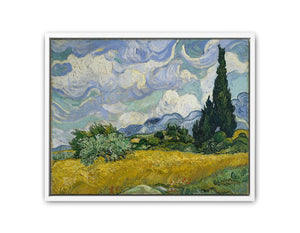
Wheat Field with Cypresses by Vincent van Gogh is an expressive 1889 landscape painted during the artist’s stay at Saint-Rémy-de-Provence in southern France. A sunlit wheat field, towering cypresses, distant mountains and an animated sky are united by thick, rhythmic brushwork. The version represented here is the original oil-on-canvas painting now held by The Metropolitan Museum of Art in New York. Alpha Art Gallery offers reproductions as canvas prints, fine art prints, framed prints and 100% hand-painted oil paintings.

About Wheat Field with Cypresses by Vincent van Gogh

Vincent van Gogh painted Wheat Field with Cypresses in 1889 while living at the Saint-Paul-de-Mausole hospital near Saint-Rémy-de-Provence. The Metropolitan Museum of Art’s painting measures approximately 73 × 93.4 cm and is an oil painting on canvas. It belongs to an important group of landscapes in which Van Gogh explored the distinctive cypress trees, wheat fields, olive trees and mountains of Provence.

This is important because Van Gogh produced several closely related versions of the composition. The Met painting is the energetic study painted directly from nature during the summer of 1889. Later that year he returned to the motif in his studio, producing another large version now in the National Gallery in London as well as a smaller version intended for his mother and sister.

The Met’s version therefore captures the immediacy of Van Gogh working in front of the landscape. Thickly applied paint and vigorous directional strokes make the wheat, trees, mountains and clouds appear to move together, transforming an observed Provençal scene into one of the artist’s most dynamic landscapes.

A Landscape From Van Gogh’s Saint-Rémy Period

Van Gogh voluntarily entered Saint-Paul-de-Mausole at Saint-Rémy in May 1889. Despite the difficult circumstances of his stay, the following year became one of the most productive periods of his career. He painted the hospital garden, nearby olive groves, wheat fields, mountains and the distinctive cypress trees that repeatedly appeared in the surrounding countryside.

Cypresses quickly became one of his major subjects. Their tall, narrow silhouettes gave him a powerful vertical form to set against horizontal fields, mountain ranges and expansive skies. In Wheat Field with Cypresses, the largest cypress rises dramatically above the wheat and into the sky, functioning almost like a visual bridge between the earth and the atmosphere.

The surrounding landscape was equally important. The golden wheat field occupies much of the foreground, the dark trees rise through the middle distance, and the Alpilles mountains form a rolling boundary beyond them. Above everything, Van Gogh fills the sky with sweeping masses of cloud. Rather than separating these elements into static zones, he connects them through continuously changing lines and brushstrokes.

What Does Wheat Field with Cypresses Depict?

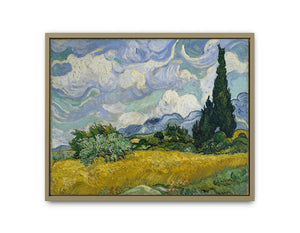
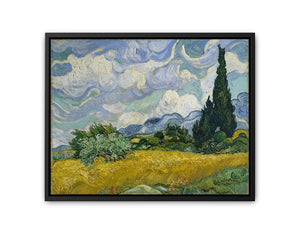
The composition presents a wheat field beneath a bright summer sky, with tall cypress trees dominating the right side. An olive bush occupies another part of the landscape, while the low mountains of the Alpilles appear in the distance. Poppies and other small touches enliven the wheat in the foreground.

The most striking feature is the contrast between the dark cypresses and the sun-filled landscape around them. Their vertical forms rise sharply against the sky, while the wheat moves horizontally across the foreground. The distant mountain ridges introduce another series of curved lines, and the clouds repeat that motion at a much larger scale.

The landscape therefore feels unified rather than assembled from separate objects. Wheat, cypresses, mountains and clouds all appear to participate in the same movement. This visual continuity is one of the reasons the painting feels so animated despite containing no prominent human figure.

Why Were Cypresses Important to Van Gogh?

Van Gogh became intensely interested in cypress trees during his Saint-Rémy period. In June 1889 he wrote to his brother Theo about his desire to make the cypress a major subject, comparing its distinctive proportions with the form of an Egyptian obelisk. He was particularly fascinated by the difficulty of representing such a dark tree within the brilliant sunlight of southern France.

That artistic challenge can be seen clearly in Wheat Field with Cypresses. The cypress is much darker than the surrounding wheat, mountains and sky, yet it does not appear detached from the landscape. Van Gogh integrates it through repeated curves, directional strokes and colour relationships.

Cypresses would continue to appear in some of his most important works, including the closely related Cypresses at The Metropolitan Museum of Art and the famous night landscape The Starry Night. Together, these works show that the tree was not an incidental detail but a sustained artistic preoccupation during 1889.

Van Gogh’s Brushwork and the Movement of Nature

The Met emphasizes the lively brushwork of Wheat Field with Cypresses. Thick applications of paint help communicate the sensation of wind moving through wheat and trees and the intensity of a hot Provençal afternoon. The physical direction of the brushstrokes becomes part of the landscape’s meaning.

Van Gogh does not describe every stalk of wheat individually. Instead, repeated strokes create the collective sensation of a field moving in the wind. The cypresses are built from darker, twisting marks, while the clouds unfold through broad curved forms. Even the mountains appear animated by repeated contours.

This is one reason the painting translates especially well to larger wall-art formats. From a distance, the viewer sees the complete landscape and its dramatic contrasts. At closer range, individual strokes and passages of colour become increasingly visible.

Impasto and the Physical Surface

The Met version is particularly notable for its rich impasto—the use of thickly applied paint that gives parts of the surface physical relief. Van Gogh admired the painter Adolphe Monticelli, whose heavily worked surfaces helped demonstrate how paint itself could become a prominent expressive element.

In Wheat Field with Cypresses, thickness is not merely decorative. The accumulation and direction of paint contribute to the sensation of moving vegetation, atmospheric turbulence and summer heat. The landscape is therefore experienced simultaneously as an image of nature and as a physical arrangement of oil paint.

This distinction is useful when choosing a reproduction. A printed canvas version can reproduce the image, colour relationships and visual appearance of brushwork. A 100% hand-painted oil reproduction introduces actual paint and individually created surface texture, providing a different decorative experience for buyers particularly attracted to Van Gogh’s material technique.

The Wheat Field, Mountains and Provençal Landscape

Although the cypress attracts immediate attention, the painting depends equally on its wheat field and mountainous setting. Wheat was a recurring subject throughout Van Gogh’s career, and during his stay at Saint-Rémy he painted it in numerous conditions and seasons.

In this composition, the wheat provides a luminous foundation for the darker trees. Its broad horizontal expanse makes the cypresses appear even taller, while the distant Alpilles mountains establish the geographic character of the Saint-Rémy landscape.

The relationship between these forms creates an effective sequence from near to far: wheat in the foreground, trees and shrubs in the middle distance, mountains beyond, and finally the expansive sky. Van Gogh nevertheless avoids conventional smooth recession by applying similarly energetic rhythms throughout the scene. The result feels compressed, immediate and intensely alive.

The Wind as Part of the Composition

The summer mistral—the powerful wind associated with southern France—is important to understanding Van Gogh’s landscapes from Provence. The National Gallery notes the sense of wind animating the related wheat-field composition: wheat bends, trees appear to sway, clouds roll across the sky and even the contours of the mountains seem energized.

The Met’s earlier outdoor version conveys that immediacy especially strongly. Because it was painted directly from nature, the landscape has the character of an encounter rather than a carefully polished studio construction. Van Gogh’s brushwork gives visual form to changing conditions that cannot literally be frozen: wind, heat, moving clouds and trembling vegetation.

From Outdoor Study to Finished Studio Version

Van Gogh considered the Met painting one of his strongest summer landscapes. After creating the outdoor study, he made a reed-pen drawing of the composition and later returned to it in paint. In September 1889, while temporarily confined to his room following a relapse, he produced a more stylized large version now held by the National Gallery in London.

The two major paintings are extremely similar at first glance but should not be treated as the same physical artwork. The Met version was the earlier direct study from nature. The National Gallery version was painted later in the studio and represents Van Gogh refining and reorganizing the motif.

This distinction provides unusual insight into his working process. Wheat Field with Cypresses was not simply a spontaneous image produced once and abandoned. Van Gogh studied the motif across painting and drawing, reconsidering how the same landscape could be transformed through different degrees of observation and stylization.

Post-Impressionism and Van Gogh’s Expressive Landscape

Vincent van Gogh is one of the central figures associated with Post-Impressionism. Although the term includes artists with very different approaches, it broadly describes painters who moved beyond Impressionism toward increasingly personal uses of colour, structure, symbolism and expression.

Wheat Field with Cypresses demonstrates this development particularly clearly. Van Gogh remains grounded in an observable landscape, yet literal description is not his only objective. Colours are intensified, contours become rhythmic, and the direction of brushwork communicates movement and emotional energy.

The result helped establish a way of painting landscape that would prove enormously influential for later modern art. Visitors comparing the work with other masterpieces from art history can see how the late nineteenth-century landscape became a vehicle for personal expression rather than simply an accurate record of scenery.

What Does Wheat Field with Cypresses Mean?

There is no single documented symbolic interpretation that explains every element of the painting. Van Gogh certainly attached importance to wheat fields and cypresses, but interpretations should distinguish his documented ideas from meanings developed by later viewers.

Wheat repeatedly carried associations with natural cycles, growth, harvest, life and mortality in Van Gogh’s work and correspondence. Cypresses also had long cultural associations with cemeteries and mourning in Mediterranean Europe. Yet it would be too simplistic to describe this particular landscape as merely a coded image of death.

Visually, the painting is full of energy and sunlight. A more responsible interpretation recognizes that Van Gogh transformed familiar elements of Provence into a landscape concerned with the vitality, movement and structure of nature while leaving room for viewers to experience broader emotional or symbolic associations individually.

Why Wheat Field with Cypresses Is Important

The painting brings together several of the defining interests of Van Gogh’s Saint-Rémy period: wheat, cypresses, mountains, dramatic skies, thick paint and rhythmic line. It also records a key stage in his artistic process because the Met’s direct study became the basis for drawings and later painted versions.

The artist himself regarded the landscape highly, despite his often severe judgment of his own work. Its continuing importance also reflects the way it combines recognizable Provençal scenery with an unmistakably individual visual language.

For collectors of Van Gogh reproductions, it offers a different experience from his flower still lifes and portraits. The broad horizontal format and sweeping natural rhythms make it particularly effective for expansive wall display.

Where Is the Original Wheat Field with Cypresses?

Artist Vincent van Gogh
Title Wheat Field with Cypresses
Date 1889
Period Saint-Rémy period
Original medium Oil on canvas
Dimensions Approximately 73 × 93.4 cm
Movement Post-Impressionism
Current collection The Metropolitan Museum of Art, New York
Accession number 1993.132

The Metropolitan Museum of Art painting is the historical original represented by this product image. Alpha Art Gallery sells reproductions and does not sell the museum’s original painting. Alpha Art Gallery is not affiliated with or endorsed by The Metropolitan Museum of Art, and “museum-quality” describes Alpha Art Gallery’s reproduction format rather than museum certification.

Choose Your Wheat Field with Cypresses Reproduction

The original composition is substantially wider than it is tall, making it particularly suited to horizontal wall spaces. Alpha Art Gallery offers several formats so buyers can choose according to the visual experience they want from Van Gogh’s landscape.

Format Presentation Best Suited To
Canvas Print Textured canvas presentation with strong visual scale Feature walls and buyers who want Van Gogh wall art on canvas
Fine Art Print Detailed traditional printed presentation Collectors who prefer a refined art-print format
Framed Print A finished presentation that creates a defined boundary around the landscape Living rooms, offices and more structured interiors
Hand-Painted Oil Reproduction Real oil paint with individually created brushwork and physical texture Buyers especially drawn to Van Gogh’s painted surface

Museum-Quality Canvas Print

Alpha Art Gallery’s museum-quality canvas prints use substantial 400–450 GSM canvas. The broad wheat field, tall cypresses and sweeping sky make this composition particularly effective at larger sizes, where the relationship between individual brushstrokes and the overall landscape becomes easier to appreciate.

Canvas is a strong option when you want Van Gogh’s image itself to dominate the wall without the additional visual boundary created by a traditional frame.

Fine Art and Framed Prints

A fine art print offers a refined printed interpretation suited to buyers who prefer the traditional appearance of artwork on a flat printed surface. A framed version gives the landscape a stronger architectural boundary, which can work particularly well because Van Gogh’s clouds, fields and vegetation contain so much internal movement.

For a study, office or traditionally arranged living space, framing can provide a more contained presentation while preserving the dramatic horizontal composition.

100% Hand-Painted Oil Painting Reproduction

Van Gogh’s thick, directional brushwork makes Wheat Field with Cypresses particularly suitable for a hand-painted oil painting reproduction. Alpha Art Gallery’s hand-painted versions are individually created by professional artists using oil on canvas.

Because each work is painted by hand, actual brushwork, texture and subtle individual differences become part of the finished reproduction. This does not make the painting Van Gogh’s original, but it provides a materially different presentation for customers who value physical oil paint and handmade craftsmanship.

Which Format Is Best for Wheat Field with Cypresses?

Choose canvas if you want the painting to function as strong decorative wall art and particularly value scale. Choose a fine art print if you prefer a traditional printed presentation. A framed print suits buyers who want the landscape visually contained within a finished border.

The hand-painted oil reproduction is especially relevant to this particular Van Gogh because physical brushwork plays such an important role in the historic painting. Buyers fascinated by the swirling clouds, thick wheat and twisting cypress forms may find a painted surface particularly appealing.

How to Display Wheat Field with Cypresses as Wall Art

The horizontal proportions make this composition a natural choice for a broad wall above a sofa, sideboard, bed, console or desk. A larger canvas or oil reproduction can emphasize the panoramic movement from wheat field to cypress, mountains and sky.

The painting also works well as a primary focal artwork because it contains both strong dark forms and large areas of open landscape. Traditional rooms can connect naturally with its nineteenth-century origins, while contemporary interiors can benefit from the highly expressive lines and energetic surface.

For smaller walls, a fine art or framed print can retain the recognizable composition in a more controlled scale. Rather than choosing solely by room type, measure the available wall and consider how far viewers will normally stand from the artwork.

Where Can I Buy a Wheat Field with Cypresses Reproduction?

Alpha Art Gallery offers Vincent van Gogh’s Wheat Field with Cypresses as a canvas print, fine art print, framed print and 100% hand-painted oil painting reproduction. Multiple sizes and frame choices are available where applicable, allowing buyers to choose a presentation appropriate for their interior and available wall space.

Artwork is securely packaged, and Alpha Art Gallery provides free worldwide shipping on all orders. Production facilities in the USA, Australia, United Kingdom and Canada support worldwide delivery.

Why Choose Alpha Art Gallery?

  • Multiple reproduction formats: choose canvas, fine art, framed or hand-painted oil.
  • 400–450 GSM canvas: substantial canvas suited to this expansive landscape.
  • Hand-painted option: professional artists individually paint reproductions using oil on canvas.
  • Multiple sizes: choose a scale appropriate for your wall.
  • Frame choices: available for applicable formats.
  • Secure packaging: artwork is prepared for international delivery.
  • Free worldwide shipping: included on all Alpha Art Gallery orders.

Frequently Asked Questions About Wheat Field with Cypresses

Who painted Wheat Field with Cypresses?

Vincent van Gogh painted Wheat Field with Cypresses in 1889 during his Saint-Rémy period. The Dutch Post-Impressionist artist was then living at Saint-Paul-de-Mausole in southern France and repeatedly painted the surrounding wheat fields, olive trees, cypresses and mountains.

When was Wheat Field with Cypresses painted?

The Metropolitan Museum of Art version was painted in the summer of 1889. It was the early outdoor study of the composition that Van Gogh subsequently explored through drawing and additional painted versions later that year.

Where did Van Gogh paint Wheat Field with Cypresses?

Van Gogh painted the landscape while staying at Saint-Rémy-de-Provence in southern France. The composition draws on characteristic Provençal scenery around Saint-Paul-de-Mausole, including wheat fields, cypress trees, olive vegetation and the Alpilles mountains.

Where is the original Wheat Field with Cypresses?

The version represented here is in The Metropolitan Museum of Art in New York. The Met records the oil-on-canvas painting under accession number 1993.132. Alpha Art Gallery offers reproductions of the artwork and does not sell the museum’s historic original.

How large is the original painting?

The Met’s Wheat Field with Cypresses measures approximately 73 × 93.4 cm, or about 28 7/8 × 36 3/4 inches. Its landscape orientation makes the composition naturally suited to horizontal wall displays.

Are there several versions of Wheat Field with Cypresses?

Yes. Van Gogh developed the composition through several works. The Met painting is the earlier outdoor study. In September 1889 he created another large version now in the National Gallery in London and also produced a smaller painted version intended for his mother and sister. A related reed-pen drawing also survives.

Why did Van Gogh paint so many cypresses?

Cypress trees fascinated Van Gogh during his Saint-Rémy period because of their distinctive dark colour, vertical shape and powerful contrast with the bright Provençal landscape. He explicitly discussed his desire to make them a major subject and incorporated them into several important paintings in 1889.

What art movement is Wheat Field with Cypresses?

The painting is generally classified as Post-Impressionist. Van Gogh transformed an observed landscape through intensified colour, visible brushwork and rhythmic lines, making the expressive organization of the painting as important as literal description of the scenery.

Can I buy Wheat Field with Cypresses as a canvas print?

Yes. Alpha Art Gallery offers the painting as a museum-quality canvas print using 400–450 GSM canvas. Multiple sizes are available, making the broad horizontal composition suitable for both moderate wall spaces and larger statement displays.

Can I buy a framed Wheat Field with Cypresses print?

Yes. Framed print options are available where applicable. A frame provides a defined visual boundary around Van Gogh’s highly animated landscape and can create a more structured presentation for living rooms, bedrooms, offices and professional interiors.

Is a hand-painted Van Gogh reproduction available?

Yes. Alpha Art Gallery offers a 100% hand-painted oil painting reproduction of Wheat Field with Cypresses. Professional artists individually paint each reproduction on canvas, creating real brushwork, physical texture and subtle handmade variation. It remains a reproduction and is not represented as Van Gogh’s historic original.

Does Alpha Art Gallery ship Wheat Field with Cypresses worldwide?

Yes. Alpha Art Gallery provides free worldwide shipping on all orders. The artwork is available internationally in several reproduction formats and is securely packaged for delivery.

Bring Van Gogh’s Provençal Landscape Into Your Space

Wheat Field with Cypresses brings together the towering trees, sunlit wheat, distant Alpilles and turbulent sky that defined Van Gogh’s exploration of the Saint-Rémy landscape. Its vigorous brushwork and sweeping horizontal composition make it particularly effective as wall art. Choose a canvas print, fine art print, framed version or individually hand-painted oil reproduction in a scale that allows this celebrated 1889 landscape to become a natural focal point in your space.

Choose Your Artwork

One Masterpiece. Four Beautiful Ways to Own It.

Experience your favourite famous painting in the finish that suits your home and your taste. Choose from a Museum-Quality Canvas Print, Fine Art Paper Print, Satin Photo Paper Print or a genuine 100% Hand-Painted Oil Painting.

Premium Fine-Art Materials
Professional Pigment Printing
Ready-to-Hang Options
Real Hand-Painted Oils
Which finish is right for you?
Textured Museum Canvas
Elegant Matte Fine Art Paper
Vibrant Satin Photo Paper
Real Painting Hand-Painted Oil
Most Popular

Museum-Quality Canvas Print

Give a famous masterpiece the texture, depth and wall presence of premium artist canvas. Our Museum Canvas is an excellent all-round choice for classical paintings and statement art.

  • Premium approximately 400–450 GSM polycotton artist canvas*
  • Professional pigment printing
  • Rich colour and fine artwork detail
  • Natural woven canvas texture
  • Low-glare surface for comfortable viewing
  • Rolled, stretched and floating framed options
Best for: customers who want a substantial, textured reproduction with a premium gallery-style appearance.
Rolled Use your own local framer
Stretched Clean, ready-to-hang canvas
Floating Frame Premium gallery presentation
Why choose Museum Canvas?

Canvas gives a famous painting a tactile, substantial quality that conventional paper cannot reproduce. The woven surface adds subtle visual depth while the low-glare finish allows the composition and colour of the artwork to remain the focus.

Refined Matte Finish

Fine Art Paper Print

A refined museum-print presentation for customers who value fine detail, understated colour and a luxurious velvet-matte appearance.

  • Premium fine-art paper selected for art reproduction*
  • Professional pigment printing
  • Elegant velvet-matte appearance
  • Excellent fine-detail reproduction
  • Beautiful tonal transitions
  • Minimal distracting reflection
Best for: classical masterpieces, detailed artworks and elegant framed interiors.
Why choose Fine Art Paper?

Fine Art Paper emphasizes subtle detail instead of surface shine. Its matte presentation is particularly suited to traditional art reproductions, delicate tonal variation and sophisticated framed displays.

How are framed paper prints presented?

Framed options are professionally finished with a contemporary wood frame and protective shatter-resistant plexiglass. Available frame styles vary by size and artwork. Framed options arrive ready to hang.

Rich Colour

Satin Photo Paper Print

Smooth, crisp and vibrant. Satin Photo Paper brings additional luminosity and contrast to colourful famous paintings while retaining an elegant semi-gloss appearance.

  • Premium photographic print surface*
  • Smooth satin / semi-gloss finish
  • Crisp artwork detail
  • Rich colour and stronger contrast
  • More luminous than matte paper
  • Less reflective than traditional high gloss
Best for: colourful masterpieces and customers who want vibrant colour with a subtle sheen.
Fine Art Paper or Satin Photo Paper?

Choose Fine Art Paper for an understated matte museum-print look. Choose Satin Photo Paper for richer colour, stronger contrast and a smooth semi-gloss finish.

Collector's Choice

100% Hand-Painted Oil Painting

For customers who want a real painting rather than a print, our artists individually recreate the masterpiece using genuine oil paint on canvas.

  • 100% hand-painted by a skilled artist
  • Real oil paint applied directly to canvas
  • Genuine brushstrokes and physical paint texture
  • Individually created rather than mechanically printed
  • No artificial printed brushstroke effect
  • Custom sizes and commissions available
Best for: collectors and art lovers wanting the character and texture of a genuine handmade painting.
A Painting. Not a Print. Real paint, real brushwork and the subtle variations that belong to something individually created by an artist.
Canvas Print vs Hand-Painted Oil Painting

A canvas print uses professional printing technology to reproduce the artwork on canvas. A hand-painted oil painting is physically recreated by an artist using real oil paint, resulting in genuine brushwork, paint texture and handmade variation.

At a Glance

Compare Your Artwork Options

All four formats offer a different way to experience the same masterpiece. The main differences are the surface, visual finish and whether the artwork is printed or painted by hand.

Artwork Type Surface Appearance Why Choose It
Museum Canvas Textured artist canvas Rich & gallery-style Texture and strong wall presence
Fine Art Paper Matte fine-art paper Elegant & refined Fine detail and minimal reflection
Satin Photo Paper Smooth semi-gloss paper Vibrant & luminous Rich colour and contrast
Hand-Painted Oil Real oil paint on canvas Painterly & textured Genuine handmade brushwork

Still Deciding? Start Here.

Most Popular Museum Canvas
Most Refined Fine Art Paper
Most Vibrant Satin Photo Paper
Most Authentic Hand-Painted Oil

Want Your Artwork Ready to Hang?

Select Stretched Canvas, Floating Framed Canvas or a Framed Paper Print for a professionally finished presentation. Prefer your own local framer? Choose Rolled Canvas.

Buying Guide

Choosing the Right Art Reproduction

A few quick answers can make choosing your preferred finish much easier.

Which format looks most like a traditional painting?

A 100% Hand-Painted Oil Painting is the closest to a traditionally painted artwork because real oil paint is applied by an artist. Among printed formats, Museum Canvas offers the most painterly-looking textured surface.

What is the difference between a canvas print and a Fine Art Print?

A canvas print is reproduced on textured artist canvas and can be rolled, stretched or floating framed. A Fine Art Print is produced on a smooth matte paper surface, emphasizing detail and traditional framed presentation.

Fine Art Paper or Satin Photo Paper—which is better?

Neither is universally better. Fine Art Paper is ideal for a refined matte appearance with minimal reflection. Satin Photo Paper is better suited to customers who prefer richer colour, stronger contrast and a gentle semi-gloss sheen.

What is the difference between a canvas print and an oil painting?

A canvas print is created using professional printing technology. A hand-painted oil painting is created by an artist applying real oil paint to canvas, producing genuine brushstrokes, texture and handmade variation.

Which option is best for famous painting reproductions?

Museum Canvas is an excellent all-round choice for famous paintings because it combines texture, scale and flexible presentation options. Fine Art Paper is ideal when subtle detail and a matte museum-print appearance are the priority, while a Hand-Painted Oil Painting is best for customers wanting a genuine painted reproduction.

*Exact canvas, paper, frame profiles and production specifications can vary by product, size or production location. Product-specific specifications, where stated, take precedence.

Quality & Craftsmanship

Made to Honour the Artwork. Crafted to Look Beautiful for Years.

A great art reproduction depends on more than the image alone. Material quality, printing, surface preparation, stretching, framing and finishing all influence how the final artwork looks on your wall. At Alpha Art Gallery, each format is selected and prepared with the goal of preserving the character, colour and visual impact of the original masterpiece.

Premium Art Materials
Professional Pigment Printing
Gallery-Style Finishing
Real Hand-Painted Oils

Our approach is simple: use the right material for the artwork, reproduce it with care, and finish it so the result feels considered rather than mass-produced. Whether you choose Museum Canvas, Fine Art Paper, Satin Photo Paper or a 100% Hand-Painted Oil Painting, the aim is a finished piece worthy of prominent display.

Premium Canvas

400–450 GSM Museum-Quality Canvas*

Our premium polycotton artist canvas provides a substantial, textured surface designed for high-quality fine-art reproduction.

  • Approximately 400–450 GSM premium polycotton canvas*
  • Natural woven texture adds depth and character
  • Low-glare surface helps reduce distracting reflections
  • Suitable for rolled, stretched and floating framed presentation
  • Designed for detailed reproduction of famous paintings
Why it matters: heavier, well-prepared canvas offers better visual presence and a more substantial gallery feel than lightweight decorative canvas.
Fine-Art Reproduction

Professional Pigment Printing

Fine-art printing is about preserving subtle colour, tonal relationships and artwork detail—not simply producing a bright image.

  • Professional pigment-based printing workflows
  • Prepared for accurate artwork reproduction
  • Strong detail and tonal separation
  • Rich colour without unnecessary artificial enhancement
  • Suitable for canvas, fine-art paper and satin surfaces
Why it matters: source quality, colour preparation, ink, surface and print resolution all work together to determine the quality of a fine-art reproduction.
Gallery Presentation

Professional Stretching & Framing

A beautiful reproduction deserves a presentation that complements the artwork rather than overpowering it.

  • FSC-certified timber stretcher bars where specified
  • Professionally tensioned stretched canvas
  • Floating frame options for a premium shadow-gap effect
  • Sleek framed paper print options
  • Shatter-resistant plexiglass used on applicable framed prints
  • Ready-to-hang options available
Why it matters: correct stretching, alignment and framing help the artwork sit cleanly, securely and professionally on the wall.
Handmade Art

100% Hand-Painted Oil Paintings

Our oil painting reproductions are not textured prints. They are individually recreated by skilled artists using real oil paint on canvas.

  • 100% hand-painted by skilled artists
  • Real oil paint applied directly to canvas
  • Genuine artist-created brushstrokes
  • Physical paint texture and handmade variation
  • No artificial printed brushstroke effect
  • Custom sizing and commissioned artwork available
Why it matters: a genuine oil painting has physical paint, brush movement and subtle handmade variation that a printed reproduction cannot fully replicate.
Our Reproduction Process

From Masterpiece to Finished Artwork

High-quality wall art requires a chain of good decisions. Each stage affects the final result.

1
Artwork Preparation The source artwork is prepared for the selected format and print size with attention to composition, detail and tonal balance.
2
Material Selection Canvas, fine-art paper, satin paper or painting canvas is chosen according to the product option selected.
3
Printing or Painting Printed formats use professional reproduction methods, while oil paintings are recreated by hand using real paint.
4
Finishing & Presentation Depending on your selection, the artwork is rolled, stretched, framed or prepared for final delivery.

Why Quality Matters in Famous Painting Reproductions

Famous artworks often contain subtle tonal changes, complex colour relationships and small details that can be lost in low-quality reproductions. Better materials and careful preparation help preserve more of the artwork's visual character.

Detail Fine lines, textures and small visual elements remain clearer and more convincing.
Colour & Tone Thoughtful reproduction helps maintain the balance between highlights, shadows and colour relationships.
Wall Presence Premium materials and finishing give the artwork a more substantial, gallery-worthy appearance.
Quality Guide

Questions About Art Print Quality

Understanding materials and production makes it easier to choose the right reproduction for your space.

What makes a museum-quality canvas print?

A high-quality canvas print depends on several factors working together: a suitable artwork source, careful image preparation, professional pigment printing, a substantial canvas surface, accurate stretching and quality finishing. Canvas weight alone does not determine print quality, but a premium 400–450 GSM canvas can provide greater substance and wall presence than lightweight decorative canvas.

What is professional pigment printing?

Pigment printing uses pigment-based inks rather than conventional dye-based consumer printing. In fine-art reproduction, it is valued for strong detail, colour stability and suitability for premium art papers and canvas. The final quality also depends on the printer, media, source image and production workflow.

Are Alpha Art Gallery oil paintings really hand-painted?

Yes. Our hand-painted oil painting option is created by an artist using real oil paint on canvas. It is not a digitally printed canvas with artificial texture added on top. Genuine brushwork, physical paint texture and subtle handmade variation are part of the finished painting.

What is the difference between a fine-art print and a standard poster?

A fine-art print is produced using materials and printing methods selected for artwork reproduction, with greater attention to detail, tonal balance and presentation. Standard decorative posters are generally produced primarily for economical mass display rather than premium fine-art reproduction.

Does thicker canvas always mean better print quality?

No. Canvas weight is only one part of quality. The source artwork, printing method, ink, surface coating, colour preparation, stretching and finishing all affect the final result. A substantial premium canvas can improve durability and visual presence, but it must be combined with a good reproduction workflow.

What is the best format for a famous painting reproduction?

Museum Canvas is an excellent all-round option when you want texture and strong wall presence. Fine Art Paper is ideal for a refined matte presentation, Satin Photo Paper suits customers who prefer stronger colour and a subtle sheen, and a Hand-Painted Oil Painting is best when you want genuine paint and brushwork rather than a printed reproduction.

Made for Your Space

Choose the Finish That Makes the Artwork Yours

Select the artwork type, size and framing option that best suits your room. Choose Museum Canvas for texture, Fine Art Paper for matte refinement, Satin Photo Paper for richer colour, or a 100% Hand-Painted Oil Painting when you want a genuine painted reproduction with real brushwork.

*Exact canvas, paper, ink, frame profile and production specifications may vary by product, size or production location. Product-specific specifications, where stated, take precedence.

Recently viewed products