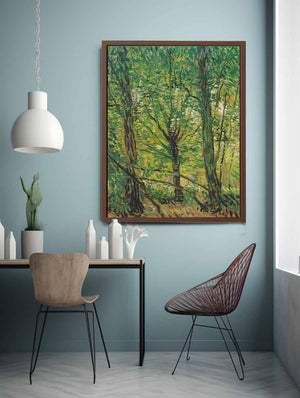
tree And Undergrowth By Vincent Van Gogh
-23%
tree And Undergrowth By Vincent Van Gogh

tree And Undergrowth By Vincent Van Gogh

Regular price $129.00 Sale price $99.00

Go kalles this summer with this vintage navy and white striped v-neck t-shirt from the Nike. Perfect for pairing with denim and white kicks for a stylish kalles vibe.

1. Select Type: Museum Canvas
2. Select Finish Option: Rolled Canvas
3. Select Size: 60cm X 90cm [24" x 36"]
Add to Wishlist
Add to Compare
Artist: Vincent Van Gogh
SKU: FA-VG-11-S1
tree And Undergrowth By Vincent Van Gogh

tree And Undergrowth By Vincent Van Gogh

Print & Painting Options

One Famous Painting. Four Beautiful Ways to Own It.

Choose the finish that best matches the way you want to experience this masterpiece. Alpha Art Gallery offers Museum-Quality Canvas Prints, Fine Art Paper Prints, Satin Photo Paper Prints and 100% Hand-Painted Oil Paintings—each with its own surface, character and visual effect.

Premium Fine-Art Materials
Professional Pigment Printing
Ready-to-Hang Options
Real Hand-Painted Oils

Which option should you choose? Museum Canvas is ideal when you want texture and wall presence. Fine Art Paper gives a refined matte museum-print look. Satin Photo Paper offers richer colour with a subtle semi-gloss sheen. If you want a genuine painting rather than a print, choose our 100% Hand-Painted Oil Painting.

Most Popular

Museum-Quality Canvas Print

A premium textured reproduction that gives famous paintings the depth, scale and presence traditionally associated with canvas.

  • Premium approximately 400–450 GSM polycotton artist canvas*
  • Professional pigment printing for rich colour and fine detail
  • Natural canvas texture adds visual depth
  • Low-glare surface ideal for artwork display
  • Excellent choice for classical and famous painting reproductions
  • Available rolled, stretched or floating framed
Best for: art lovers who want a substantial, textured fine-art reproduction with strong gallery-style wall presence.
Rolled Canvas Same premium canvas, ready for your own local framer.
Stretched Canvas Professionally stretched and supplied ready to hang.
Floating Frame A premium contemporary presentation with an elegant shadow gap.
Why choose Museum Canvas? +

Famous paintings often contain subtle colour relationships, visible texture and compositional depth. A quality canvas reproduction provides a substantial surface that helps the image feel more like a piece of wall art than a conventional paper print. Stretched canvases use timber stretcher bars, while floating framed canvases place the stretched artwork inside an outer frame with an approximately 5 mm visual gap.

Refined Matte Finish

Fine Art Paper Print

A sophisticated fine-art reproduction with an elegant velvet-matte appearance and excellent detail.

  • Premium archival-grade fine-art paper*
  • Professional pigment printing
  • Soft velvet-matte appearance
  • Excellent tonal transitions and fine-detail reproduction
  • Low reflection compared with glossy surfaces
  • Especially beautiful when professionally framed
Best for: classical masterpieces, drawings, detailed paintings and customers who prefer an elegant museum-print presentation.
Why choose Fine Art Paper? +

Fine Art Paper is designed for viewers who value subtle detail and a restrained surface. The matte presentation helps minimize distracting reflections while preserving delicate lines, tonal shifts and colour relationships. It is an excellent choice for framed reproductions of well-known paintings and works on paper.

About framed Fine Art Prints +

Framed paper prints are presented in sleek wood frames with a contemporary slim profile and protective shatter-resistant plexiglass. Available frame choices vary by product and size. Framed options are supplied ready to hang.

Vibrant Semi-Gloss

Satin Photo Paper Print

A smooth, vivid reproduction with crisp detail and a subtle semi-gloss surface that gives colour and contrast extra impact.

  • Premium photographic print surface*
  • Elegant satin / semi-gloss appearance
  • Sharp image reproduction
  • Rich colour and strong contrast
  • More luminous than matte Fine Art Paper
  • Less reflective than traditional high-gloss photo paper
Best for: colourful masterpieces, modern art and customers who enjoy stronger colour with a subtle polished sheen.
Fine Art Paper or Satin Photo Paper? +

Choose Fine Art Paper for a soft matte museum-print appearance with minimal reflection. Choose Satin Photo Paper when you prefer stronger colour, crisp contrast and a gentle semi-gloss finish. Neither is universally better—the right choice depends on the artwork and your preferred visual style.

Collector's Choice

100% Hand-Painted Oil Painting

For customers who want a real painting rather than a print, this masterpiece is individually recreated by a skilled artist using real oil paint on canvas.

  • 100% hand-painted by a skilled artist
  • Real oil paint applied directly to canvas
  • Genuine brushstrokes and physical paint texture
  • Individually recreated rather than mechanically printed
  • No artificial printed brushstroke effect
  • Custom sizes and commissioned paintings available
Best for: collectors and art lovers who want the closest experience to owning a traditionally painted version of the masterpiece.
A Painting, Not a Print. Every hand-painted oil reproduction is created with real paint and genuine artist-applied brushwork. Subtle differences in brushwork and paint application are part of the character of an individually made painting.
Canvas Print vs Hand-Painted Oil Painting +

A canvas print reproduces the artwork using professional printing technology on textured canvas. A hand-painted oil painting is physically recreated by an artist using real oil paint, resulting in genuine brushstrokes, paint texture and handmade variation.

Compare the Four Artwork Formats

The main difference is the surface and how the artwork is created. The first three options are professionally printed reproductions. The oil painting option is individually painted by hand.

Artwork Type Surface Appearance Best Feature Best For
Museum Canvas Textured artist canvas Rich & gallery-style Texture & wall presence Classic famous painting reproductions
Fine Art Paper Velvet-matte fine-art paper Elegant & refined Fine detail Traditional framed presentation
Satin Photo Paper Smooth semi-gloss paper Vibrant & luminous Colour impact Colour-rich and modern artworks
Hand-Painted Oil Real oil paint on canvas Textured & painterly Genuine brushwork Collectors wanting a real painting

Still Not Sure Which One to Choose?

Most Popular Museum Canvas
Most Refined Fine Art Paper
Most Vibrant Satin Photo Paper
Most Authentic Hand-Painted Oil

Prefer Your Artwork Ready to Hang?

Choose a Stretched Canvas, Floating Framed Canvas or Framed Paper Print for a professionally finished presentation designed to go straight onto your wall.

Prefer to use your own framer? Choose Rolled Canvas.

Quick Buying Questions

Which format looks most like a traditional painting?

A 100% Hand-Painted Oil Painting provides the closest experience to a traditionally painted artwork because real oil paint is applied by hand. Among printed options, Museum Canvas provides the most painterly surface because of its visible canvas texture.

What is the difference between Canvas and Fine Art Paper?

Canvas has a textured woven surface and can be stretched or floating framed, giving the artwork more physical depth. Fine Art Paper has a smoother matte surface that emphasizes delicate detail and traditional framed presentation.

Which option is best for famous painting reproductions?

Museum Canvas is an excellent all-round option for famous paintings because it combines texture, visual presence and flexible framing choices. Fine Art Paper is ideal when subtle detail and a matte museum-print appearance are more important.

Which option has the strongest colour?

Satin Photo Paper generally provides the most vivid, polished colour appearance because its semi-gloss surface enhances contrast and luminosity.

*Exact paper, canvas, framing materials and specifications may vary by product, size or production location. Where a specific product page lists a different specification, that product-specific information takes precedence.

Tree and Undergrowth by Vincent Van Gogh corresponds to Vincent van Gogh’s Trees and Undergrowth, a woodland landscape painted in Paris in July 1887 and catalogued as F 309a / JH 1312. Van Gogh transformed filtered forest light, foliage and the woodland floor into a dense pattern of coloured marks while still creating a convincing sense of depth. The historical oil-on-canvas painting is in the Van Gogh Museum in Amsterdam. Alpha Art Gallery offers reproductions as canvas prints, fine art prints, framed prints and 100% hand-painted oil paintings.

About Trees and Undergrowth by Vincent van Gogh

Vincent van Gogh painted Trees and Undergrowth during the summer of 1887, when he was living in Paris with his brother Theo. The painting belongs to an important stage in his artistic development. Compared with the darker earth colours that characterize much of his earlier Dutch work, his Paris paintings reveal an increasingly bright palette and a growing fascination with the effects of light, complementary colours and visibly separated touches of paint.

The Van Gogh Museum identifies this woodland scene as a landscape from July 1887. The historical painting measures approximately 46.5 × 55.5 cm and is painted in oil on canvas. It is also identified by the catalogue references F 309a and JH 1312, which are especially useful because another distinct 1887 Van Gogh painting bears the same English title, Trees and Undergrowth.

This product reproduces the horizontally oriented F 309a version. The catalogue reference provides a reliable way to distinguish it from Van Gogh’s other paintings of trees, woods and undergrowth.

Sunlight Filtering Through the Forest

The central visual idea of this painting is the play of sunlight through foliage. The Van Gogh Museum describes how the changing light allowed the artist to experiment with many variations of green. Rather than treating the forest as a single mass of one colour, Van Gogh constructed the woodland from numerous individual touches.

Green dominates the subject, but the painting is enlivened by lighter and warmer accents. Flecks of white, yellow and warmer colour interrupt the foliage and forest floor, suggesting the way sunlight produces constantly changing patches of brightness within a wooded environment.

A lighter horizontal passage across the middle distance helps create depth. This is important because the dense pattern of marks could otherwise make the composition feel almost flat. Van Gogh therefore balances decorative surface activity with enough spatial information to make the viewer sense a clearing or opening beyond the immediate undergrowth.

A Painting Built From Colour and Brushmarks

Trees and Undergrowth is particularly revealing when viewed closely because individual touches of paint remain visible. Van Gogh does not attempt to smooth the surface into a photographic illusion. Instead, separate marks contribute simultaneously to foliage, light, shadow and the overall rhythm of the picture.

This method reflects the enormous changes occurring in Van Gogh’s art during his Paris years. Living in the centre of the modern French art world brought him into contact with Impressionism and with newer experiments in divided colour associated with Neo-Impressionist painters. He absorbed these ideas without simply adopting another artist’s system.

The result in Trees and Undergrowth is recognizably Van Gogh: observed nature transformed through energetic marks and increasingly independent colour.

Van Gogh in Paris, 1886–1888

Van Gogh arrived in Paris in 1886 and lived with his brother Theo. The experience dramatically expanded his knowledge of contemporary painting. He encountered the work of Impressionist and Neo-Impressionist artists, collected Japanese prints and formed relationships with younger painters including Émile Bernard and Henri de Toulouse-Lautrec.

His palette became substantially lighter during this period. Instead of depending heavily on browns and dark tonal modelling, he began experimenting with sharper contrasts, brighter pigments and increasingly visible brushwork.

The forest and garden landscapes of 1887 are particularly valuable for understanding this transformation because natural subjects gave Van Gogh an opportunity to study how changing light breaks colour into numerous variations. Trees and Undergrowth captures this interest particularly clearly.

Is Trees and Undergrowth Impressionist or Post-Impressionist?

Vincent van Gogh is conventionally classified as one of the major artists of Post-Impressionism. Trees and Undergrowth was nevertheless painted at a moment when he was actively learning from Impressionism and experimenting with ideas connected with Neo-Impressionism.

The small separated touches of colour can recall Neo-Impressionist practice, but Van Gogh did not consistently follow the systematic optical method associated with artists such as Georges Seurat. His marks became increasingly personal and expressive. For product classification, Post-Impressionism is therefore the strongest primary movement tag, while Neo-Impressionism is better understood as part of the broader artistic context and influence surrounding his Paris experimentation.

Forest Depth Without a Traditional Panorama

Unlike landscapes organized around a distant horizon, this painting places the viewer inside a woodland environment. Trees, foliage and undergrowth dominate the field of vision. The subject is therefore less about looking across a vast landscape than experiencing filtered light within vegetation.

Van Gogh nevertheless avoids creating a completely flat decorative screen. The lighter passage across the middle distance allows the eye to move through the woodland, suggesting that the forest continues beyond the dense surface of leaves and branches.

This balance between pattern and depth is one reason the painting remains visually interesting as wall art. From farther away, the image reads as a complete forest scene. At closer viewing distance, the many separate touches and colour relationships become increasingly prominent.

Why This Painting Matters in Van Gogh’s Development

Trees and Undergrowth is valuable because it documents the period in which Van Gogh was rapidly moving toward the visual language of his later masterpieces. The dramatic colours and sweeping strokes associated with Arles and Saint-Rémy did not appear suddenly. They developed through sustained experimentation during the Paris years.

Here, ordinary woodland becomes a testing ground for light, colour and surface. Van Gogh demonstrates that a subject does not need monumental architecture, dramatic figures or an extraordinary event to become compelling. The shifting appearance of sunlight across vegetation provides enough material for an entire painting.

Visitors comparing this work with other celebrated works of art can use it to trace the development of Van Gogh between his darker Dutch paintings and the highly expressive landscapes he produced in southern France.

Historical Artwork Details

Artist Vincent van Gogh
Official/common title Trees and Undergrowth
Catalogue references F 309a / JH 1312
Date July 1887
Period Paris period
Original medium Oil on canvas
Original dimensions Approximately 46.5 × 55.5 cm
Orientation Horizontal
Primary movement Post-Impressionism
Current collection Van Gogh Museum, Amsterdam

The historical painting is part of the Van Gogh Museum collection. Alpha Art Gallery sells reproductions of the artwork and does not sell the museum’s original. Alpha Art Gallery is not affiliated with or endorsed by the Van Gogh Museum, and “museum-quality” refers to Alpha Art Gallery’s reproduction format rather than museum certification.

Choose Your Trees and Undergrowth Reproduction

Format Presentation Good Choice For
Canvas Print Textured canvas surface with strong visual presence Displaying the dense woodland pattern at medium or large scale
Fine Art Print Refined traditional printed presentation Buyers who want the many small colour relationships clearly presented
Framed Print A finished border around the organic woodland scene Structured residential or professional interiors
Hand-Painted Oil Reproduction Real oil paint and individually created brushwork Buyers attracted to Van Gogh’s physical painted surface

Museum-Quality Canvas Print

Alpha Art Gallery’s canvas prints use substantial 400–450 GSM museum-quality canvas. Canvas is well suited to this work because the picture is built from countless small touches that collectively form the woodland. At larger sizes, the viewer can appreciate both the complete forest composition and the changing marks at closer range.

Fine Art and Framed Prints

A fine art print provides a clear, refined presentation for buyers who prefer a traditional printed artwork. A framed version adds a stronger boundary around a composition filled with irregular organic forms, helping separate Van Gogh’s dense forest from the surrounding wall.

100% Hand-Painted Oil Painting Reproduction

Alpha Art Gallery also offers 100% hand-painted oil painting reproductions. Professional artists individually paint each reproduction using oil on canvas, producing real brushwork, physical texture and natural handmade differences.

This format can be especially appealing for Trees and Undergrowth because visible paint application is central to the historic work. The reproduction remains a reproduction rather than Van Gogh’s original, but actual oil paint gives the surface a different physical character from a printed image.

How to Display Trees and Undergrowth as Wall Art

The horizontal F 309a composition works naturally above sofas, consoles, desks, sideboards and other furniture where the available wall space is wider than it is tall. Its forest subject can bring an organic element into a living room, bedroom, study or office without relying on conventional floral decoration.

A larger canvas emphasizes the immersive impression of vegetation and filtered light. A framed print creates a more contained presentation. For an art-focused interior where surface and craftsmanship matter, a hand-painted reproduction can make the physical marks of the painting more prominent.

Where Can I Buy Trees and Undergrowth by Van Gogh?

Alpha Art Gallery offers the F 309a version of Vincent van Gogh’s Trees and Undergrowth as a canvas print, fine art print, framed print and 100% hand-painted oil reproduction. Multiple sizes and frame choices are available where applicable.

Artwork is securely packaged, and free worldwide shipping is included on all orders. Alpha Art Gallery has production facilities in the USA, Australia, United Kingdom and Canada to support worldwide delivery.

Frequently Asked Questions

Who painted Trees and Undergrowth?

Vincent van Gogh painted Trees and Undergrowth. This F 309a version dates from July 1887, during the period when Van Gogh was living in Paris and rapidly developing a lighter palette and more experimental approach to colour and brushwork.

Where is the original Trees and Undergrowth?

The F 309a painting is in the Van Gogh Museum in Amsterdam, Netherlands. The historical work belongs to the museum collection; Alpha Art Gallery offers reproductions rather than the museum’s original painting.

How large is the original?

The F 309a version measures approximately 46.5 × 55.5 cm and is painted in oil on canvas. It has a horizontal landscape orientation, making reproductions naturally suitable for walls with more width than height.

Why are there two Van Gogh paintings called Trees and Undergrowth?

Van Gogh painted more than one woodland study in Paris in 1887, and two different works in the Van Gogh Museum are catalogued under the English title Trees and Undergrowth. Catalogue numbers help distinguish them: this horizontal version is F 309a / JH 1312, while another vertically oriented painting is F 307 / JH 1318.

What is special about the light in this painting?

Van Gogh used numerous variations of colour to suggest sunlight passing through foliage and reaching the woodland floor. A lighter passage across the middle distance also creates the impression of illumination deeper within the forest, helping establish spatial depth within the dense pattern of paint.

Can I buy this Van Gogh painting as a canvas print?

Yes. Alpha Art Gallery offers the artwork on 400–450 GSM museum-quality canvas in multiple available sizes. Its horizontal woodland composition works particularly well as canvas wall art when displayed at a scale large enough to reveal Van Gogh’s many separate colour touches.

Can I order a hand-painted version?

Yes. A 100% hand-painted oil reproduction on canvas is available. Each reproduction is individually painted by professional artists, so real brushwork, physical texture and subtle handmade variation become part of the finished piece.

Does Alpha Art Gallery ship worldwide?

Yes. Alpha Art Gallery provides free worldwide shipping on all orders. Reproductions are securely packaged for international delivery.

Bring Van Gogh’s Paris Woodland Into Your Space

Trees and Undergrowth transforms filtered woodland light into a layered field of colour and brushwork. Choose canvas, fine art, framed or hand-painted oil presentation and select the size that allows this important 1887 Van Gogh landscape to work naturally within your interior.

Choose Your Artwork

One Masterpiece. Four Beautiful Ways to Own It.

Experience your favourite famous painting in the finish that suits your home and your taste. Choose from a Museum-Quality Canvas Print, Fine Art Paper Print, Satin Photo Paper Print or a genuine 100% Hand-Painted Oil Painting.

Premium Fine-Art Materials
Professional Pigment Printing
Ready-to-Hang Options
Real Hand-Painted Oils
Which finish is right for you?
Textured Museum Canvas
Elegant Matte Fine Art Paper
Vibrant Satin Photo Paper
Real Painting Hand-Painted Oil
Most Popular

Museum-Quality Canvas Print

Give a famous masterpiece the texture, depth and wall presence of premium artist canvas. Our Museum Canvas is an excellent all-round choice for classical paintings and statement art.

  • Premium approximately 400–450 GSM polycotton artist canvas*
  • Professional pigment printing
  • Rich colour and fine artwork detail
  • Natural woven canvas texture
  • Low-glare surface for comfortable viewing
  • Rolled, stretched and floating framed options
Best for: customers who want a substantial, textured reproduction with a premium gallery-style appearance.
Rolled Use your own local framer
Stretched Clean, ready-to-hang canvas
Floating Frame Premium gallery presentation
Why choose Museum Canvas?

Canvas gives a famous painting a tactile, substantial quality that conventional paper cannot reproduce. The woven surface adds subtle visual depth while the low-glare finish allows the composition and colour of the artwork to remain the focus.

Refined Matte Finish

Fine Art Paper Print

A refined museum-print presentation for customers who value fine detail, understated colour and a luxurious velvet-matte appearance.

  • Premium fine-art paper selected for art reproduction*
  • Professional pigment printing
  • Elegant velvet-matte appearance
  • Excellent fine-detail reproduction
  • Beautiful tonal transitions
  • Minimal distracting reflection
Best for: classical masterpieces, detailed artworks and elegant framed interiors.
Why choose Fine Art Paper?

Fine Art Paper emphasizes subtle detail instead of surface shine. Its matte presentation is particularly suited to traditional art reproductions, delicate tonal variation and sophisticated framed displays.

How are framed paper prints presented?

Framed options are professionally finished with a contemporary wood frame and protective shatter-resistant plexiglass. Available frame styles vary by size and artwork. Framed options arrive ready to hang.

Rich Colour

Satin Photo Paper Print

Smooth, crisp and vibrant. Satin Photo Paper brings additional luminosity and contrast to colourful famous paintings while retaining an elegant semi-gloss appearance.

  • Premium photographic print surface*
  • Smooth satin / semi-gloss finish
  • Crisp artwork detail
  • Rich colour and stronger contrast
  • More luminous than matte paper
  • Less reflective than traditional high gloss
Best for: colourful masterpieces and customers who want vibrant colour with a subtle sheen.
Fine Art Paper or Satin Photo Paper?

Choose Fine Art Paper for an understated matte museum-print look. Choose Satin Photo Paper for richer colour, stronger contrast and a smooth semi-gloss finish.

Collector's Choice

100% Hand-Painted Oil Painting

For customers who want a real painting rather than a print, our artists individually recreate the masterpiece using genuine oil paint on canvas.

  • 100% hand-painted by a skilled artist
  • Real oil paint applied directly to canvas
  • Genuine brushstrokes and physical paint texture
  • Individually created rather than mechanically printed
  • No artificial printed brushstroke effect
  • Custom sizes and commissions available
Best for: collectors and art lovers wanting the character and texture of a genuine handmade painting.
A Painting. Not a Print. Real paint, real brushwork and the subtle variations that belong to something individually created by an artist.
Canvas Print vs Hand-Painted Oil Painting

A canvas print uses professional printing technology to reproduce the artwork on canvas. A hand-painted oil painting is physically recreated by an artist using real oil paint, resulting in genuine brushwork, paint texture and handmade variation.

At a Glance

Compare Your Artwork Options

All four formats offer a different way to experience the same masterpiece. The main differences are the surface, visual finish and whether the artwork is printed or painted by hand.

Artwork Type Surface Appearance Why Choose It
Museum Canvas Textured artist canvas Rich & gallery-style Texture and strong wall presence
Fine Art Paper Matte fine-art paper Elegant & refined Fine detail and minimal reflection
Satin Photo Paper Smooth semi-gloss paper Vibrant & luminous Rich colour and contrast
Hand-Painted Oil Real oil paint on canvas Painterly & textured Genuine handmade brushwork

Still Deciding? Start Here.

Most Popular Museum Canvas
Most Refined Fine Art Paper
Most Vibrant Satin Photo Paper
Most Authentic Hand-Painted Oil

Want Your Artwork Ready to Hang?

Select Stretched Canvas, Floating Framed Canvas or a Framed Paper Print for a professionally finished presentation. Prefer your own local framer? Choose Rolled Canvas.

Buying Guide

Choosing the Right Art Reproduction

A few quick answers can make choosing your preferred finish much easier.

Which format looks most like a traditional painting?

A 100% Hand-Painted Oil Painting is the closest to a traditionally painted artwork because real oil paint is applied by an artist. Among printed formats, Museum Canvas offers the most painterly-looking textured surface.

What is the difference between a canvas print and a Fine Art Print?

A canvas print is reproduced on textured artist canvas and can be rolled, stretched or floating framed. A Fine Art Print is produced on a smooth matte paper surface, emphasizing detail and traditional framed presentation.

Fine Art Paper or Satin Photo Paper—which is better?

Neither is universally better. Fine Art Paper is ideal for a refined matte appearance with minimal reflection. Satin Photo Paper is better suited to customers who prefer richer colour, stronger contrast and a gentle semi-gloss sheen.

What is the difference between a canvas print and an oil painting?

A canvas print is created using professional printing technology. A hand-painted oil painting is created by an artist applying real oil paint to canvas, producing genuine brushstrokes, texture and handmade variation.

Which option is best for famous painting reproductions?

Museum Canvas is an excellent all-round choice for famous paintings because it combines texture, scale and flexible presentation options. Fine Art Paper is ideal when subtle detail and a matte museum-print appearance are the priority, while a Hand-Painted Oil Painting is best for customers wanting a genuine painted reproduction.

*Exact canvas, paper, frame profiles and production specifications can vary by product, size or production location. Product-specific specifications, where stated, take precedence.

Quality & Craftsmanship

Made to Honour the Artwork. Crafted to Look Beautiful for Years.

A great art reproduction depends on more than the image alone. Material quality, printing, surface preparation, stretching, framing and finishing all influence how the final artwork looks on your wall. At Alpha Art Gallery, each format is selected and prepared with the goal of preserving the character, colour and visual impact of the original masterpiece.

Premium Art Materials
Professional Pigment Printing
Gallery-Style Finishing
Real Hand-Painted Oils

Our approach is simple: use the right material for the artwork, reproduce it with care, and finish it so the result feels considered rather than mass-produced. Whether you choose Museum Canvas, Fine Art Paper, Satin Photo Paper or a 100% Hand-Painted Oil Painting, the aim is a finished piece worthy of prominent display.

Premium Canvas

400–450 GSM Museum-Quality Canvas*

Our premium polycotton artist canvas provides a substantial, textured surface designed for high-quality fine-art reproduction.

  • Approximately 400–450 GSM premium polycotton canvas*
  • Natural woven texture adds depth and character
  • Low-glare surface helps reduce distracting reflections
  • Suitable for rolled, stretched and floating framed presentation
  • Designed for detailed reproduction of famous paintings
Why it matters: heavier, well-prepared canvas offers better visual presence and a more substantial gallery feel than lightweight decorative canvas.
Fine-Art Reproduction

Professional Pigment Printing

Fine-art printing is about preserving subtle colour, tonal relationships and artwork detail—not simply producing a bright image.

  • Professional pigment-based printing workflows
  • Prepared for accurate artwork reproduction
  • Strong detail and tonal separation
  • Rich colour without unnecessary artificial enhancement
  • Suitable for canvas, fine-art paper and satin surfaces
Why it matters: source quality, colour preparation, ink, surface and print resolution all work together to determine the quality of a fine-art reproduction.
Gallery Presentation

Professional Stretching & Framing

A beautiful reproduction deserves a presentation that complements the artwork rather than overpowering it.

  • FSC-certified timber stretcher bars where specified
  • Professionally tensioned stretched canvas
  • Floating frame options for a premium shadow-gap effect
  • Sleek framed paper print options
  • Shatter-resistant plexiglass used on applicable framed prints
  • Ready-to-hang options available
Why it matters: correct stretching, alignment and framing help the artwork sit cleanly, securely and professionally on the wall.
Handmade Art

100% Hand-Painted Oil Paintings

Our oil painting reproductions are not textured prints. They are individually recreated by skilled artists using real oil paint on canvas.

  • 100% hand-painted by skilled artists
  • Real oil paint applied directly to canvas
  • Genuine artist-created brushstrokes
  • Physical paint texture and handmade variation
  • No artificial printed brushstroke effect
  • Custom sizing and commissioned artwork available
Why it matters: a genuine oil painting has physical paint, brush movement and subtle handmade variation that a printed reproduction cannot fully replicate.
Our Reproduction Process

From Masterpiece to Finished Artwork

High-quality wall art requires a chain of good decisions. Each stage affects the final result.

1
Artwork Preparation The source artwork is prepared for the selected format and print size with attention to composition, detail and tonal balance.
2
Material Selection Canvas, fine-art paper, satin paper or painting canvas is chosen according to the product option selected.
3
Printing or Painting Printed formats use professional reproduction methods, while oil paintings are recreated by hand using real paint.
4
Finishing & Presentation Depending on your selection, the artwork is rolled, stretched, framed or prepared for final delivery.

Why Quality Matters in Famous Painting Reproductions

Famous artworks often contain subtle tonal changes, complex colour relationships and small details that can be lost in low-quality reproductions. Better materials and careful preparation help preserve more of the artwork's visual character.

Detail Fine lines, textures and small visual elements remain clearer and more convincing.
Colour & Tone Thoughtful reproduction helps maintain the balance between highlights, shadows and colour relationships.
Wall Presence Premium materials and finishing give the artwork a more substantial, gallery-worthy appearance.
Quality Guide

Questions About Art Print Quality

Understanding materials and production makes it easier to choose the right reproduction for your space.

What makes a museum-quality canvas print?

A high-quality canvas print depends on several factors working together: a suitable artwork source, careful image preparation, professional pigment printing, a substantial canvas surface, accurate stretching and quality finishing. Canvas weight alone does not determine print quality, but a premium 400–450 GSM canvas can provide greater substance and wall presence than lightweight decorative canvas.

What is professional pigment printing?

Pigment printing uses pigment-based inks rather than conventional dye-based consumer printing. In fine-art reproduction, it is valued for strong detail, colour stability and suitability for premium art papers and canvas. The final quality also depends on the printer, media, source image and production workflow.

Are Alpha Art Gallery oil paintings really hand-painted?

Yes. Our hand-painted oil painting option is created by an artist using real oil paint on canvas. It is not a digitally printed canvas with artificial texture added on top. Genuine brushwork, physical paint texture and subtle handmade variation are part of the finished painting.

What is the difference between a fine-art print and a standard poster?

A fine-art print is produced using materials and printing methods selected for artwork reproduction, with greater attention to detail, tonal balance and presentation. Standard decorative posters are generally produced primarily for economical mass display rather than premium fine-art reproduction.

Does thicker canvas always mean better print quality?

No. Canvas weight is only one part of quality. The source artwork, printing method, ink, surface coating, colour preparation, stretching and finishing all affect the final result. A substantial premium canvas can improve durability and visual presence, but it must be combined with a good reproduction workflow.

What is the best format for a famous painting reproduction?

Museum Canvas is an excellent all-round option when you want texture and strong wall presence. Fine Art Paper is ideal for a refined matte presentation, Satin Photo Paper suits customers who prefer stronger colour and a subtle sheen, and a Hand-Painted Oil Painting is best when you want genuine paint and brushwork rather than a printed reproduction.

Made for Your Space

Choose the Finish That Makes the Artwork Yours

Select the artwork type, size and framing option that best suits your room. Choose Museum Canvas for texture, Fine Art Paper for matte refinement, Satin Photo Paper for richer colour, or a 100% Hand-Painted Oil Painting when you want a genuine painted reproduction with real brushwork.

*Exact canvas, paper, ink, frame profile and production specifications may vary by product, size or production location. Product-specific specifications, where stated, take precedence.

Recently viewed products