Harvest Painting By Van Gogh
-23%
Harvest Painting By Van Gogh

Harvest Painting By Van Gogh

Regular price $129.00 Sale price $99.00

Go kalles this summer with this vintage navy and white striped v-neck t-shirt from the Nike. Perfect for pairing with denim and white kicks for a stylish kalles vibe.

1. Select Type: Museum Canvas
2. Select Finish Option: Rolled Canvas
3. Select Size: 60cm X 90cm [24" x 36"]
Add to Wishlist
Add to Compare
Artist: Vincent Van Gogh
SKU: FA-VG-15-S1
Harvest Painting By Van Gogh

Harvest Painting By Van Gogh

Print & Painting Options

One Famous Painting. Four Beautiful Ways to Own It.

Choose the finish that best matches the way you want to experience this masterpiece. Alpha Art Gallery offers Museum-Quality Canvas Prints, Fine Art Paper Prints, Satin Photo Paper Prints and 100% Hand-Painted Oil Paintings—each with its own surface, character and visual effect.

Premium Fine-Art Materials
Professional Pigment Printing
Ready-to-Hang Options
Real Hand-Painted Oils

Which option should you choose? Museum Canvas is ideal when you want texture and wall presence. Fine Art Paper gives a refined matte museum-print look. Satin Photo Paper offers richer colour with a subtle semi-gloss sheen. If you want a genuine painting rather than a print, choose our 100% Hand-Painted Oil Painting.

Most Popular

Museum-Quality Canvas Print

A premium textured reproduction that gives famous paintings the depth, scale and presence traditionally associated with canvas.

  • Premium approximately 400–450 GSM polycotton artist canvas*
  • Professional pigment printing for rich colour and fine detail
  • Natural canvas texture adds visual depth
  • Low-glare surface ideal for artwork display
  • Excellent choice for classical and famous painting reproductions
  • Available rolled, stretched or floating framed
Best for: art lovers who want a substantial, textured fine-art reproduction with strong gallery-style wall presence.
Rolled Canvas Same premium canvas, ready for your own local framer.
Stretched Canvas Professionally stretched and supplied ready to hang.
Floating Frame A premium contemporary presentation with an elegant shadow gap.
Why choose Museum Canvas? +

Famous paintings often contain subtle colour relationships, visible texture and compositional depth. A quality canvas reproduction provides a substantial surface that helps the image feel more like a piece of wall art than a conventional paper print. Stretched canvases use timber stretcher bars, while floating framed canvases place the stretched artwork inside an outer frame with an approximately 5 mm visual gap.

Refined Matte Finish

Fine Art Paper Print

A sophisticated fine-art reproduction with an elegant velvet-matte appearance and excellent detail.

  • Premium archival-grade fine-art paper*
  • Professional pigment printing
  • Soft velvet-matte appearance
  • Excellent tonal transitions and fine-detail reproduction
  • Low reflection compared with glossy surfaces
  • Especially beautiful when professionally framed
Best for: classical masterpieces, drawings, detailed paintings and customers who prefer an elegant museum-print presentation.
Why choose Fine Art Paper? +

Fine Art Paper is designed for viewers who value subtle detail and a restrained surface. The matte presentation helps minimize distracting reflections while preserving delicate lines, tonal shifts and colour relationships. It is an excellent choice for framed reproductions of well-known paintings and works on paper.

About framed Fine Art Prints +

Framed paper prints are presented in sleek wood frames with a contemporary slim profile and protective shatter-resistant plexiglass. Available frame choices vary by product and size. Framed options are supplied ready to hang.

Vibrant Semi-Gloss

Satin Photo Paper Print

A smooth, vivid reproduction with crisp detail and a subtle semi-gloss surface that gives colour and contrast extra impact.

  • Premium photographic print surface*
  • Elegant satin / semi-gloss appearance
  • Sharp image reproduction
  • Rich colour and strong contrast
  • More luminous than matte Fine Art Paper
  • Less reflective than traditional high-gloss photo paper
Best for: colourful masterpieces, modern art and customers who enjoy stronger colour with a subtle polished sheen.
Fine Art Paper or Satin Photo Paper? +

Choose Fine Art Paper for a soft matte museum-print appearance with minimal reflection. Choose Satin Photo Paper when you prefer stronger colour, crisp contrast and a gentle semi-gloss finish. Neither is universally better—the right choice depends on the artwork and your preferred visual style.

Collector's Choice

100% Hand-Painted Oil Painting

For customers who want a real painting rather than a print, this masterpiece is individually recreated by a skilled artist using real oil paint on canvas.

  • 100% hand-painted by a skilled artist
  • Real oil paint applied directly to canvas
  • Genuine brushstrokes and physical paint texture
  • Individually recreated rather than mechanically printed
  • No artificial printed brushstroke effect
  • Custom sizes and commissioned paintings available
Best for: collectors and art lovers who want the closest experience to owning a traditionally painted version of the masterpiece.
A Painting, Not a Print. Every hand-painted oil reproduction is created with real paint and genuine artist-applied brushwork. Subtle differences in brushwork and paint application are part of the character of an individually made painting.
Canvas Print vs Hand-Painted Oil Painting +

A canvas print reproduces the artwork using professional printing technology on textured canvas. A hand-painted oil painting is physically recreated by an artist using real oil paint, resulting in genuine brushstrokes, paint texture and handmade variation.

Compare the Four Artwork Formats

The main difference is the surface and how the artwork is created. The first three options are professionally printed reproductions. The oil painting option is individually painted by hand.

Artwork Type Surface Appearance Best Feature Best For
Museum Canvas Textured artist canvas Rich & gallery-style Texture & wall presence Classic famous painting reproductions
Fine Art Paper Velvet-matte fine-art paper Elegant & refined Fine detail Traditional framed presentation
Satin Photo Paper Smooth semi-gloss paper Vibrant & luminous Colour impact Colour-rich and modern artworks
Hand-Painted Oil Real oil paint on canvas Textured & painterly Genuine brushwork Collectors wanting a real painting

Still Not Sure Which One to Choose?

Most Popular Museum Canvas
Most Refined Fine Art Paper
Most Vibrant Satin Photo Paper
Most Authentic Hand-Painted Oil

Prefer Your Artwork Ready to Hang?

Choose a Stretched Canvas, Floating Framed Canvas or Framed Paper Print for a professionally finished presentation designed to go straight onto your wall.

Prefer to use your own framer? Choose Rolled Canvas.

Quick Buying Questions

Which format looks most like a traditional painting?

A 100% Hand-Painted Oil Painting provides the closest experience to a traditionally painted artwork because real oil paint is applied by hand. Among printed options, Museum Canvas provides the most painterly surface because of its visible canvas texture.

What is the difference between Canvas and Fine Art Paper?

Canvas has a textured woven surface and can be stretched or floating framed, giving the artwork more physical depth. Fine Art Paper has a smoother matte surface that emphasizes delicate detail and traditional framed presentation.

Which option is best for famous painting reproductions?

Museum Canvas is an excellent all-round option for famous paintings because it combines texture, visual presence and flexible framing choices. Fine Art Paper is ideal when subtle detail and a matte museum-print appearance are more important.

Which option has the strongest colour?

Satin Photo Paper generally provides the most vivid, polished colour appearance because its semi-gloss surface enhances contrast and luminosity.

*Exact paper, canvas, framing materials and specifications may vary by product, size or production location. Where a specific product page lists a different specification, that product-specific information takes precedence.

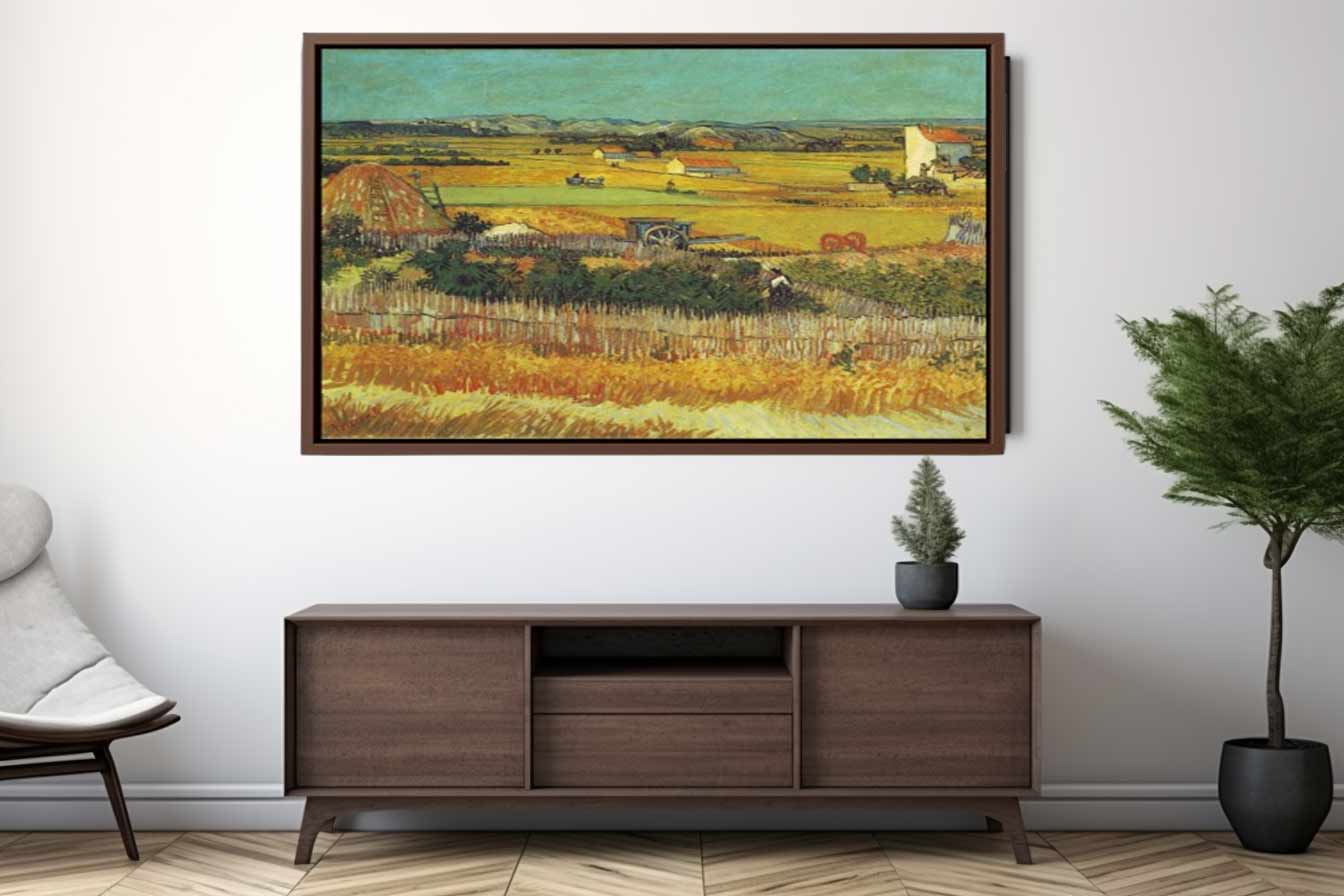
Harvest Painting by Vincent van Gogh reproduces The Harvest, one of Van Gogh’s major landscapes from Arles, painted in June 1888. The sweeping view shows the plain of La Crau outside Arles during harvest season, with wheat fields, farm activity and the distant Alpilles forming an expansive vision of summer in Provence. Van Gogh himself regarded the composition highly. The historic oil-on-canvas painting is now in the Van Gogh Museum in Amsterdam. Alpha Art Gallery offers reproductions as canvas prints, fine art prints, framed prints and 100% hand-painted oil paintings.

About The Harvest by Vincent van Gogh

Vincent van Gogh painted The Harvest in June 1888, only a few months after moving from Paris to Arles in southern France. Catalogued as F 412 / JH 1440, the work measures approximately 73 × 92 cm and belongs to the remarkable series of landscapes through which Van Gogh explored the intense light, agricultural rhythms and colours of Provence.

The Van Gogh Museum identifies the setting as the plain of La Crau outside Arles, with the Alpilles mountain range visible in the distance. The land stretches broadly across the canvas in separate fields and working areas, creating one of Van Gogh’s most panoramic representations of rural life from this period.

Unlike a landscape dominated by a single tree, building or figure, The Harvest distributes interest across the entire countryside. Wheat, stacks, carts, farm workers, distant buildings and strips of cultivated land combine to create the impression of a landscape actively being worked rather than an untouched rural view.

Van Gogh Painting in the Heat of Provence

June 1888 was an exceptionally productive period for Van Gogh. His correspondence records that harvest time had begun around Arles and that he was repeatedly working outdoors in the wheat fields, even during the intense midday heat.

The summer landscape fascinated him partly because it was so different from the northern European atmosphere he had previously known. Provence provided brilliant light, dry ground and intensely contrasting colours that encouraged him to move even further from the darker tonal palette of his Dutch period.

The Harvest emerged from this concentrated engagement with the countryside. Van Gogh made preparatory studies and later returned to the composition in drawings, evidence that he considered the arrangement important rather than merely one rapidly completed outdoor sketch.

What Does The Harvest Depict?

The painting depicts agricultural land on the plain of La Crau during the wheat harvest. Sections of cut and standing crops extend toward the horizon, while stacks, carts and figures indicate the various stages of farm work taking place across the fields.

A blue cart provides one of the most recognizable accents within the composition. Rather than dominating the picture, it forms part of the larger network of fields, pathways and harvested areas. Small human figures are similarly absorbed into the landscape, emphasizing the scale of the agricultural plain around them.

In the distance, low hills and the Alpilles help establish the Provençal setting. The composition therefore moves from detailed activity in the foreground toward increasingly simplified forms farther away.

How Van Gogh Created Depth

The Van Gogh Museum highlights an important technical feature of The Harvest: Van Gogh varied the way he applied paint according to spatial distance. In the foreground, brushstrokes change direction and remain visibly active. Farther into the landscape, the fields are organized into more uniform areas of colour.

This difference creates depth without relying only on traditional linear perspective. The nearest ground feels tactile and busy, while the distant plain becomes calmer and more generalized. The viewer’s eye can therefore travel naturally from the working fields toward the far horizon.

This quality is especially noticeable in a larger reproduction. At a distance, the composition reads as a broad Provençal landscape. Up close, the directional marks and divisions between fields become an important part of the painting’s visual structure.

The Colours of a Provençal Summer

Van Gogh’s colour is central to the identity of The Harvest. Warm wheat tones dominate much of the plain, while cooler passages in the landscape and atmosphere provide contrast. The overall impression is one of brightness and heat rather than the subdued greys associated with much of his earlier Dutch work.

By the time he arrived in Arles, Van Gogh had already encountered Impressionism and Neo-Impressionism in Paris and had become increasingly interested in complementary colour relationships. Southern France gave him an environment in which those lessons could be pushed further.

Here colour serves both descriptive and expressive purposes. It distinguishes different areas of cultivated land while also conveying the intensity of summer light.

The Harvest and Van Gogh’s Interest in Rural Labour

Farm work had interested Van Gogh long before he arrived in Provence. During his Dutch years, he repeatedly drew and painted peasants, sowers, diggers and agricultural labourers. He greatly admired artists such as Jean-François Millet, whose images of rural workers demonstrated that ordinary agricultural life could become a serious artistic subject.

The Harvest continues that interest but transforms it through Van Gogh’s brighter mature palette. Human labour remains present, yet individual workers are relatively small. The wider cycle of cultivation and harvest becomes the principal subject.

The painting can therefore be understood as both a landscape and a representation of agricultural life. Fields are not merely decorative bands of colour: they record a countryside shaped by work.

Why The Harvest Was Important to Van Gogh

Van Gogh regarded The Harvest as one of the strongest landscapes he had produced. His correspondence from the period shows that he compared the work favourably with other paintings he valued and continued to refer to it months later when selecting important canvases.

Its importance lies partly in the successful balance between observation and organization. The scene contains many individual elements, yet the picture does not become chaotic. Roads, fields, stacks and colour areas divide the large plain into a carefully structured composition.

It also demonstrates how quickly Van Gogh’s artistic language changed after arriving in southern France. The landscape is brighter, broader and more decorative than much of his earlier work while still retaining his long-standing interest in rural subjects.

Arles, La Crau and the Alpilles

The plain of La Crau lies near Arles and provided Van Gogh with extensive agricultural views. In the distance, the terrain rises toward the Alpilles, the low mountain range that would become even more prominent in his later Saint-Rémy paintings.

Van Gogh repeatedly returned to the wheat fields around Arles during June 1888, producing a group of related landscapes showing different stages and perspectives of the harvest. The Harvest stands out because of its breadth and the amount of agricultural activity incorporated into one view.

Its setting therefore connects several important geographic entities in Van Gogh’s mature career: Arles, La Crau, Montmajour and the broader Provençal landscape.

Post-Impressionism and The Harvest

Van Gogh is one of the major artists associated with Post-Impressionism. The term encompasses painters who absorbed aspects of Impressionism while developing more individual approaches to colour, structure and expression.

In The Harvest, Van Gogh still pays close attention to an observed landscape. Yet his purpose extends beyond recording exactly what the eye sees. Colour relationships are intensified, different types of brushwork organize depth, and the individual fields become almost decorative areas within the larger design.

Visitors exploring other landmark paintings from art history can use The Harvest to understand how Van Gogh transformed an ordinary agricultural panorama into a highly personal modern landscape.

Historical Artwork Details

Artist Vincent van Gogh
Official title The Harvest
Alternative descriptive title Harvest at La Crau
Catalogue references F 412 / JH 1440
Date June 1888
Place created Arles, France
Subject Harvest landscape on the plain of La Crau
Original medium Oil on canvas
Dimensions Approximately 73 × 92 cm
Movement Post-Impressionism
Current collection Van Gogh Museum, Amsterdam

The historical painting belongs to the Van Gogh Museum collection. Alpha Art Gallery sells reproductions of the artwork rather than the museum’s original. Alpha Art Gallery is not affiliated with or endorsed by the Van Gogh Museum, and “museum-quality” describes Alpha Art Gallery’s reproduction format rather than museum certification.

Choose Your Harvest by Van Gogh Reproduction

The broad horizontal composition makes The Harvest particularly effective in larger wall-art formats. The most suitable option depends on whether you prioritize visual scale, traditional printed presentation, framing or physical painted texture.

Format How It Presents The Harvest Best Suited To
Canvas Print Strong wall presence with the agricultural panorama reproduced on canvas Large feature walls and buyers wanting an expansive landscape
Fine Art Print Refined traditional printed presentation Collectors who prefer detailed art prints
Framed Print Creates a structured boundary around the broad landscape Living rooms, offices and finished interiors
Hand-Painted Oil Reproduction Real oil paint, visible brushwork and individually painted texture Buyers attracted to Van Gogh’s physical painting technique

Museum-Quality Canvas Print

Alpha Art Gallery’s canvas prints use substantial 400–450 GSM museum-quality canvas. The format suits The Harvest especially well because its numerous fields and distant landscape benefit from enough scale to preserve their visual separation.

A larger canvas allows viewers to appreciate the overall panoramic arrangement from across a room while discovering carts, fields, figures and directional brushwork when standing closer.

Fine Art and Framed Prints

A fine art print offers a traditional printed presentation in which the complex divisions of the landscape remain clearly defined. Framing can further emphasize the broad rectangular composition by creating a strong external boundary around the many agricultural forms inside it.

A framed version can work especially well in a study, living room, professional office or dining area where a finished presentation is preferred.

100% Hand-Painted Oil Painting Reproduction

Alpha Art Gallery also offers 100% hand-painted oil painting reproductions. Professional artists individually paint each reproduction using oil on canvas, introducing actual brushwork, physical paint texture and natural handmade variation.

This format is particularly relevant to The Harvest because Van Gogh used different directions and densities of paint to organize the landscape. A hand-painted reproduction remains a reproduction rather than the historic Van Gogh original, but it provides a materially different experience from a printed image.

How to Display The Harvest as Wall Art

The horizontal orientation makes this painting ideal for broad spaces above sofas, sideboards, beds, consoles or desks. Its panoramic subject allows the artwork to occupy substantial width without relying on one oversized central figure.

A large canvas can create an open, expansive feeling in a living room or reception area. A framed print offers a more controlled presentation for studies, offices and traditional interiors. The combination of historic rural imagery with Van Gogh’s modern colour and brushwork also allows the painting to work naturally in contemporary interiors.

Where Can I Buy The Harvest by Vincent van Gogh?

Alpha Art Gallery offers The Harvest by Vincent van Gogh as a canvas print, fine art print, framed print and 100% hand-painted oil painting reproduction. Multiple sizes and available frame choices allow you to select a presentation appropriate for your wall.

Artwork is securely packaged, and Alpha Art Gallery provides free worldwide shipping on all orders. Production facilities in the USA, Australia, United Kingdom and Canada support worldwide fulfilment.

Frequently Asked Questions About The Harvest

Who painted The Harvest?

Vincent van Gogh painted The Harvest in June 1888. He created the landscape during his Arles period, when the light and agricultural countryside of Provence became central subjects in his rapidly developing mature style.

Where was The Harvest painted?

Van Gogh painted the work near Arles in southern France. The landscape represents the plain of La Crau, with agricultural fields stretching across the foreground and middle distance and the Alpilles visible farther away.

Where is the original Harvest painting?

The historic original is in the Van Gogh Museum in Amsterdam. The museum identifies the work as The Harvest and dates it to June 1888. Alpha Art Gallery offers reproductions rather than Van Gogh’s original painting.

How large is Van Gogh’s original The Harvest?

The original oil-on-canvas painting measures approximately 73 × 92 cm. Its horizontal proportions are particularly suitable for landscape-format reproductions and broad wall spaces.

What does The Harvest depict?

The painting depicts harvest activity across the plain of La Crau near Arles. Wheat fields, farm workers, stacks, carts and cultivated sections of land extend toward the distant Provençal hills, creating a panoramic representation of agricultural life.

Why is The Harvest important?

The painting is important because Van Gogh himself regarded it as one of his strongest Arles landscapes. It also demonstrates his successful use of colour, directional brushwork and spatial organization to transform a complex working landscape into a unified composition.

Can I buy The Harvest as a canvas print?

Yes. Alpha Art Gallery offers The Harvest on 400–450 GSM museum-quality canvas in multiple sizes. Its broad proportions make it particularly suitable for substantial canvas wall art.

Can I order a hand-painted Harvest reproduction?

Yes. Alpha Art Gallery offers a 100% hand-painted oil reproduction on canvas. Professional artists paint each reproduction individually, creating real brushwork, texture and subtle handmade variations.

Does Alpha Art Gallery ship worldwide?

Yes. Alpha Art Gallery provides free worldwide shipping on all orders, with reproductions securely packaged for international delivery.

Bring Van Gogh’s Provençal Harvest Into Your Space

The Harvest captures the heat, colour and agricultural rhythm of Provence during one of the most productive periods of Van Gogh’s career. Its sweeping fields, distant hills and carefully varied brushwork make it both an important 1888 landscape and a compelling choice for broad wall spaces. Select a canvas print, fine art print, framed version or individually hand-painted oil reproduction in the size that best suits your interior.

Choose Your Artwork

One Masterpiece. Four Beautiful Ways to Own It.

Experience your favourite famous painting in the finish that suits your home and your taste. Choose from a Museum-Quality Canvas Print, Fine Art Paper Print, Satin Photo Paper Print or a genuine 100% Hand-Painted Oil Painting.

Premium Fine-Art Materials
Professional Pigment Printing
Ready-to-Hang Options
Real Hand-Painted Oils
Which finish is right for you?
Textured Museum Canvas
Elegant Matte Fine Art Paper
Vibrant Satin Photo Paper
Real Painting Hand-Painted Oil
Most Popular

Museum-Quality Canvas Print

Give a famous masterpiece the texture, depth and wall presence of premium artist canvas. Our Museum Canvas is an excellent all-round choice for classical paintings and statement art.

  • Premium approximately 400–450 GSM polycotton artist canvas*
  • Professional pigment printing
  • Rich colour and fine artwork detail
  • Natural woven canvas texture
  • Low-glare surface for comfortable viewing
  • Rolled, stretched and floating framed options
Best for: customers who want a substantial, textured reproduction with a premium gallery-style appearance.
Rolled Use your own local framer
Stretched Clean, ready-to-hang canvas
Floating Frame Premium gallery presentation
Why choose Museum Canvas?

Canvas gives a famous painting a tactile, substantial quality that conventional paper cannot reproduce. The woven surface adds subtle visual depth while the low-glare finish allows the composition and colour of the artwork to remain the focus.

Refined Matte Finish

Fine Art Paper Print

A refined museum-print presentation for customers who value fine detail, understated colour and a luxurious velvet-matte appearance.

  • Premium fine-art paper selected for art reproduction*
  • Professional pigment printing
  • Elegant velvet-matte appearance
  • Excellent fine-detail reproduction
  • Beautiful tonal transitions
  • Minimal distracting reflection
Best for: classical masterpieces, detailed artworks and elegant framed interiors.
Why choose Fine Art Paper?

Fine Art Paper emphasizes subtle detail instead of surface shine. Its matte presentation is particularly suited to traditional art reproductions, delicate tonal variation and sophisticated framed displays.

How are framed paper prints presented?

Framed options are professionally finished with a contemporary wood frame and protective shatter-resistant plexiglass. Available frame styles vary by size and artwork. Framed options arrive ready to hang.

Rich Colour

Satin Photo Paper Print

Smooth, crisp and vibrant. Satin Photo Paper brings additional luminosity and contrast to colourful famous paintings while retaining an elegant semi-gloss appearance.

  • Premium photographic print surface*
  • Smooth satin / semi-gloss finish
  • Crisp artwork detail
  • Rich colour and stronger contrast
  • More luminous than matte paper
  • Less reflective than traditional high gloss
Best for: colourful masterpieces and customers who want vibrant colour with a subtle sheen.
Fine Art Paper or Satin Photo Paper?

Choose Fine Art Paper for an understated matte museum-print look. Choose Satin Photo Paper for richer colour, stronger contrast and a smooth semi-gloss finish.

Collector's Choice

100% Hand-Painted Oil Painting

For customers who want a real painting rather than a print, our artists individually recreate the masterpiece using genuine oil paint on canvas.

  • 100% hand-painted by a skilled artist
  • Real oil paint applied directly to canvas
  • Genuine brushstrokes and physical paint texture
  • Individually created rather than mechanically printed
  • No artificial printed brushstroke effect
  • Custom sizes and commissions available
Best for: collectors and art lovers wanting the character and texture of a genuine handmade painting.
A Painting. Not a Print. Real paint, real brushwork and the subtle variations that belong to something individually created by an artist.
Canvas Print vs Hand-Painted Oil Painting

A canvas print uses professional printing technology to reproduce the artwork on canvas. A hand-painted oil painting is physically recreated by an artist using real oil paint, resulting in genuine brushwork, paint texture and handmade variation.

At a Glance

Compare Your Artwork Options

All four formats offer a different way to experience the same masterpiece. The main differences are the surface, visual finish and whether the artwork is printed or painted by hand.

Artwork Type Surface Appearance Why Choose It
Museum Canvas Textured artist canvas Rich & gallery-style Texture and strong wall presence
Fine Art Paper Matte fine-art paper Elegant & refined Fine detail and minimal reflection
Satin Photo Paper Smooth semi-gloss paper Vibrant & luminous Rich colour and contrast
Hand-Painted Oil Real oil paint on canvas Painterly & textured Genuine handmade brushwork

Still Deciding? Start Here.

Most Popular Museum Canvas
Most Refined Fine Art Paper
Most Vibrant Satin Photo Paper
Most Authentic Hand-Painted Oil

Want Your Artwork Ready to Hang?

Select Stretched Canvas, Floating Framed Canvas or a Framed Paper Print for a professionally finished presentation. Prefer your own local framer? Choose Rolled Canvas.

Buying Guide

Choosing the Right Art Reproduction

A few quick answers can make choosing your preferred finish much easier.

Which format looks most like a traditional painting?

A 100% Hand-Painted Oil Painting is the closest to a traditionally painted artwork because real oil paint is applied by an artist. Among printed formats, Museum Canvas offers the most painterly-looking textured surface.

What is the difference between a canvas print and a Fine Art Print?

A canvas print is reproduced on textured artist canvas and can be rolled, stretched or floating framed. A Fine Art Print is produced on a smooth matte paper surface, emphasizing detail and traditional framed presentation.

Fine Art Paper or Satin Photo Paper—which is better?

Neither is universally better. Fine Art Paper is ideal for a refined matte appearance with minimal reflection. Satin Photo Paper is better suited to customers who prefer richer colour, stronger contrast and a gentle semi-gloss sheen.

What is the difference between a canvas print and an oil painting?

A canvas print is created using professional printing technology. A hand-painted oil painting is created by an artist applying real oil paint to canvas, producing genuine brushstrokes, texture and handmade variation.

Which option is best for famous painting reproductions?

Museum Canvas is an excellent all-round choice for famous paintings because it combines texture, scale and flexible presentation options. Fine Art Paper is ideal when subtle detail and a matte museum-print appearance are the priority, while a Hand-Painted Oil Painting is best for customers wanting a genuine painted reproduction.

*Exact canvas, paper, frame profiles and production specifications can vary by product, size or production location. Product-specific specifications, where stated, take precedence.

Quality & Craftsmanship

Made to Honour the Artwork. Crafted to Look Beautiful for Years.

A great art reproduction depends on more than the image alone. Material quality, printing, surface preparation, stretching, framing and finishing all influence how the final artwork looks on your wall. At Alpha Art Gallery, each format is selected and prepared with the goal of preserving the character, colour and visual impact of the original masterpiece.

Premium Art Materials
Professional Pigment Printing
Gallery-Style Finishing
Real Hand-Painted Oils

Our approach is simple: use the right material for the artwork, reproduce it with care, and finish it so the result feels considered rather than mass-produced. Whether you choose Museum Canvas, Fine Art Paper, Satin Photo Paper or a 100% Hand-Painted Oil Painting, the aim is a finished piece worthy of prominent display.

Premium Canvas

400–450 GSM Museum-Quality Canvas*

Our premium polycotton artist canvas provides a substantial, textured surface designed for high-quality fine-art reproduction.

  • Approximately 400–450 GSM premium polycotton canvas*
  • Natural woven texture adds depth and character
  • Low-glare surface helps reduce distracting reflections
  • Suitable for rolled, stretched and floating framed presentation
  • Designed for detailed reproduction of famous paintings
Why it matters: heavier, well-prepared canvas offers better visual presence and a more substantial gallery feel than lightweight decorative canvas.
Fine-Art Reproduction

Professional Pigment Printing

Fine-art printing is about preserving subtle colour, tonal relationships and artwork detail—not simply producing a bright image.

  • Professional pigment-based printing workflows
  • Prepared for accurate artwork reproduction
  • Strong detail and tonal separation
  • Rich colour without unnecessary artificial enhancement
  • Suitable for canvas, fine-art paper and satin surfaces
Why it matters: source quality, colour preparation, ink, surface and print resolution all work together to determine the quality of a fine-art reproduction.
Gallery Presentation

Professional Stretching & Framing

A beautiful reproduction deserves a presentation that complements the artwork rather than overpowering it.

  • FSC-certified timber stretcher bars where specified
  • Professionally tensioned stretched canvas
  • Floating frame options for a premium shadow-gap effect
  • Sleek framed paper print options
  • Shatter-resistant plexiglass used on applicable framed prints
  • Ready-to-hang options available
Why it matters: correct stretching, alignment and framing help the artwork sit cleanly, securely and professionally on the wall.
Handmade Art

100% Hand-Painted Oil Paintings

Our oil painting reproductions are not textured prints. They are individually recreated by skilled artists using real oil paint on canvas.

  • 100% hand-painted by skilled artists
  • Real oil paint applied directly to canvas
  • Genuine artist-created brushstrokes
  • Physical paint texture and handmade variation
  • No artificial printed brushstroke effect
  • Custom sizing and commissioned artwork available
Why it matters: a genuine oil painting has physical paint, brush movement and subtle handmade variation that a printed reproduction cannot fully replicate.
Our Reproduction Process

From Masterpiece to Finished Artwork

High-quality wall art requires a chain of good decisions. Each stage affects the final result.

1
Artwork Preparation The source artwork is prepared for the selected format and print size with attention to composition, detail and tonal balance.
2
Material Selection Canvas, fine-art paper, satin paper or painting canvas is chosen according to the product option selected.
3
Printing or Painting Printed formats use professional reproduction methods, while oil paintings are recreated by hand using real paint.
4
Finishing & Presentation Depending on your selection, the artwork is rolled, stretched, framed or prepared for final delivery.

Why Quality Matters in Famous Painting Reproductions

Famous artworks often contain subtle tonal changes, complex colour relationships and small details that can be lost in low-quality reproductions. Better materials and careful preparation help preserve more of the artwork's visual character.

Detail Fine lines, textures and small visual elements remain clearer and more convincing.
Colour & Tone Thoughtful reproduction helps maintain the balance between highlights, shadows and colour relationships.
Wall Presence Premium materials and finishing give the artwork a more substantial, gallery-worthy appearance.
Quality Guide

Questions About Art Print Quality

Understanding materials and production makes it easier to choose the right reproduction for your space.

What makes a museum-quality canvas print?

A high-quality canvas print depends on several factors working together: a suitable artwork source, careful image preparation, professional pigment printing, a substantial canvas surface, accurate stretching and quality finishing. Canvas weight alone does not determine print quality, but a premium 400–450 GSM canvas can provide greater substance and wall presence than lightweight decorative canvas.

What is professional pigment printing?

Pigment printing uses pigment-based inks rather than conventional dye-based consumer printing. In fine-art reproduction, it is valued for strong detail, colour stability and suitability for premium art papers and canvas. The final quality also depends on the printer, media, source image and production workflow.

Are Alpha Art Gallery oil paintings really hand-painted?

Yes. Our hand-painted oil painting option is created by an artist using real oil paint on canvas. It is not a digitally printed canvas with artificial texture added on top. Genuine brushwork, physical paint texture and subtle handmade variation are part of the finished painting.

What is the difference between a fine-art print and a standard poster?

A fine-art print is produced using materials and printing methods selected for artwork reproduction, with greater attention to detail, tonal balance and presentation. Standard decorative posters are generally produced primarily for economical mass display rather than premium fine-art reproduction.

Does thicker canvas always mean better print quality?

No. Canvas weight is only one part of quality. The source artwork, printing method, ink, surface coating, colour preparation, stretching and finishing all affect the final result. A substantial premium canvas can improve durability and visual presence, but it must be combined with a good reproduction workflow.

What is the best format for a famous painting reproduction?

Museum Canvas is an excellent all-round option when you want texture and strong wall presence. Fine Art Paper is ideal for a refined matte presentation, Satin Photo Paper suits customers who prefer stronger colour and a subtle sheen, and a Hand-Painted Oil Painting is best when you want genuine paint and brushwork rather than a printed reproduction.

Made for Your Space

Choose the Finish That Makes the Artwork Yours

Select the artwork type, size and framing option that best suits your room. Choose Museum Canvas for texture, Fine Art Paper for matte refinement, Satin Photo Paper for richer colour, or a 100% Hand-Painted Oil Painting when you want a genuine painted reproduction with real brushwork.

*Exact canvas, paper, ink, frame profile and production specifications may vary by product, size or production location. Product-specific specifications, where stated, take precedence.

Recently viewed products