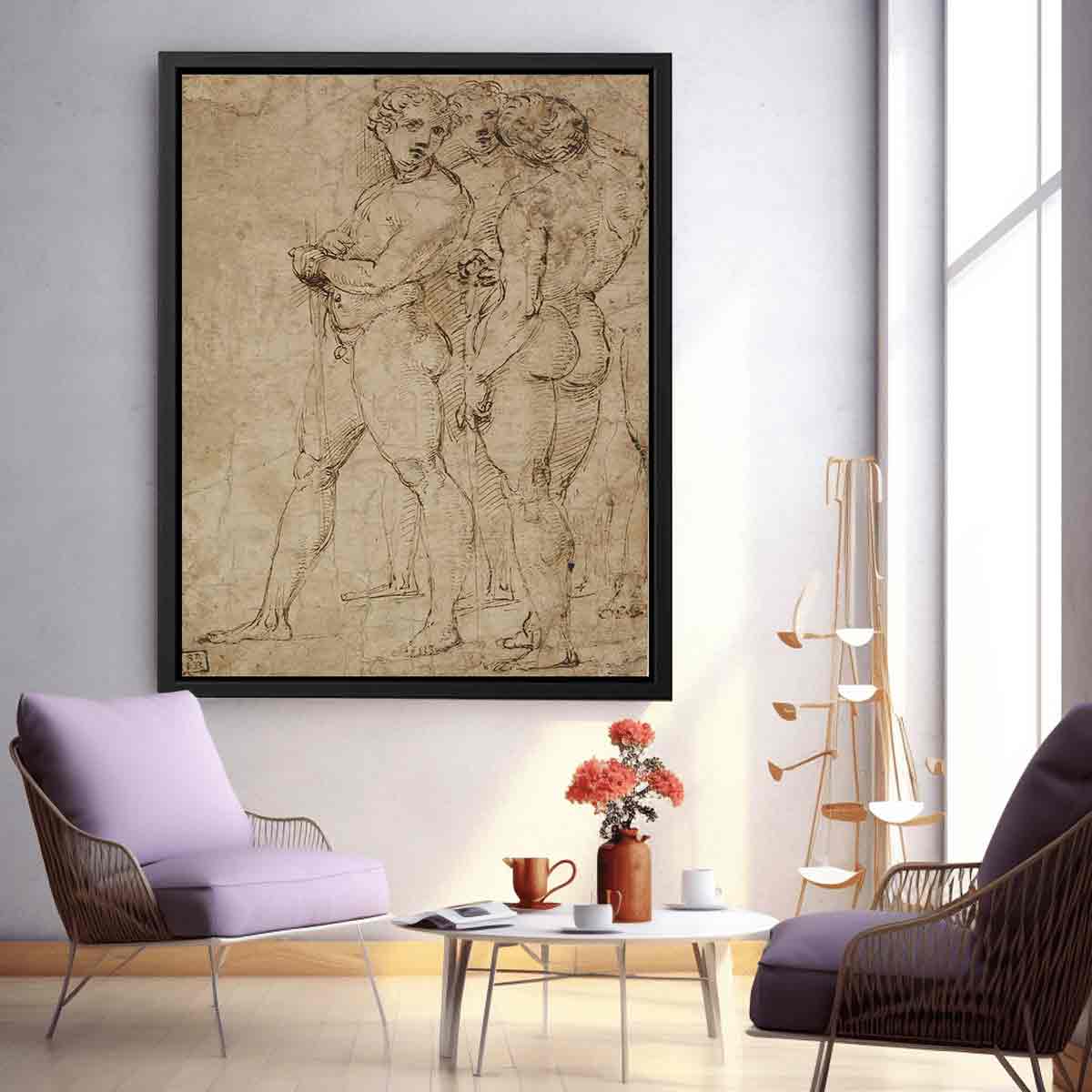
Three Standing Nude Men by Raphael
Three Standing Nude Men is a revealing example of Raphael’s early investigation of the human figure. Rather than showing a completed religious narrative or formal portrait, the drawing concentrates on the physical structure of male bodies, their balance, proportions and variations of pose. The sheet offers collectors a direct glimpse into the discipline behind Renaissance art: before a figure could appear convincingly in a finished fresco or altarpiece, Raphael studied how the body carried weight, turned through space and communicated movement.
The British Museum identifies the work as a drawing by Raphael in pen and brown ink, dating to approximately 1505–1508. The sheet measures 243 by 148 millimetres and depicts three standing nude men together with the leg of a fourth figure. The museum also notes its relationship to related studies in Oxford and Chantilly, suggesting that the sheets may once have formed parts of a larger composition.
Raphael and the Study of the Male Nude
The nude figure was fundamental to Renaissance artistic training. Artists needed a detailed understanding of anatomy to create convincing saints, warriors, heroes and mythological characters. Raphael’s studies show that he approached the human body as both a subject of observation and a source of compositional invention.
In this drawing, the three men provide variations on the standing pose. Their bodies can be compared almost like successive experiments. The distribution of weight changes, the torsos turn differently and the relationships between limbs and shoulders produce different rhythms. Raphael is not simply recording what he sees; he is learning how the human figure can be constructed for later artistic use.
The Web Gallery of Art describes the drawing as particularly concerned with the relationship between contour and volume. Raphael’s lively pen lines establish the edges of the bodies, while hatching gives those forms mass and solidity.
The Influence of Florence
The date of the drawing places it within an important phase of Raphael’s career. Around 1505–1508, he was absorbing the achievements of Florentine masters and developing the more ambitious figure style that would characterize his mature work.
Leonardo da Vinci and Michelangelo were particularly important to this artistic environment. Their investigations of anatomy and movement challenged younger artists to rethink the possibilities of the human figure. Raphael responded by studying the body with remarkable concentration while developing a style that remained distinctly his own.
The British Museum connects the drawing with this period of artistic exchange, while the Web Gallery of Art notes Raphael’s extensive use of pen and ink from around 1505 and the medium’s suitability for strong delineation and anatomical investigation.
Line as a Tool for Understanding the Body
One of the most attractive qualities of Three Standing Nude Men is its energetic line. The pen appears to move rapidly around the contours, establishing shoulders, hips, legs and torsos without excessive description. Hatching then builds the impression of volume.
This makes the drawing especially interesting when reproduced at a large enough size for the marks to remain visible. A viewer can follow Raphael’s lines and see how a relatively limited set of strokes creates a convincing three-dimensional body.
For collectors of drawing, this directness is part of the appeal. The finished image does not conceal the artist’s process. Instead, it celebrates the process.
Three Figures as a Compositional Laboratory
The relationship between the figures is equally important. Raphael appears to be exploring how several bodies might occupy the same visual space. Their positions can be compared, contrasted and potentially connected to a larger narrative composition.
The British Museum records scholarly proposals that the surviving sheets at the British Museum, Oxford and Chantilly may have formed a single composition. In that proposed arrangement, the Chantilly sheet may have occupied the left side, Oxford the center and the British Museum sheet the right.
Whether or not the reconstruction is ultimately accepted, the possibility reveals how Raphael’s individual studies could function as building blocks for a larger work. The drawing therefore represents both anatomical observation and compositional planning.
The Renaissance Ideal of the Human Body
Renaissance artists admired the human body not only for its physical beauty but because it provided a means of expressing proportion, movement and ideal form. Classical sculpture offered models of heroic anatomy, while observation of living bodies gave artists a practical understanding of how those ideal forms worked.
Raphael combined these sources with extraordinary flexibility. His figures could appear graceful, powerful, restrained or dynamic depending on the demands of the composition.
Three Standing Nude Men is particularly revealing because the figures are not yet transformed into saints or mythological heroes. The viewer sees the body before it has been assigned a narrative identity. That makes the drawing an unusually pure study of artistic construction.
Raphael and Michelangelo
Michelangelo’s influence on Raphael during his Florentine years is an important part of the history of Renaissance figure drawing. Michelangelo’s monumental bodies demonstrated how anatomy could be used to create extraordinary physical energy.
Raphael studied such inventions carefully, but his response was not simple imitation. He translated the lessons of Florentine art into his own system of proportion, rhythm and clarity. The result was a figure style that would later support the monumental frescoes of the Vatican.
For collectors interested in the relationship between Raphael and Michelangelo, this drawing provides a valuable window into the period when Raphael was actively absorbing the artistic discoveries of his contemporaries.
A Drawing That Reveals Raphael’s Working Method
It is easy to associate Raphael with polished finished paintings, but drawings such as this demonstrate the enormous amount of preparation behind that apparent perfection. The calm balance of his mature compositions was built through repeated studies of anatomy and gesture.
The drawing is therefore valuable as an object of artistic history. It allows the viewer to see the Renaissance master in the role of student, experimenter and designer.
Why This Raphael Study Works as Wall Art
A reproduction of Three Standing Nude Men is particularly appropriate for interiors that value artistic process. The restrained palette and linear character make it suitable for studies, libraries, offices, galleries and creative spaces.
-
Fine art print: preserves the graphic quality of Raphael’s pen-and-ink technique.
-
Canvas: gives the figure study greater physical presence while retaining its classical character.
-
Framed artwork: creates the appearance of a museum-inspired Renaissance drawing for a refined interior.
-
Hand-painted reproduction: offers collectors an individually crafted interpretation of the historic composition.
A Collector’s Alternative to Raphael’s Famous Paintings
Collectors often begin with Raphael’s Madonnas, portraits or Vatican frescoes. A figure study offers a different kind of connection with the artist. Instead of presenting a famous finished narrative, it reveals the underlying process that made Raphael’s later masterpieces possible.
This makes the drawing especially suitable for someone building a collection around Renaissance drawing, classical anatomy, artistic studies or the workshop practices of Italian masters.
The British Museum Drawing
The British Museum’s record identifies the sheet as Three standing nude men and the leg of a fourth, drawn by Raphael in pen and brown ink around 1505–1508. The museum classifies it within the Roman and Umbrian school traditions and records the sheet as paper measuring 243 by 148 millimetres.
The work’s relatively small original dimensions make a carefully produced reproduction particularly interesting. Enlarged on a wall, the viewer can appreciate details of line and hatching that are easy to miss when looking at the original sheet as a small museum object.
Bring Renaissance Figure Study Into Your Collection
Three Standing Nude Men by Raphael is an excellent choice for collectors who want artwork that exposes the intellectual discipline behind Renaissance painting. Its three male figures, energetic pen lines and anatomical investigation capture Raphael during a crucial stage of artistic development.
Whether displayed as a fine art print, canvas, framed drawing or hand-painted reproduction, the work can bring the atmosphere of the Renaissance studio into a modern interior. It is especially appropriate for collectors interested in Raphael, Michelangelo, Florentine art, classical anatomy and the history of figure drawing.
More than a study of three bodies, the drawing is a study of artistic possibility. Raphael uses the human figure to investigate balance, volume, contour and movement, creating a work that remains fascinating precisely because it allows viewers to see the master thinking through line.