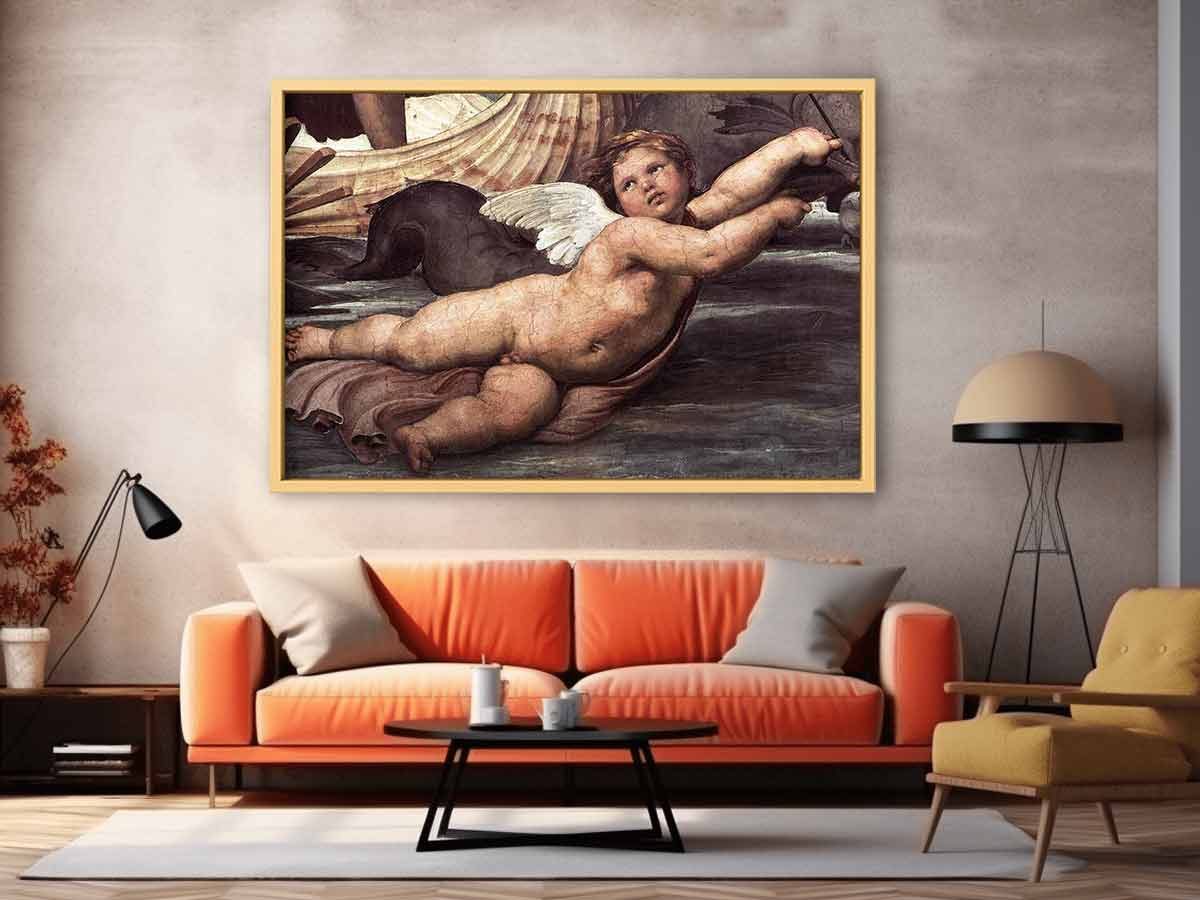
The Voyage of Galatea: Raphael's Mythological World
The Voyage of Galatea belongs to the mythological decoration associated with Raphael's celebrated work at the Villa Farnesina in Rome. The supplied classification identifies the artwork as a detail, with Raphael, mythology, fantasy, angels and the Villa Farnesina forming its principal context. Raphael's Galatea cycle was created for the wealthy banker Agostino Chigi and represents one of the most important examples of Renaissance mythological decoration in Rome. The subject is especially appealing to collectors who want Raphael art that combines classical mythology with movement, beauty and the decorative energy of the High Renaissance.
Galatea and the Classical Imagination
Galatea is a sea nymph from classical mythology, and her story offered Renaissance artists a rich mixture of beauty, movement and divine transformation. In the Farnesina decoration, Raphael and his workshop translated the mythological world into an exuberant visual language populated by gods, nymphs, sea creatures and winged figures. The result was not simply an illustration of an ancient story. It was an imaginative environment designed to celebrate classical culture and the sophistication of Chigi's Roman villa.
The Villa Farnesina
The Villa Farnesina was an exceptional setting for mythological painting. Built for Agostino Chigi, it was designed as a luxurious Renaissance residence where architecture and decoration worked together. Raphael's contribution to the villa helped establish its reputation as a major center of Roman Renaissance art. A reproduction of a Galatea detail allows collectors to bring a fragment of this extraordinary decorative environment into a contemporary interior.
Movement as a Decorative Principle
One of the great strengths of mythological Renaissance art is its ability to make movement decorative. Figures can twist, turn, float and travel through space, creating rhythms that move the eye across the composition. A subject associated with a voyage naturally lends itself to this visual energy. Raphael's figures and mythological creatures can be understood not only as characters but also as compositional elements whose gestures create a flowing pattern across the wall.
Classical Beauty and Renaissance Idealism
The Galatea cycle reflects the Renaissance fascination with ideal beauty. Classical mythology provided artists with subjects that could be represented without the constraints of contemporary dress or ordinary social life. Gods and nymphs could appear in idealized forms, allowing the artist to explore proportion, anatomy and movement. Raphael's treatment of these figures helped establish the decorative vocabulary that would influence later European art.
Raphael and Agostino Chigi
Agostino Chigi was one of the most powerful and wealthy patrons in Renaissance Rome. His villa became a showcase for artists, architects and decorative specialists. Raphael's involvement demonstrates the close relationship between elite patronage and artistic innovation during the period. The mythological subject was particularly appropriate for a luxurious private residence because it connected the patron with the prestige of classical culture.
Why Galatea Works as Contemporary Wall Art
Mythological art can translate especially well into modern interiors because its subjects combine historical depth with visually expressive forms. A Galatea detail can introduce movement and classical elegance without requiring the viewer to know every element of the original cycle. A large canvas can emphasize the decorative energy of the figures, while a fine art print can work in a study, bedroom, library or gallery wall. Framing can reinforce the connection with historic European collections.
The Renaissance Revival of Antiquity
Raphael's mythological work belongs to the wider Renaissance revival of ancient Greece and Rome. Humanists studied classical texts, collectors acquired antiquities and artists incorporated ancient motifs into new compositions. The Farnesina frescoes demonstrate how this revival could become immersive. Mythology was not merely a literary reference; it became an entire visual environment of gods, bodies, movement and symbolic stories.
Raphael's Influence on Decorative Painting
The Galatea fresco became influential because it demonstrated how monumental painting could combine narrative, idealized anatomy and decorative rhythm. Later artists repeatedly looked to Raphael for models of classical beauty and graceful movement. Collectors who choose a reproduction are therefore engaging with a subject that has played an important role in the history of European decorative art.
Bring the Farnesina Spirit Into Your Collection
The Voyage of Galatea detail offers a vibrant alternative to Raphael's quieter religious images. Its mythological identity, connection with Villa Farnesina and emphasis on movement make it ideal for collectors who appreciate classical culture and Renaissance decorative art. As a fine art print, canvas, framed reproduction or hand-painted interpretation, it can bring the atmosphere of Raphael's Roman mythology into a contemporary interior while celebrating one of the most memorable artistic environments of the Italian Renaissance.
The Mythological Energy of Galatea
The Galatea cycle is famous for its sense of movement and visual abundance. Mythological characters are not arranged as static portraits; they participate in an imaginative world of motion, water, wind and divine intervention. A detail from the Voyage of Galatea can capture that energy particularly well, allowing the viewer to concentrate on a small portion of the larger decorative rhythm.
The Farnesina as a Renaissance Villa
The Villa Farnesina was designed as a place of luxury, sociability and cultural display. Its frescoes were therefore expected to entertain as well as demonstrate learning. The mythology of Galatea suited this environment because ancient stories could be presented as elegant decoration while also signaling the patron's knowledge of classical culture.
Classical Fantasy for Contemporary Collectors
A Raphael Galatea reproduction can introduce a different atmosphere from a devotional Madonna or Vatican history painting. The subject is romantic, mythological and decorative, making it suitable for living rooms, bedrooms, dining spaces and private galleries. Canvas can emphasize its decorative scale, while a framed print can create a more intimate connection with the Renaissance source.
A Celebration of Renaissance Mythology
The Galatea decorations demonstrate the Renaissance belief that ancient mythology could be transformed into elegant contemporary art. The stories supplied recognizable characters, but Raphael's treatment gave them a new visual life through idealized bodies, sweeping gestures and carefully orchestrated movement. The result feels both antique and distinctly Renaissance.
A Collectible Fragment of Roman Art
A detail of the Voyage of Galatea can be particularly rewarding for collectors because it resembles the experience of discovering a fragment of a historic decorative cycle. The artwork carries the identity of Raphael, the history of the Farnesina and the mythology of the ancient world into one compact visual statement.